

In Cosmovision at Tintera, her first solo show in Cairo in over a decade, Lara Baladi does not hold back the scale of both her ambition and process of seeing.
After spending more than ten years documenting and archiving the 2011 revolution in Egypt (in her project Vox Populi), and along the way creating exciting formats to understand and access this visual memory, Egyptian-Lebanese artist Lara Baladi has turned her complex, multi-layered thinking process to her own personal archive and journey with photography. In Cosmovision, her current show at Tintera, one of the few dedicated photographic galleries in the Egyptian capital, she tries to come to terms with that medium and its meaning, and maybe even its future.
It is hard to think about photography as an artistic practice in the age of Instagram and TikTok, considering the voluminous amount of image creation and dissemination that these platforms push out every second of every day, across millions of screens all over the world. What does it mean to take photos now? Is a printed photograph meaningful anymore? Can it still hold value as a witness or a token, like it once did?
Many visual artists have to contend with this dilemma and there are of course easy answers. Such as overidentifying with the second image revolution of our time (first the digital camera and then smartphones) and ‘transporting’ the process of creation online, using the tools and platforms themselves as mass-production machines that endlessly re/produce and recycle millions of images everyday (as with the Richard Prince infamous portraits series New Portraits from 2015). But that is not very interesting and Baladi is not the kind of artist who is content with easy answers. Nor is Tintera as a space.
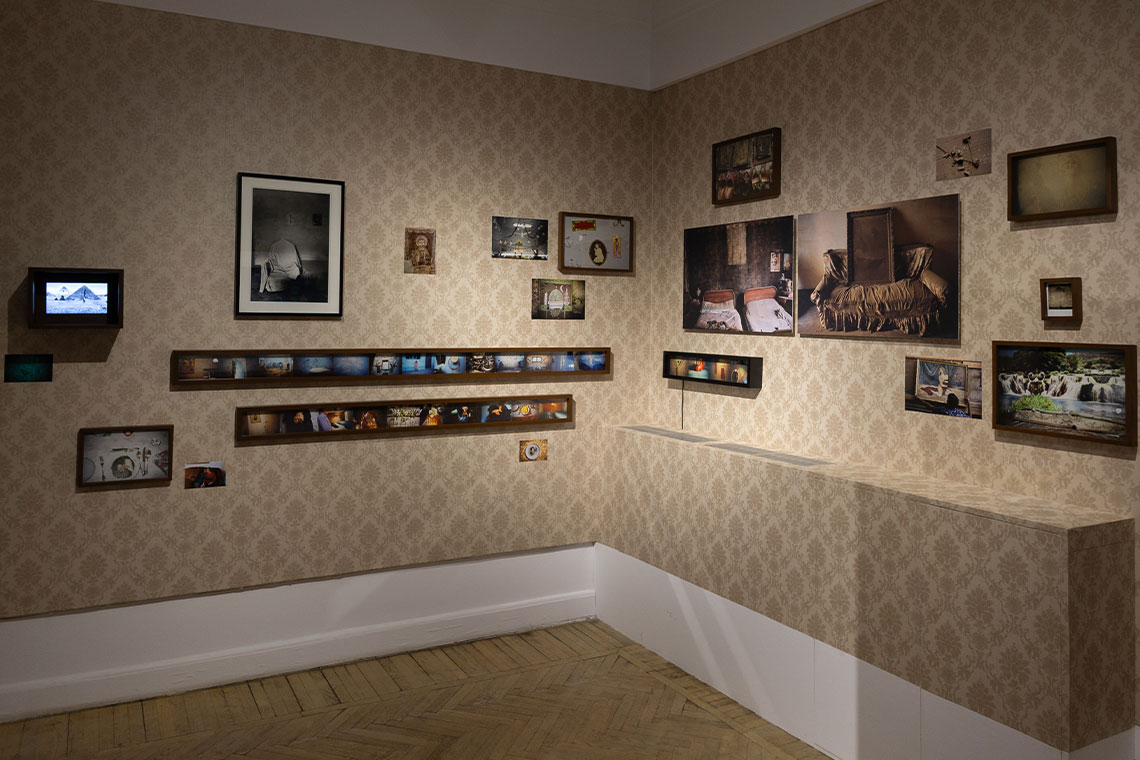
This is evident as one enters the gallery and passes the initial series of photos, introducing the artist. There is a portrait showing Baladi standing on a French-style couch, with a series of mannequin heads lined up by her feet. The photograph – by Egyptian artist Youssef Nabil – portends Baladi’s sense of playfulness and keen eye for the delightful surprises of the absurd, an eye that seems so well suited to a city like Cairo. As one takes a slight turn to the left, one encounters an entire wall done with retro wallpaper of the type seen in most bourgeois homes in 1970s Cairo (my parents’ first flat had one just like it). The colour and texture immediately set a very intimate and domestic sense of place. It is as if memories are not just associated with the places in the photos but also the very wall on which they are mounted. This notion of the materiality of the presentation of the image is central to both the exhibition and to Baladi’s practice.
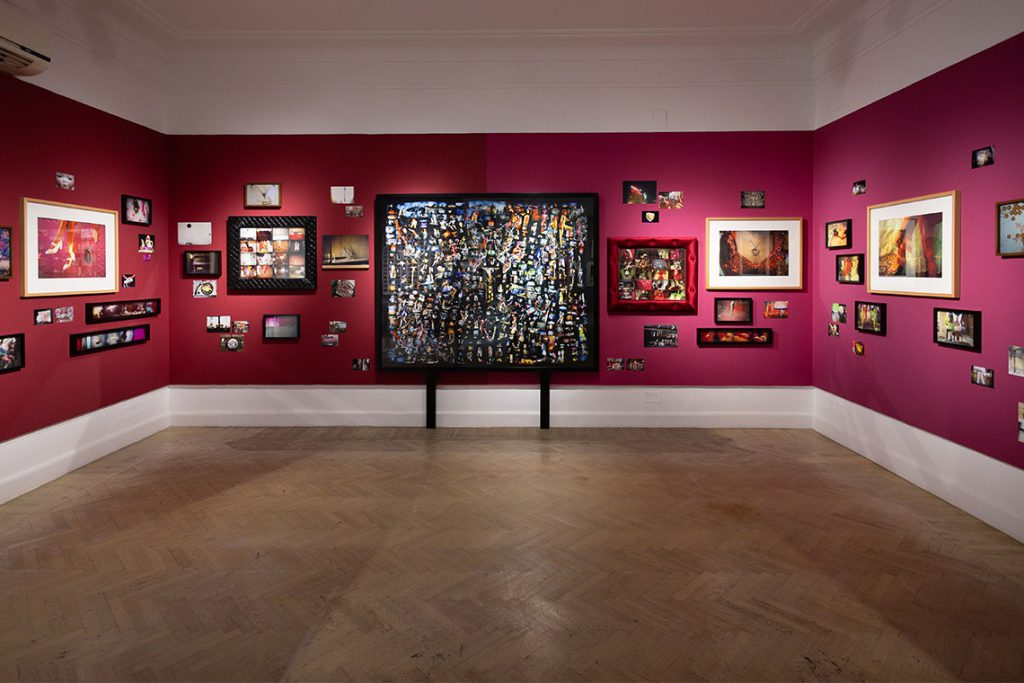
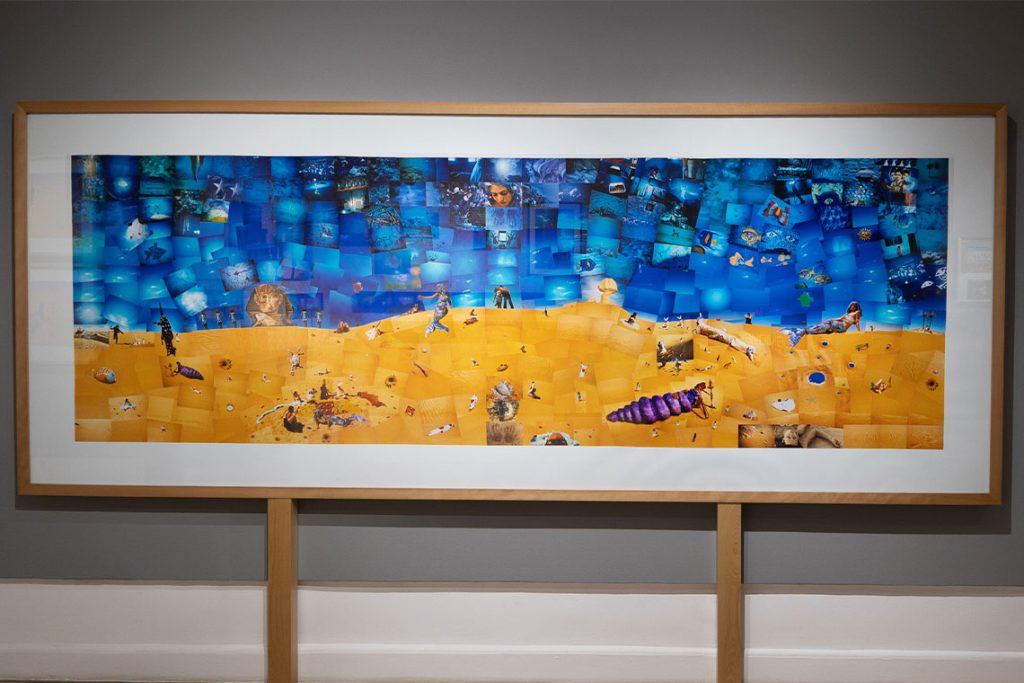
The artist has an innate understanding of the materiality of her medium and the potential effect of scale and the complexity of layers. She understands that images hold meanings that speak to a specific locality and temporality, and that the context of their reception plays an indelible part in how they are perceived and understood. Also, how that cannot be replicated virtually and definitely not with endless, mindless reproduction. Baladi almost preempts the replication of her own work by reproducing dozens of images and ‘recomposing’ them in gigantic tapestries – a thematic and approach she used in Sandouk El Dounia (2007) – that can only be seen as separate artworks, in and of themselves. The photograph is no longer a singular piece but rather a unit, a thread, that can be used to create other artworks.
As I walked through the gallery I could see the way in which the exhibition is organised as a journey, the personal passage of Baladi as a person, exploring issues of identity (Egyptian, Lebanese, Arab, French, all of the above, and at times, none of the above) and faith (religious iconography), as well as a history of the photographic medium itself. References to Orientalist photography – and at times its reimagining – can be seen in works such as Oum El Dounia (2000). This panoramic work spans multiple references and representations of the ‘Orient’ and ‘Egypt’, restaging them not only as a tongue-in-cheek adaptation but also as a reversal of the subject taking the image and the subject being photographed.
Baladi is not just playing with the stereotypes of Orientalist photography (the introduction of the medium in Egypt, and indeed globally, was reflected in Tintera’s 2024 exhibition, Views on Egypt – Through a 19th Century Lens). She also tackles how the contemporary transition between analog and digital presents a new way of understanding the production and presentation of the image, using that to maximum effect in works such as Digital Alienation (2003), a print on a large plexiglass board of rows and rows of self-portraits of the artist in a photobooth in Japan in the early 2000s. A precursor to the selfie? Perhaps, but it is not just that. The work itself serves as a backdrop to another piece, showing images from the news during the American invasion of Iraq in 2003. The layering of the two works complicates the reception of the image, showing the proliferation of one type (instant digital photo booths in Japan) parallel to the proliferation of images of war and destruction. One can imagine the kind of impact those images had on Baladi, considering her own biography growing up in the shadow of the Lebanese Civil War.
The works also display a strong sense of urbanism and a certain connection to the city. Even when showcasing intimate, domestic interiors one has a sense that this is the internal life and fantasies of an urban dweller. The city reigns supreme in Baladi’s work and Cairo takes the lion’s share with its absurd urbanscapes, which she uses as a fitting backdrop to her own fantasies and magical worlds. There is cosplaying, scenes from night life and Cairo markets, abandoned spaces and a sense of the decrepit. In a way, the title of the exhibition mirrors the vision of Baladi herself: cosmic, chaotic, but with a meticulous density that is as controlled as it is layered.
Baladi sees herself as embedded in a spatio-temporal axis, despite the nomadic and sometimes quite dizzying changing geographies of her practice (Cairo, Beirut, Senegal, New York, Tokyo). Her work is about a particular sense of geography, but also an acute awareness of time. The photograph itself is a time-based medium. It is a tricky balance to achieve, to be able to invest the work with a deep emotional sense of place, even when one is not entirely settled in it. In a way, Baladi is truly cosmopolitan but more than that, she infuses what she does with a certain humanity that is as gentle as it is playful and exuberant.
Cosmovision runs until 11 January
