


The exhibition In That Same Hour at Darat al Funun asks a series of critical questions about witness, responsibility and what it means to continue looking when looking itself becomes unbearable.
In the heart of Amman, 19 works from around the world have taken over Darat al Funun. The artists behind them take root in grief, showcasing heartbreak and resistance in Gaza, and articulating global solidarity two years into the ongoing genocide. Presenting works by artists from Jordan, Palestine, Syria, Lebanon, South Africa, Spain, Canada, Puerto Rico and Algeria, In That Same Hour forms a mosaic of trauma and resilience, moving between intimate moments of grief and the collective suffering shared across Gaza. All of it unfolding within one, single hour; an hour in which lives are altered, erased, remembered and mourned simultaneously. The exhibition text makes clear the curatorial premise:
“In that same hour, neighborhoods are erased, entire families disappear, and fragments become records of what once held life. The archive fills with what should still be here and with what refuses to be forgotten.
In that same hour, a world declares itself without disguise. A world awakens, and a world falls silent. The future being written stands before us. That which follows is reckoned despite its shadow.”
In That Same Hour spans the entirety of Darat al Funun, taking visitors on an immersive journey through the distinctly heartbreaking voices of its artists. Each work differs formally and conceptually from the next, yet all carry equal weight, accumulating together to form a story with no neat conclusions or moments of relief, and shoved in the faces of visitors.

Entering the main building, one is first confronted by Jayce Salloum’s panorama, cartographies (of a genocide) (2025), which looms across three walls. Surveilled and captured on 20 November 2024 and 25 November 2025, Salloum documents in simple and plain sight the devastation wrought upon Gaza during the last two years alone. From an aerial perspective, the work exposes the relationship between being and building, transforming satellite imagery – a tool often used to distance and abstract violence – into a record of intimacy with place.
In the next room, Johannesburg-based artist Zara Julius presents Death is a Part of the Process (2024), a six-channel installation incorporating sound, crochet textile, poster and video. Exploring Black sonic traditions and how they might reconstitute time, memory and history amid unfreedom and landlessness, Julius constructs an immersive space that refuses silence. Her work draws on the unmistakable bridge between Black and Palestinian struggles, not as metaphor but as shared conditions shaped by dispossession, endurance and collective memory.
In the Blue House, Mahmoud Massad’s Hammers and Permits (2025) commands the space with quiet force. Hammers used by labourers are planted into the floor, while Israeli-issued permits are displayed across the wall. Together, they document the bureaucratic violence embedded in everyday survival, where the right to work, to move, to exist, is continually conditional. The installation speaks to labour as a physical exertion and as a site of control, precarity and humiliation. Mahmoud Alhaj’s series Violence 24/7 (2023) offers a starkly different perspective on how Gaza is viewed by the occupying force. Alhaj draws over images of Gaza’s buildings as if they were maps in a military shooting game: coloured targets layered onto black-and-white backdrops of the city. The work exposes the gamification of violence, where destruction becomes procedural, abstracted and endlessly repeatable.
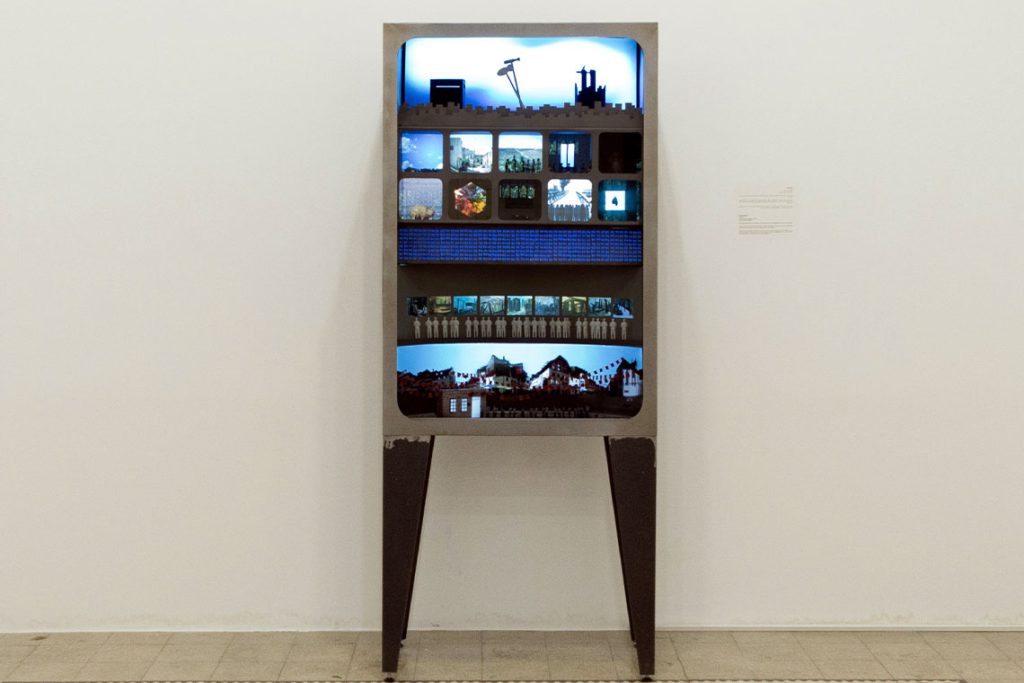
With a focus on the social dimensions of art, Raed Ibrahim’s Remnants that Continue (2025) takes the form of a television box containing 13 miniature scenes. Ranging from missiles moving across Gaza, small armies advancing, and devastated buildings sitting frozen in time, the work mirrors the constant loop of mediated violence, asking what it means to consume images of destruction daily while remaining physically distant from their consequences. In his darkly comical video Discussion Between Gentlemen (2016), Bady Dalloul stages the Sykes-Picot Agreement as two disembodied hands, armed with green and red pencils, draw, erase and redraw the borders of the Arab world. The absurd simplicity of the gesture underscores the devastating permanence of colonial decision-making, reminding viewers how casually entire regions were, and continue to be, reshaped.
These are only a fraction of the works shown in the space. Taken together, the installations spread across Darat al Funun do not offer catharsis or closure. Instead, they leave viewers with a sense of accumulation, of grief layered upon grief, image upon image, hour upon hour. The exhibition resists spectacle in favour of insistence, demanding sustained attention rather than momentary empathy. There is no single hour of despair or hope. It is not just two years marked by death and displacement. It is every hour, every day, for decades. In That Same Hour makes clear that what is unfolding in Gaza is not confined to a moment in time, but embedded in a longer history of erasure, resistance and survival, one that continues to demand to be seen.
