


The Iran-born artist speaks about the concept and development of his site-specific installation, Entre chien et loup, conceived for the Canada Pavilion.
Canvas: As an artist who was born in Tehran but has lived in Canada for many years now, how do you feel about representing Canada at the Biennale?
Abbas Akhavan: With a national pavilion, obviously, there’s an inevitability that you’re representing a country. I think I’m trying to take liberty with it in the way that a Canadian-born artist would, without the question of personal identity coming into play. While I think we’re all informed by our experiences, I’m more interested in generalities than identities, in systems that are not necessarily about me.
What was your initial concept for the pavilion?
I was interested in the history of pavilions and glasshouses and had made some smaller works about them before, including Study for a Glasshouse (2013) at PAMA (Peel Art Gallery, Museum + Archives) in Brampton. As a site-specific artist, I was mindful of the Canada Pavilion’s building, which is a glass structure. When they told me that I’d got the pavilion, I actually called a friend that same day to tell him the news. He asked me what my first thought was and I said “waterlilies”. I had no idea what I was saying, I just had this feeling.
How did this idea turn into one component of the installation?
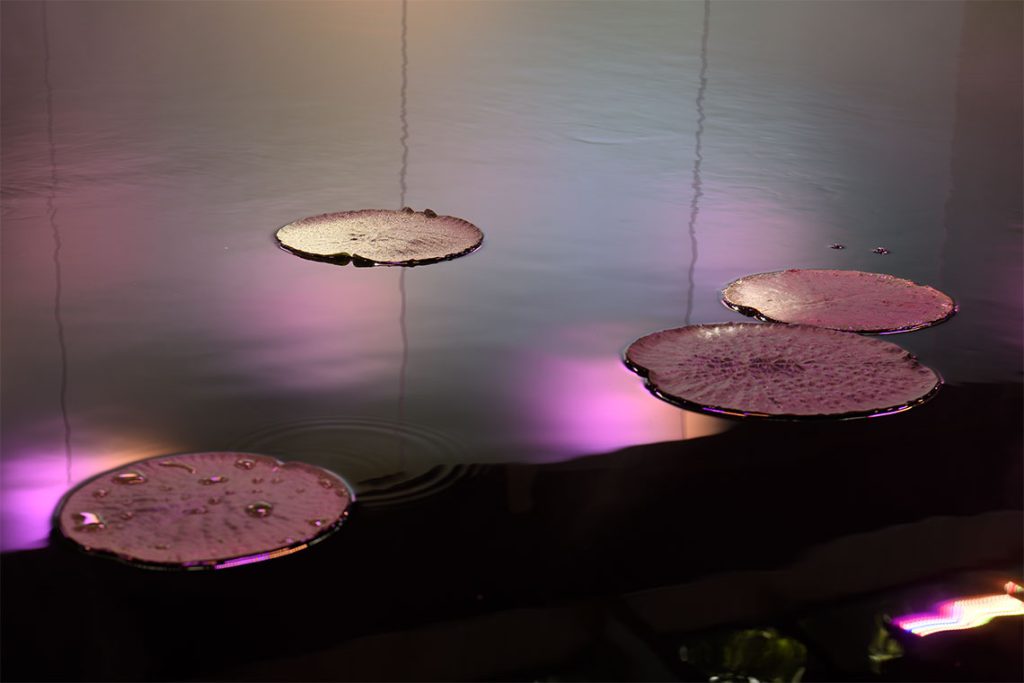
There are giant waterlilies from South America called Victoria cruziana and which are grown in Kew Gardens in London. I started to learn more about their namesake, Queen Victoria, as well as their colonial history, and approached Kew Gardens to speak to some of their botanists and horticulturists. I found out that the Waterlily House there was about to undergo a year-long renovation, but Kew Gardens eventually sent us some waterlily seeds. We cultivated these at the Padua Botanical Garden in Italy and the resulting plants now take up a third of the Canada Pavilion this year.
The tropical waterlilies were shown in a special display at the 1851 Great Exhibition at Crystal Palace in Hyde Park as a celebration of Britain’s botanical expertise and technological advancements. This feels like an interesting moment to reenact that episode, to become a host greenhouse during the lifespan of these plants, which is from May to November and coincides with the duration of the Biennale.
What are you hoping to say by hosting these waterlilies in Venice?
Much of my work has to do with the maintenance of living matter through human-cultured avenues of technology and artifice. My objective in this instance is not to talk about Queen Victoria, although the history of Britain through this plant is inevitably related to Canada as a Commonwealth country, but rather the fact that these plants are a 100-million-year-old genus. This reenactment can hopefully facilitate this awareness, with the exhibition acting as a witness to these vibrant, incredible, portals. I wanted to exaggerate this element, so through the installation in Venice you’re also in Kew Gardens and, through that, you’re in the Amazon as well.
Could you tell us more about the other two works that make up the rest of the pavilion’s installation?
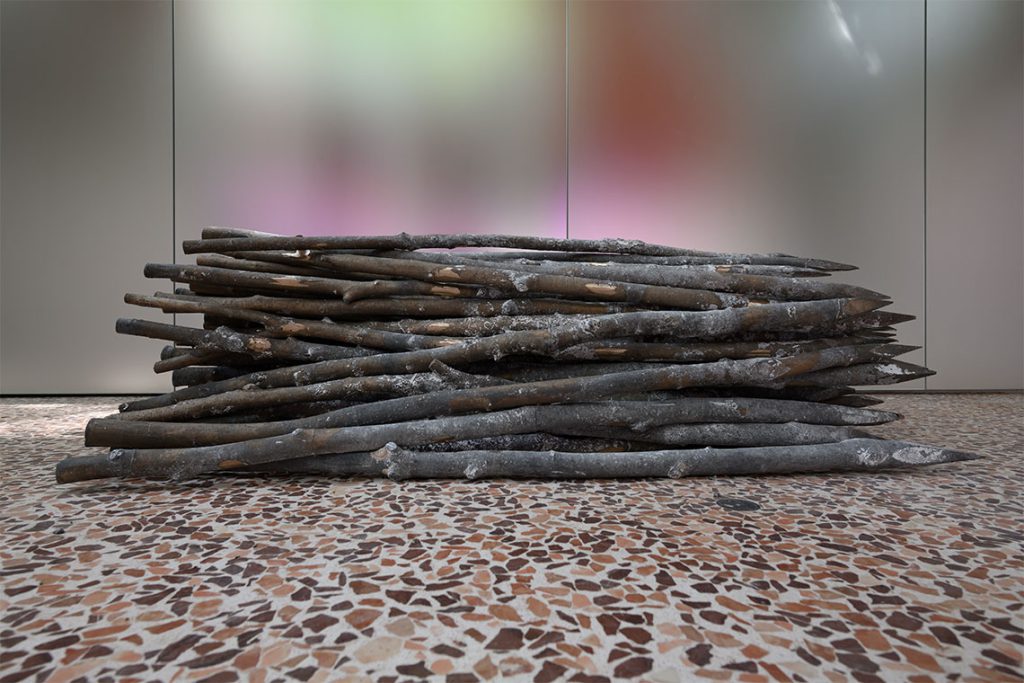
One is a reiteration of Study for a Garden (2016–), this time as a pile of 75 stacked sticks made out of bronze that are about a metre and a half long. They’re all really sharp at one end and look like they have a white film over them. The duality of these sticks, whether they’re weapons or fences, speaks to the territorial nature of the garden.
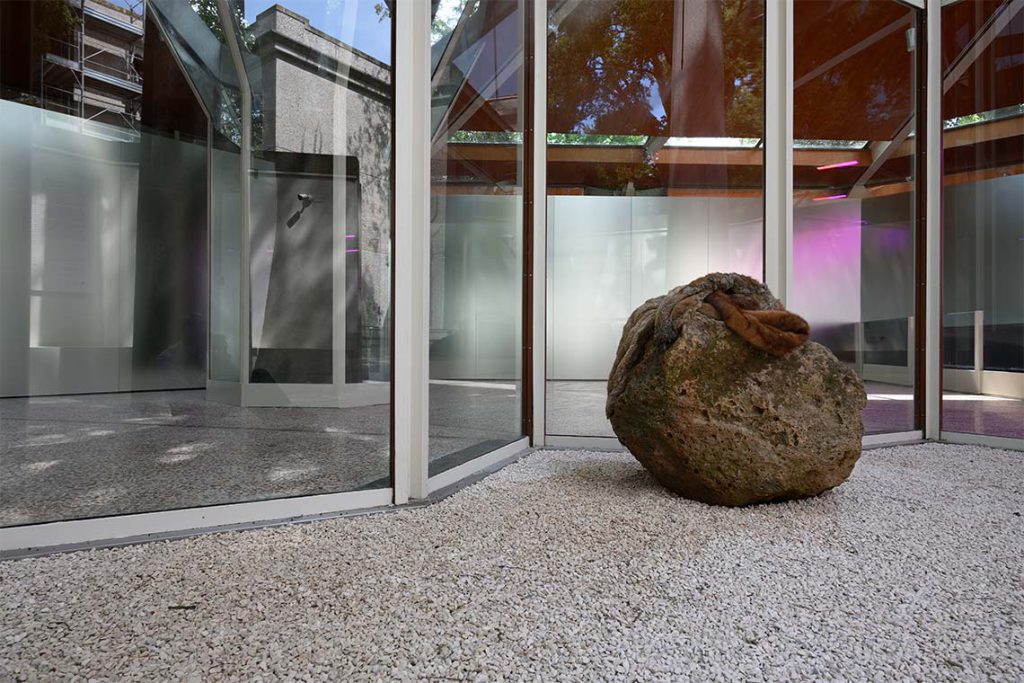
The other work is a boulder with a fur coat draped on it, and is located in the pavilion’s courtyard. A water system leaks water from one of its arms, wetting the boulder until it becomes covered in moss. The moss stays alive, but the fur coat starts to look disgusting and will stay wet for the next six months. Although I like my works to remain open to interpretation, one of the threads throughout these three components of the overall installation, which is called Entre chien et loup, is inevitably the evolution of our relationship to the natural world. There’s a shift in the economy of use and trade when an animal becomes a fur coat, when sticks become bronze, or when a waterlily is given a name.
What is the significance of the pavilion’s title, Entre chien et loup?
It means ‘between dog and wolf’. It’s about the hour when things become indecipherable. How does a giant Amazon waterlily become Queen Victoria, and then how does it unbecome that? Or, how does a fur coat look like a wolf or a lion or a boulder look like a ruin? I’m trying to see if there’s a place where, instead of art dictating about life, it can make room for new ways of thinking about it.
The specificity of place has an important role in your work. Is there anything in the installation that touches upon local history?
I actually did all of my research, aside from the waterlily, on the lion of Venice and trying to understand its scientific and vernacular history. I was interested in how this fugitive symbol has come to stand on a pillar to represent Venice in its entirety. It didn’t feel so different from the waterlilies. Also, I learnt that Venice – geographically, mythologically and environmentally – has an amphibious quality, part on land, part on water, which is why I thought it would be interesting to add an overall sense of moisture to the show, not only through the wet fur coat but also with the misters that dampen the boulder and coat in the courtyard, as well as in the interior gallery space.
How would you like people to approach the work?
Honestly, I just want them to forget art and look at these plants and feel not only a sense of proximity but also one of humility and maybe even of awe. I hope that people will be transported outside of themselves, away from needing to take a picture or document something. Just to have a moment of contemplation or pause, especially in Venice, where the tempo is fast and you run around to experience as much as you can.
The Canada Pavilion is located in the Giardini
This interview first appeared in Canvas 123: Venice Special Issue
