

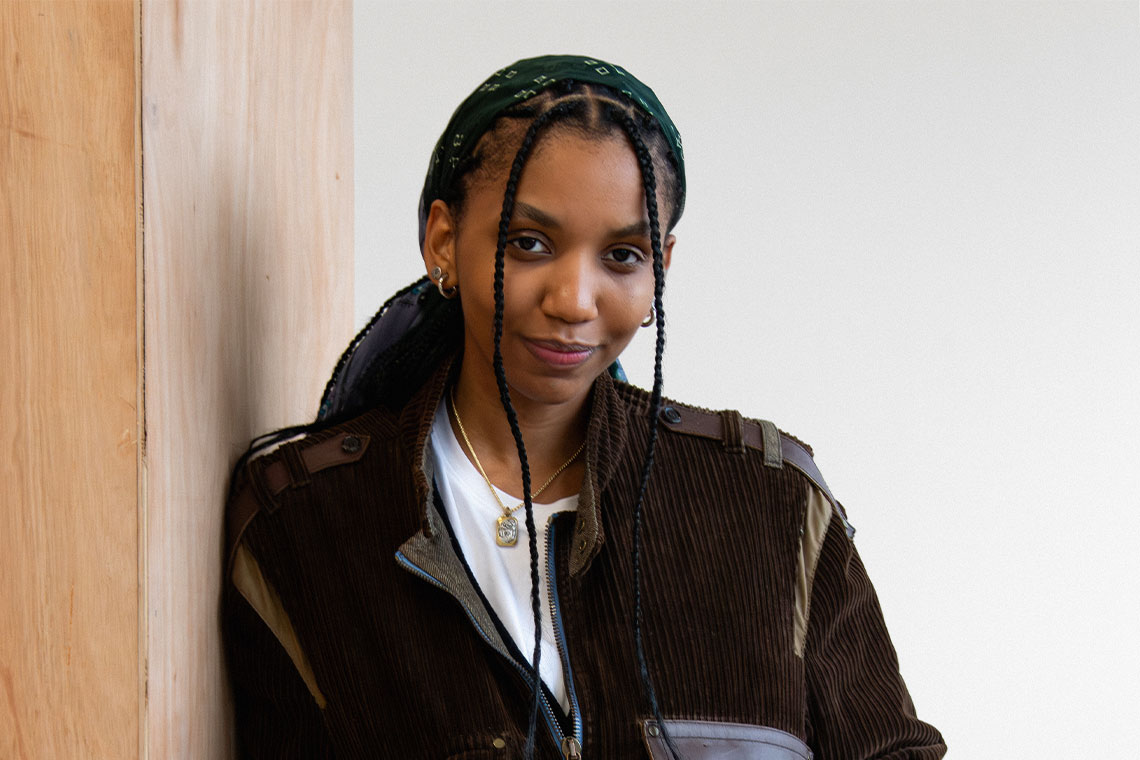
Informed by a desire to record both the past and the present, the Riyadh-based artist’s practice reimagines personal histories through intimate and collective archives.
Canvas: What prompted you to explore archives in your practice?
Abeer Sultan: I began my career assisting other artists, such as Basmah Felemban. That led me to the art scene and I ended up doing my first residency at Misk Art Institute, where I moved into research and developed my own visual language. That’s when I really started working with archives and sequencing. The first work I created there was Al Bidaya (2022), which translates to ‘the beginning’.
Al Bidaya explores death and archives of lamentation. What can these sources teach us about the past, and why do you use them?
I was researching lamentation and how to grieve the dead, alongside the idea of silence, while trying to fictionalise someone I’ve known and mourned in another form. This dimension was embodied in the deer in Al Bidaya. The deer exists in this digital space because it’s a screen, and then when the film combines footage of women grieving from around North Africa, the Mediterranean and the Arabian Gulf, it becomes a realm in which time is almost suppressed in some ways. The idea of sound is very taboo in the funerals we have in Saudi Arabia, so the film itself doesn’t have audio. It also includes a poem by Brigit Kelly that I translated into Arabic and only used as subtitles. I kept thinking about it, because it’s so abstract and has a duality to it, something that is dead but also alive. So it has these implications of resurrection.
When did you become interested in physical materials as archives, rather than digital forms?
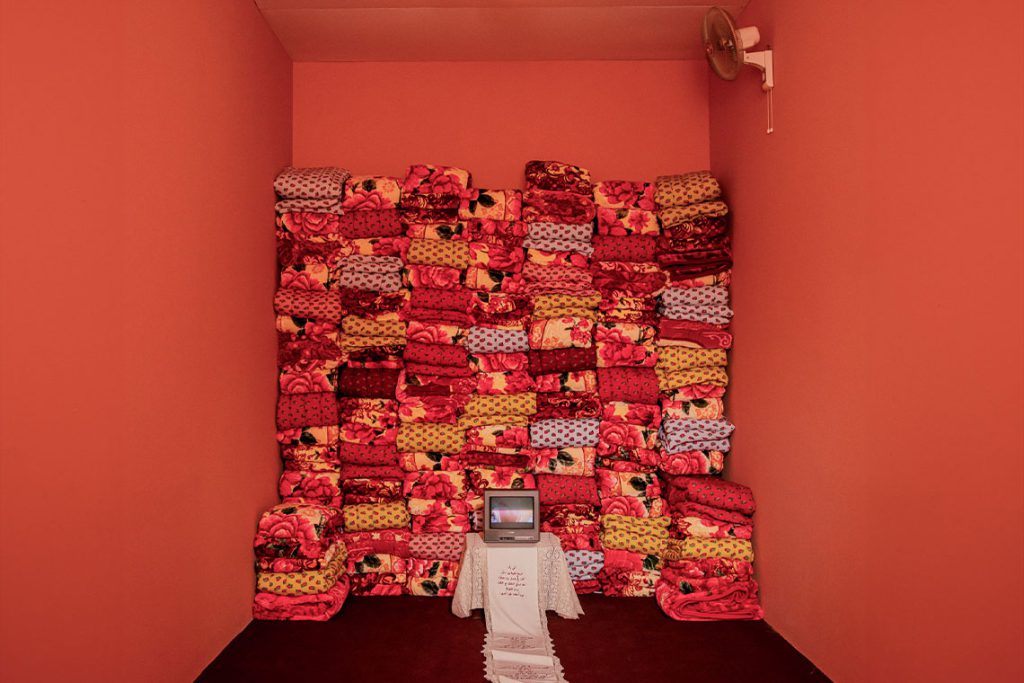
The materiality came into my practice as I looked at turning objects into stories, following my Master’s in Museum Studies. I’ve always been interested in materials, in the tangible. For some time, I created video installations, but although the scale is big, it feels intangible to me. I’m becoming obsessed with preserving things in some way or another. The use of physical materials happened organically, as you can see in my recent collages such as The Mound (2025) and Dragée (2026). I would paste things into my sketchbook, whatever I was seeing, collecting, writing. It felt almost like a ritual – a daily practice of looking and collecting. It also allowed me to use my family archive directly, because I would often reimagine it or recreate it instead.
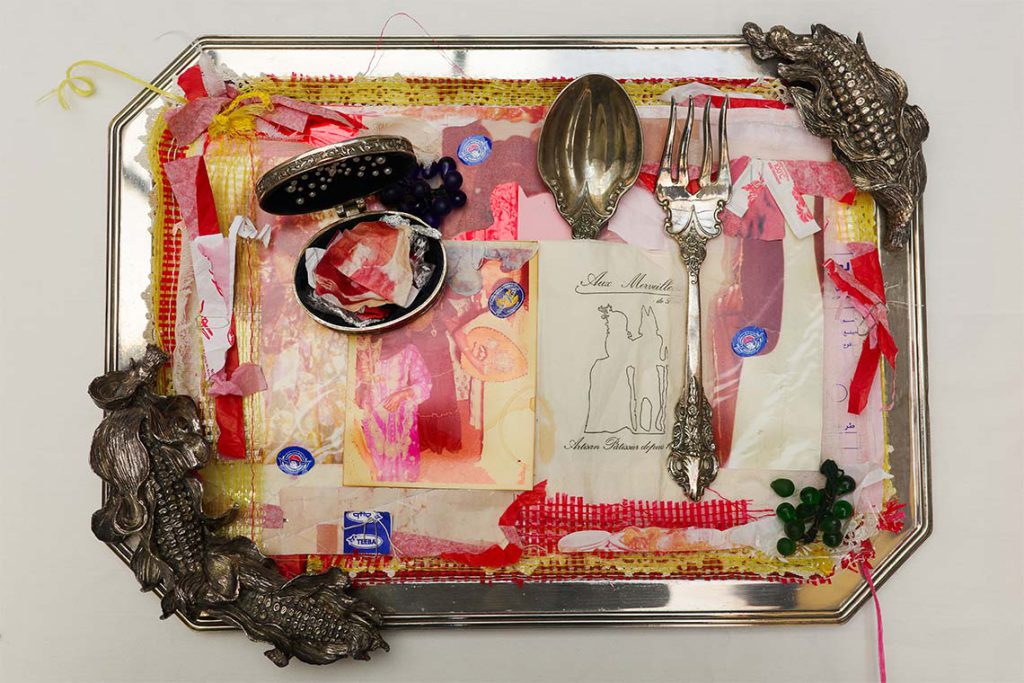
Your collage, Dragée, is currently on show at SAMoCA as part of the exhibition A Night of a Lifetime. It includes different items such as chocolate wrappers, photographs, a fork and a spoon collaged on a metal tray. Can you tell us more about it?
This work was so much fun to do because, in it, I am almost reimagining my parents’ wedding. The idea of the bride also appears in my previous work, The Mound (2025). The bride represents my mom in some ways. Sometimes you can’t see her directly, but Dragée is direct. You see her dress, you see the couple eating the cake. The tray felt like an offering, but also a way for me to consume and digest history.
How does archiving your family history help you to understand your past better?
Most of these family photographs are in storage or in a drawer that we cannot access regularly. I communicate and understand things visually, so my collage practice is a way to comprehend or explore something by laying it out on the table. Doing so makes me see the connection between things.
Has this visual mapping always been present in your work?
It came with Al Bidaya and The Reparation of a Lost Tooth (2024), an installation where I tracked where I lost most of my teeth as a child in my grandmother’s house. I was asking other people to make their own maps of where their teeth fell out and how painful it was, so everyone was encouraged to participate. I cannot access that house anymore, which makes me think of ways to imagine it, because the photos we have are not very clear.
What are you working on at the moment?
I am currently participating in a residency at Delfina Foundation in London, supported by the Saudi Visual Arts Commission. The work I’m developing is more of a direct investigation of myself. During my childhood, soap operas were very popular in the region. I grew up with them and Nollywood. I’m half Nigerian and half Saudi, so there’s this hybrid identity that I’ve never explored, combined with how women are represented in each culture. I’m taking screenshots of scenes featuring the female archetypes and how they’re seen. I use the internet for most of this research and I’m planning on sampling sounds from the films and bringing them into one soundscape. For this, I’m developing lyrics about wanting to attain what you can’t have, so you crush it metaphorically to let go of it. There is also this idea of emancipation from the image. It’s very personal.
Do you feel that the Internet changes how we archive or remember things?
Now more than ever, because everything is disappearing in some ways, it’s become an fascination of mine to take screenshots and to record what I’ve seen. I also go into comment sections to see what people are saying, how they react to the videos. It’s an active act of archiving.
