

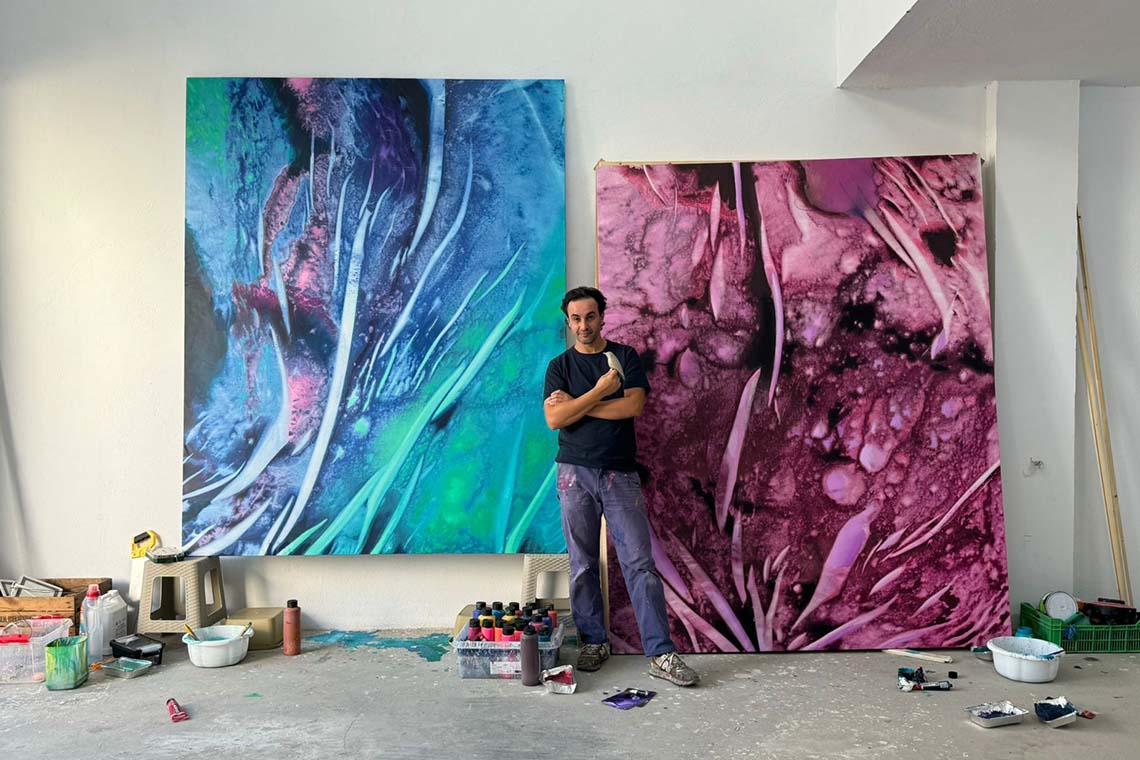
Living in-between worlds, the artist finds a home in his flowing and solaceful territory paintings.
For the Franco-Tunisian painter and sculptor Béchir Boussandel, it can be said that it is not paint that has shaped his art but rather the simple element of water, his most vital source of inspiration and creativity. “Water is probably the first material in my painting,” Boussandel tells Canvas, with the help of his friend Ghyzlène Boukaïla, who is translating. “Maybe it’s also a metaphor of movement and a question of an identity that is always adapting.”
Exposed to maritime and Mediterranean culture since his earliest days, Boussandel was born in 1984 in the port of Dunkirk in northern France. He would often visit his parents’ hometown of Bizerte, a charming and ancient Tunisian coastal city founded by the Phoenicians. When there, Boussandel always felt connected to the local artistic and cultural life, as well as to the natural scenery, from the desert to the sea. “Nature was always present,” he remembers. His uncles worked in theatre and visual art, but for Boussandel, becoming an artist was not initially part of his plans. “No, no,” he says with a chuckle. “I didn’t know that I wanted to be an artist, but I remember that every time I drew, people were watching me. In the act of painting, I still have the same naivety today that I had when drawing as a child.”
Between 2004 and 2009, Boussandel was a student at the École des Beaux-Arts in Dunkirk and was impacted early on by Western art giants such as Yves Klein and Mark Rothko. He says that it was through such figures that he was influenced in how to draw or sketch a landscape “with a defined perspective and a super-structured method”. Later on, however, his style of painting was freed from such order. “I removed the horizontal line and it was a big liberation for me in my painting,” he recalls. “After graduation, I looked for a studio and kept working with the same energy that I had as a student, but I didn’t have big projects or ambitions. I just continued to work. It’s not easy when you leave the Beaux-Arts, because you are in a bubble when there.”
In his early work, Boussandel worked on canvas, depicting peculiar objects that symbolised man-made borders, such as the four-legged concrete structure of tetrapods in the sea, emulating the function of the large rocks used to reduce wave damage. “The tetrapod is artificial and it has this real idea relating to borders,” he explains. “It was made by humans, like the borders that we have today.” Indeed, the themes of movement and migration, both physical and metaphorical, would become main themes in his work, expressed through calming paintings of fluid, otherworldly landscapes and territories. The artist says that in these works he is on a quest to explore identity, good form and experimentation.
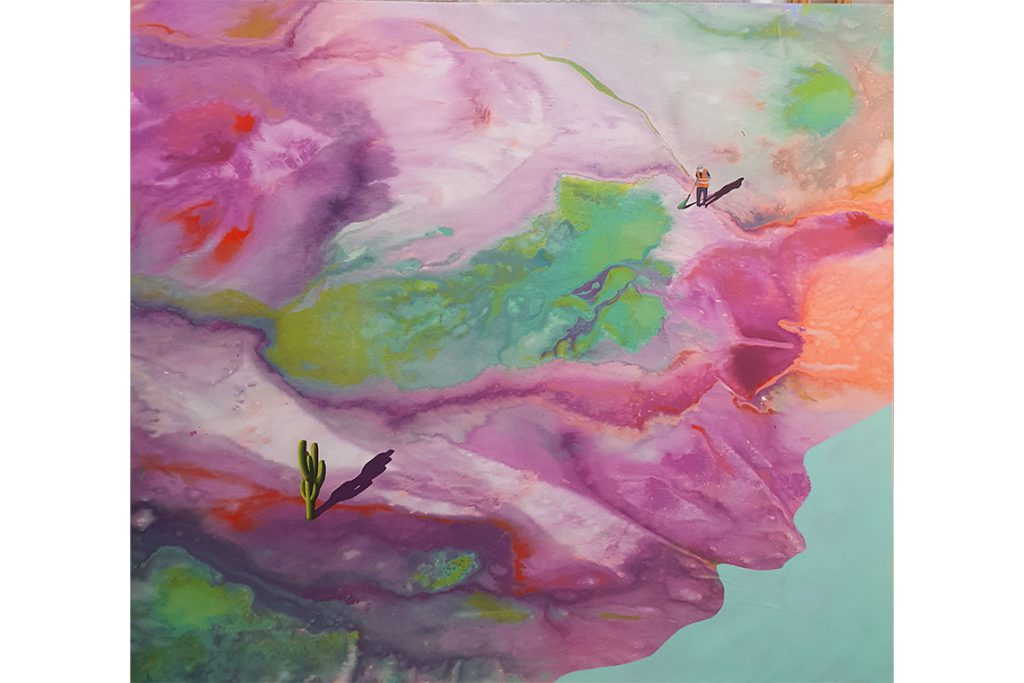
Boussandel implements a unique way of producing his images, where nature is literally a collaborator in the process and the artist is happy to go with the flow. Working in his rooftop space in Bizerte, often alfresco, he immerses large stretches of canvas in water and then covers the surface with several pigments of acrylic paint. He calls it “a combination of chance and skill”, and mentions that it is a technique similar to that of black-and-white Chinese ink wash painting. Exposed to the elements, the surface of his canvases is brushed by the wind, which gently swirls the water and pigments together, leading to organically shaped, dreamy effects. “The canvas draws itself,” he says. “I don’t know where it is going or what the result will be. The painting gives me something, and I don’t want to leave a trace of my hand in it.”
The result is a bird’s-eye view of imaginative spaces and territories, to which Boussandel may add his own little tinkering. The colours are bright and vibrant, like the sunset (his favourite time of day), ranging from mellow shades of green and purple to fiery hues of orange and yellow as seen in Terre Brulée (2024) and Premiere à eclairé la nuit (2024). He says that he wants to share intensity, depth and emotions through his work. “When I’m making my painting, or when I’m mixing my colours, it’s not something I even think about. It’s truly intuitive,” he explains.
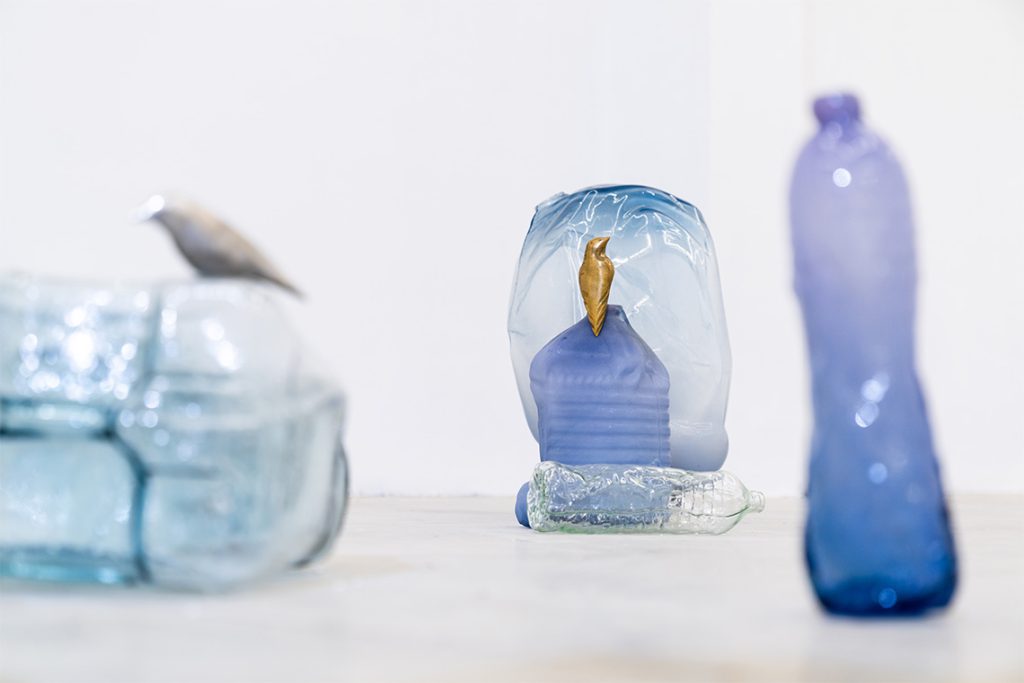
It is clear that nature has been leaving a positive and inspiring trace on the artist’s senses for a long time, but what about in the other direction? Aside from painting, Boussandel has also experimented with delicate glasswork, creating installations that quietly address climate concerns and especially pollution. In a recent show at Tabari Artspace in Dubai, Tenté par d’autres soleils (Tempted by Other Suns), previously shown in Tunis, he presented glass vessels blown in moulds that he fashioned from the plastic water bottles that are endlessly discarded in the streets of Tunisia.
These poetic pieces, delicate but durable, were produced in collaboration with local artisans. Some of the bottles – especially in the Liquid car and Bidon series – are topped with little perched birds, cast in aluminium or copper. It is an elegant detail that comments on themes of migration, freedom of movement, a search for betterness and shelter, as well as the vulnerability of the environment. Through this installation, Boussandel also raises awareness of local plastic bottle collectors, called barbecha in Tunisia, who eke their living from the collection and recycling of discarded waste materials.
Like his multi-dimensional sculptural practice, Boussandel’s metaphysical paintings are more than just landscapes of colour. They are an open field of internal thoughts and careful questions, and perhaps he is finding his answers through every gesture he makes. Throughout our conversation, he brings up deep concerns that revolve around our nuanced place as individuals in the world. “I was born in France but my culture is Tunisian, and my culture is French and I was not born in Tunisia,” he says. “There is a huge element of therapy in the process of creating. We’re always trying to find our place. I think art is where we can find ourselves, in our own territory, in our own space.” Until he finds his “right place” on Earth, it looks like the artist has created a temporary sanctuary for himself, as well as for his fellow wanderers to revel in his serene compositions. “The role of art in general,” he concludes, “is to take you to another world, where the viewer can feel different things and maybe experience a new type of emotion.”
