

Soft textiles and playful aesthetics mask rigorous inquiry as Barrada uses natural dyes from her Tangier garden to trace histories of colonial appropriation, labour and cultural erasure.
Yto Barrada’s exhibition at South London Gallery arrives wrapped in the language of horticulture. Thrill, Fill and Spill borrows its title from a gardener’s mantra for container planting – the focal “thriller”, companion “fillers” and trailing “spillers” – which the artist repurposes as a metaphor for the creative process: ideas that take root, gather density and ultimately exceed their bounds. It is a fitting framework for an artist whose two-decade practice has consistently excavated the tangled roots of cultural exchange, colonial appropriation and the contested geographies of borderlands. Here, installed across a single gallery, these concerns bloom through colour theory, textile work, sculptural installation and video.
The exhibition’s chromatic backbone stems from The Mothership, Barrada’s artist-led eco-campus and dye garden in her hometown of Tangier. Natural dyes extracted from plants cultivated there permeate the textile works on view, yet these are not merely decorative explorations of natural pigments. As Barrada notes, “I think of dyeing as transversal in that it has the beauty of the history of art – it touches industrial development and technology and science – and it is also still considered a female low art.” The plants themselves carry colonial histories in their very DNA, whilst the dyeing techniques – Indian, Indonesian, North African, West African – have been variously borrowed, misattributed, reclaimed and erased. In Barrada’s hands, colour becomes an archive of labour, migration and appropriation.

This is most evident in the two striped textile works, Untitled (Two Pink Stripes on Green, I and II) (2025) that command one half of the gallery’s back wall. Hand-dyed and sewn, these pieces reference both Frank Stella’s 1960s Moroccan-inspired stripe paintings and the Modernist artists of the Casablanca School, whilst also nodding to Daniel Buren’s copyrighted 8.7 cm stripes. The layered art-historical citations feel pointed, particularly given that local authorities recently whitewashed Buren’s 2015 Casablanca public commission without his knowledge. Against the gallery’s pink-striped wallpaper – an aesthetic choice that evokes both vintage tea rooms and nurseries, spaces of contained femininity and curated cosiness – these works quietly interrogate Modernism’s extractive relationship with North African visual culture.
The Untitled series of five works, each comprising coloured squares on contrasting fabric grounds, reinforces this playful yet purposeful approach. Up close, some of the material reveals a subtle tie-dye effect – the kind of thing one might have produced at summer camp – which beside the children’s building block aesthetic of nearby maquettes creates an unexpectedly soft, nostalgic quality. The association proves autobiographical: Barrada’s lightbulb moment came when one of her daughters returned from camp having learned about natural dyes. Opposite, the eight Untitled (Colour Wheel) (2025) works echo this sensibility with their repeated imperfect hexagons containing various colour and shape configurations. There is something disarming about the gentle domesticity of these pieces, which belie their engagement with questions of cultural ownership and the gendered hierarchies of craft versus fine art.
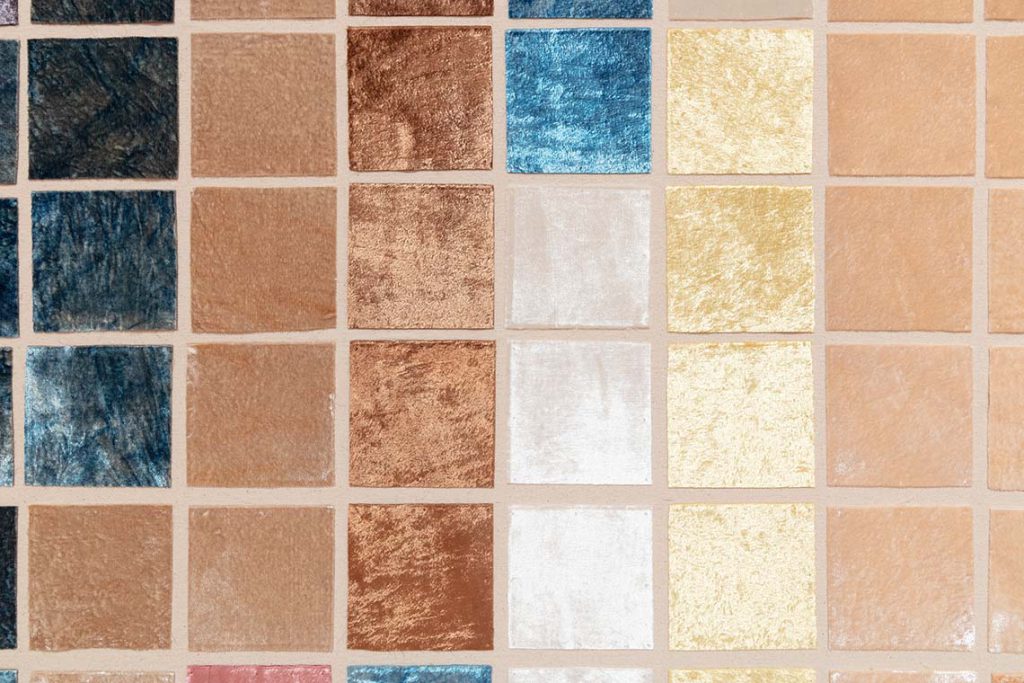
The exhibition’s most conceptually rigorous works are undoubtedly Colour Analysis (Tintin in Palestine, I and II) (2025). Here, Barrada employs overlooked American colour theorist Emily Noyes Vanderpoel’s 1902 grid method – via a custom computer programme – to analyse two versions of Hergé’s controversial comic. The 1939 original depicted Tintin in British Mandate Palestine during the Arab Revolt, featuring real paramilitary groups including the Irgun. When republished in 1970s England, the narrative was scrubbed clean, relocated to the fictional Middle Eastern country of Khemed, stripped of its political context. Barrada’s colour-field translations of these panels become diagrams of political redaction as much as chromatic study. The abstracted grids are deceptively beautiful, their geometric precision masking the violence of historical erasure. Displayed alongside the original black-and-white educational slides as archival objects, these works exemplify what Barrada describes as her interest in the “tension between clarity and opacity”.
Climate crisis enters the conversation through Tangier Island Wall (2019), a circular arrangement of crab traps that takes us to another Tangier – an island in Chesapeake Bay, Virginia, where rising sea levels threaten a small community dependent on crab fishing. The porous “seawall” references a complete protective barrier promised but never delivered by President Trump. Barrada terms this a beau geste – a noble but ultimately useless act. The traps are arranged in a circle to echo the shapes in the South London Garden’s Orozco Garden, creating an empty space in the centre of the traps; not accessible to visitors, this void prompts questions about what is worth protecting. The traps themselves contain void fill, that ubiquitous packing material which Barrada calls “entrails of paper”; what appears to be stone ballast is revealed as the humble stuff of Amazon packages. Elsewhere, Void Fill (2025) takes the conceit further, casting the material in bronze – that monument-making medium – rendering the disposable permanent.

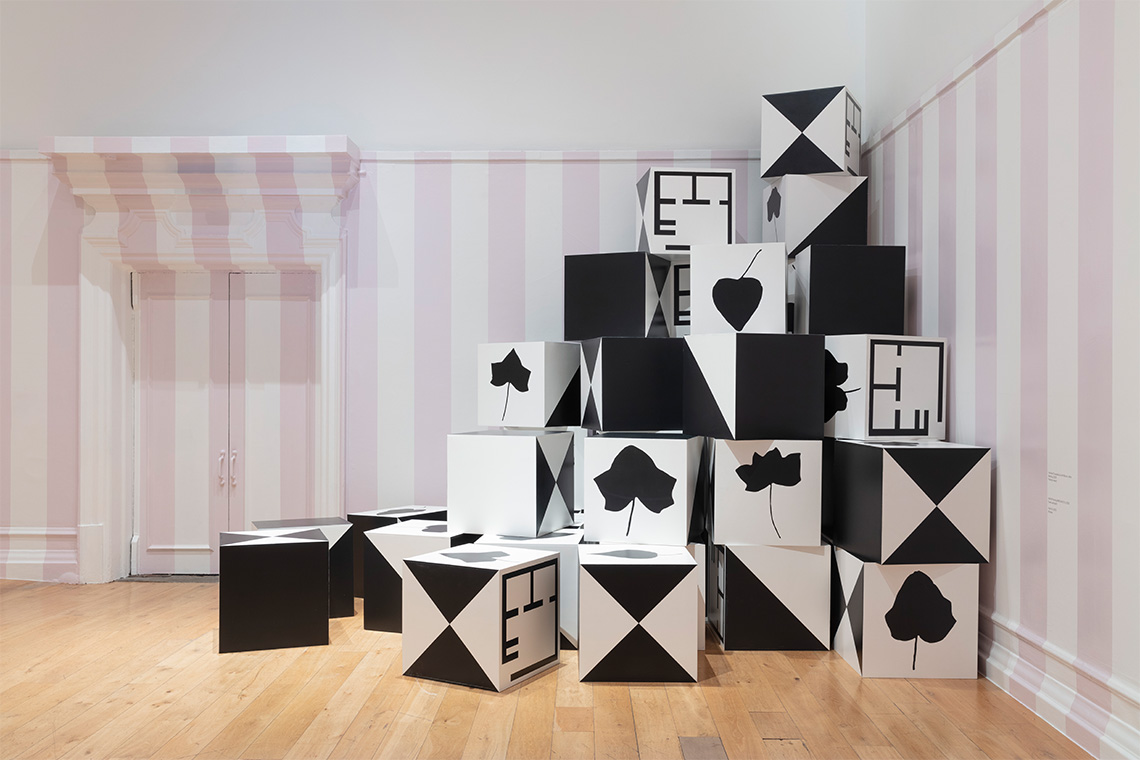
Untitled (13 maquettes for MoMA PS1 Courtyard Commission ‘Le Grand Soir’) (2025) offers wooden models of Morocco’s human pyramid tradition – a practice that evolved from fifteenth-century warrior tactics through spiritual ritual to Western circus spectacle, tracing yet another arc of appropriation. More arresting is Untitled (Casablanca Unit Blocks – With Bettina) (2023), where large black-and-white blocks cascade from one corner, evoking both toppling playing cards and chess pieces. Commissioned by the São Paulo Biennial, the work connects Modernist urban planning for Casablanca’s migrant worker housing with Bettina Grossman’s New York foliage paintings. Barrada became responsible for Grossman’s estate after the multidisciplinary artist’s death in 2021, and this sculptural conversation between their practices feels both elegiac and architecturally playful.
The exhibition’s only moving-image work, Continental Drift (2021), assembles eight years of footage across the USA, Morocco and Antarctica on two monitors with a slight time delay. It is a generous, digressive piece that introduces us to Tangier characters – a cat, tourists, a snail vendor, cinephile collector Jerry B – whilst touching on the Grand Socco plaza and The Cinémathèque de Tanger, the arthouse Barrada founded in 2006. In one sequence, the camera glimpses the ageing thug involved in the abduction of Barrada’s politically active grandfather in the 1950s. Personal and political histories bleed together, much like the natural dyes that seep through fabric.
Thrill, Fill and Spill confirms Barrada as an artist deeply committed to place-making and cultural exchange, yet never naive about the power dynamics embedded in such exchanges. The exhibition overflows with ideas – perhaps too many for a single gallery – but that seems precisely the point. Like the gardener’s spiller plants, Barrada’s practice refuses containment, trailing across disciplines, geographies and histories.
