

This year’s Busan Biennale brings together artists to form collective sonic expressions that serve as a tool for remembering the past, challenging systems and imagining alternative futures.
Taking place in the port city, the 2026 Busan Biennale has brought together 46 artists and teams from 22 countries under the theme of Dissident Chorus. Curated by Evelyn Simons and Amal Khalaf, the exhibition foregrounds sound as a material and form of expression while focusing also on how the body becomes an archive and tool for resistance.
The biennale activates three sites, including the Busan Museum of Contemporary Art on Eulsukdo Island, an ecological park and habitat for migratory birds. The location carries through into the first part of the exhibition with themes of regeneration and geography, as well as generational and ecological concerns.
Joshua Serafin’s installation creates a spiral corridor structure leading to a three-channel film installation entitled Whispering Pleas of the Eternal Echoes (2026). In a fragmented exploration of ancestry and migration, the videos navigate family histories across generations and countries as they shape identity, resilience and belonging while proposing a new universe where all connections merge.
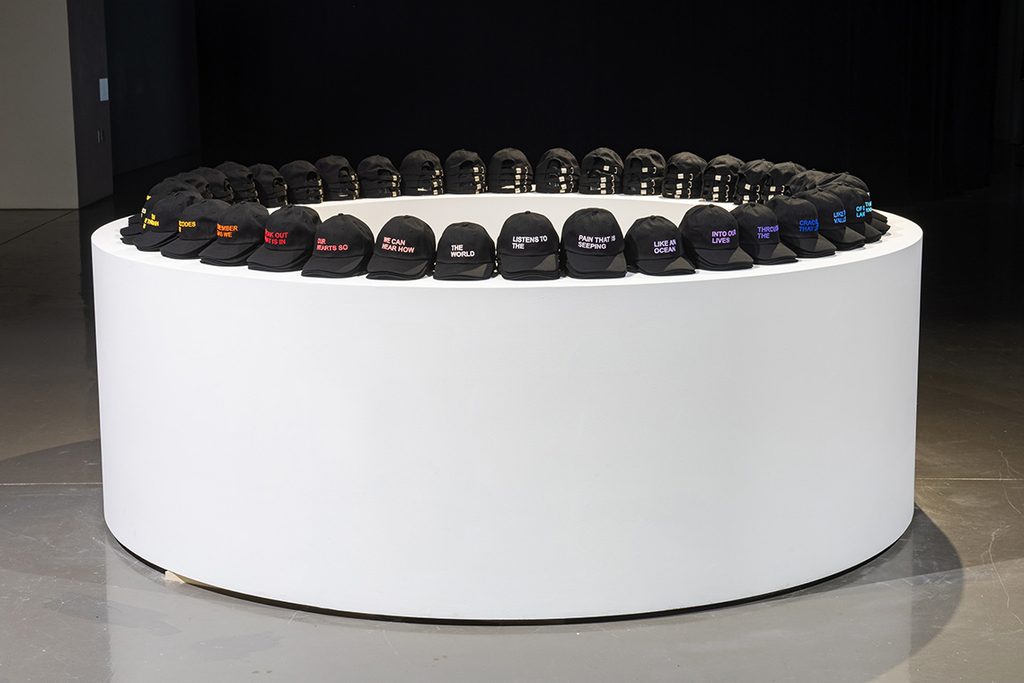
Similarly defying linear boundaries, Yazan Khalili’s interactive installation We carry our pain like a language (2026) presents 39 hats embroidered with a section of poetry, with each hat available to purchase by the public. As the caps are bought, worn and disappear, the poem disperses and becomes impossible to understand in its entirety. Only through collecting knowledge of all of the parts does its message reach through the crowd and beyond, avoiding censorship or institutional barriers. Tanat Teeradakorn also utilises items as a tool for sharing information, through consumables, tourist souvenirs such as t-shirts, keychains and pins. Memory Threshold: Chaos Resonance (2026) also includes a sound installation grounded in political themes as the artist questions the role of repetition and production in circulating messages and in questioning what narratives become diluted or more palatable for cultural consumption.
Sungsil Ryu’s monumental TEN THOUSAND DREAMS (2026) presents scissor-lift platforms hosting zombie-like uniformed children in varying states of decay, accompanied by three musical tracks. The work combines children’s voices with hopeful melodies exhorting one to dream big and achieve one’s goals, with an underlying eerie critique on societal pressures and capitalism that questions how human ambition was shaped and consumed as an alternative to South Korea’s lack of natural resources.
The location of the Former Busan Nam High School on Yeongdo Island was only vacated earlier this year, and is now another site for the biennale. Aliaskar Abarkas’s Spell (2026) is situated outside on the sports field, as a participatory work to learn through collective movement. Reclaimed textiles are installed using geometric patterns and protective symbols to create a musical score traced into the land with each step.
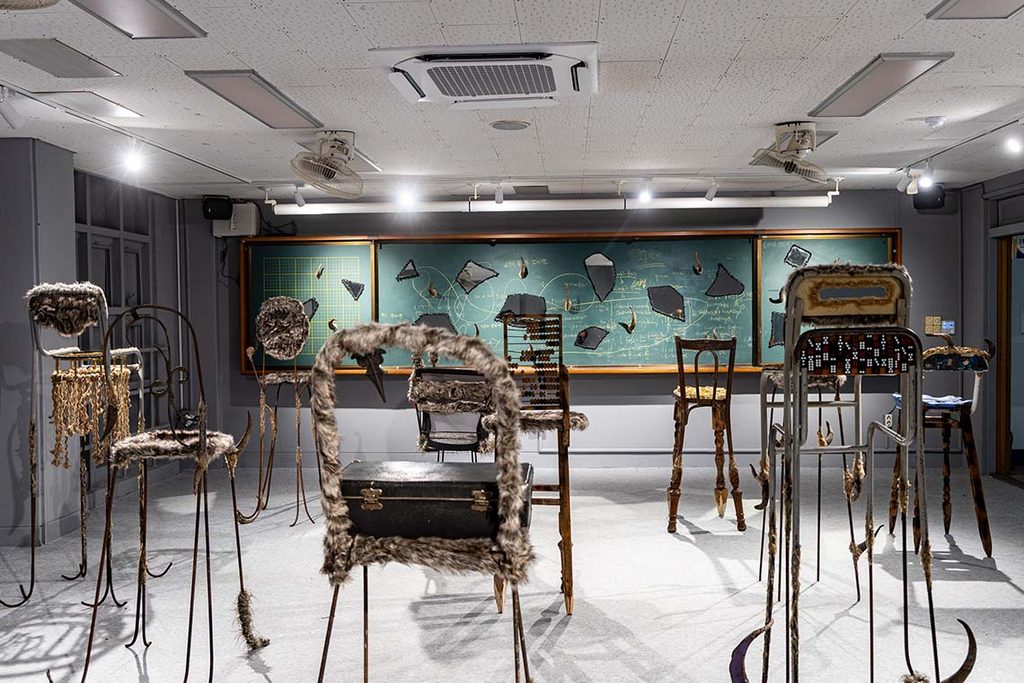
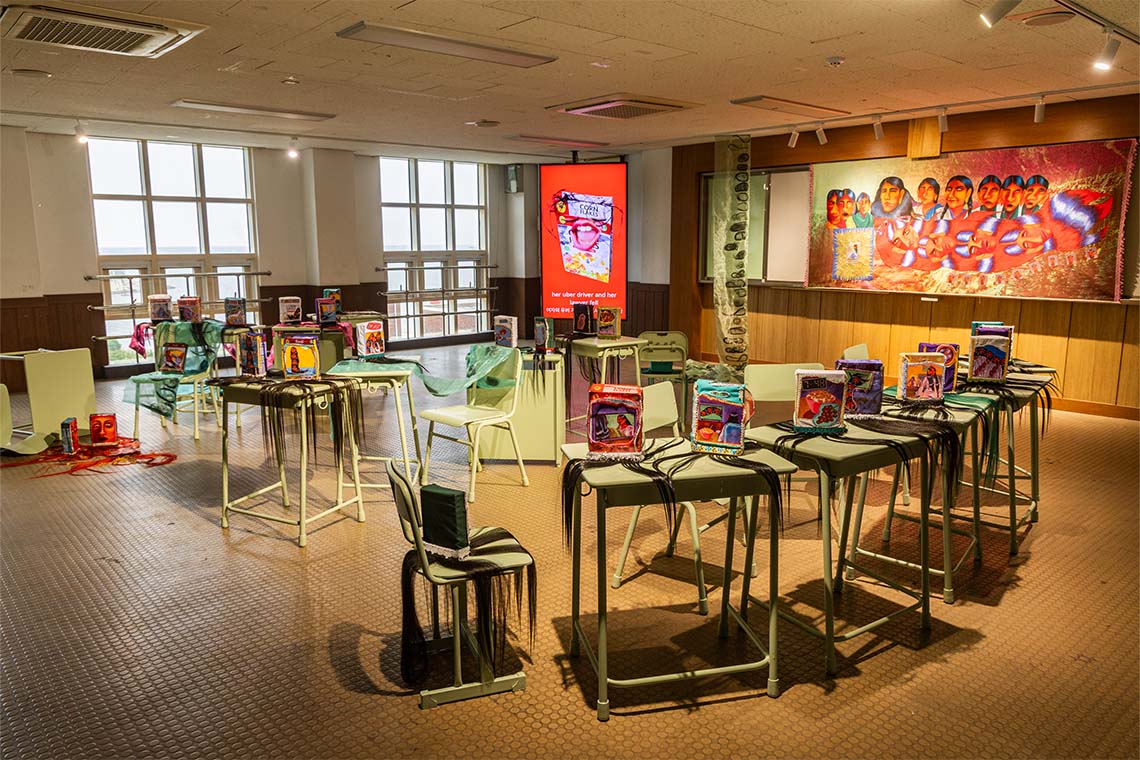
The school also becomes a place for unlearning, questioning narratives and reframing notions. A looping video plays in the background of an abandoned classroom and desks are dotted with synthetic hair, lace and cornflake boxes with fabric covers and drawings in Fatima Khaleem Khan’s Spilt Milk (2026). The cereal is from a Pakistani military-linked conglomerate that also funds state-backed television and operates school curricula. The work probes who controls knowledge, how it is consumed and the way in which its transmission shapes identity and behaviour through home, school and television. In another classroom, Jantsankhorol Erdenebayar’s Resonance of the Vernacular (2026) delves into collective memories, Mongolian culture, labour and how people adapt to political, environmental and economic change. Chairs made from various materials – such as wood, rope, metal and faux fur – allude to nomadic traditions and changing relationships to the natural world. Facing the classroom is a chalk board collaged with mirror fragments and protruding horns as a site where institutional systems are sites of ideological tension between past, present, shared ambitions and personal values.
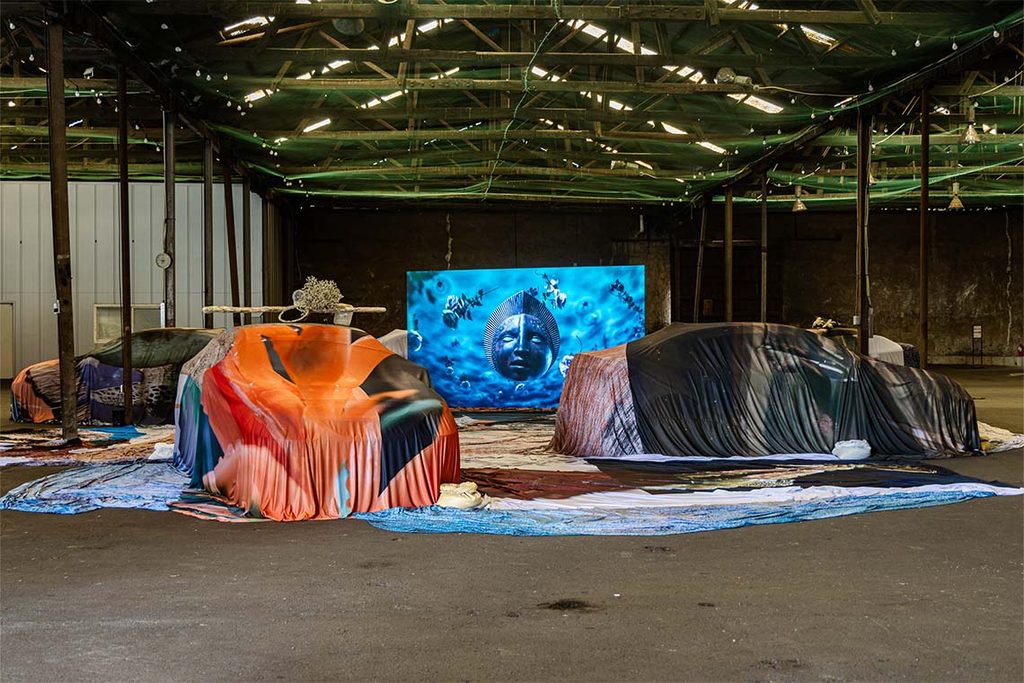
Also in Yeongdo is the other biennale location, Space OneZ, a converted century-old marine warehouse, with cargo ships docked outside. The location captures Busan’s port and its marine history, shaped by stories shared across waters of labour, survival, violence and human and non-human myths. Julien Creuzet’s ZUMBI ZUMBI ETERNO (2023) inhabits the majority of the first space as a monumental installation. Zumbi references the Brazilian quilombola leader, also known as Zumbi Dos Palmares, who resisted Portuguese colonial rule At the centre of the work is a film where jellyfish and toxic puffer fish drift by and symbols of life, death and transformation converge. Surrounding the video are several cars wrapped in textiles, almost as relics left to succumb to their surroundings. The piece becomes an exploration of the ocean as a space of memory and as a living archive, connecting the past of suffering and resistance with industry and cultural identity as the human and non-human become intertwined.
Placed at the other opening of the warehouse is Brahim Tall’s The Choir of Dissonance: The Creation of the Sea (2025), which places 19 speakers in a circle, all whispering. Each audio is positioned at the height of each person who shared their voice. They each speak as individuals, but together become a shared sound uniting to form something beyond themselves.
Across Busan, the biennale comes together as an exploration of sound that becomes more than words and melodies to encapsulates movement, memories, history, knowledge, trauma and healing. Through installations, film, sound, sculpture and participatory works, the artists create different interpretations of what it means to speak, remember and resist. Each sings different parts, but collectively they embody a unified call to acknowledge the past and search for understanding, belonging and perhaps a chance to redirect the current trajectory of the world and reimagine new ways of living and thinking.
Busan Biennale 2026 runs until 1 November
