

Through poetic narratives and bright hues Basim Magdy creates a world where the familiar slips into the surreal.
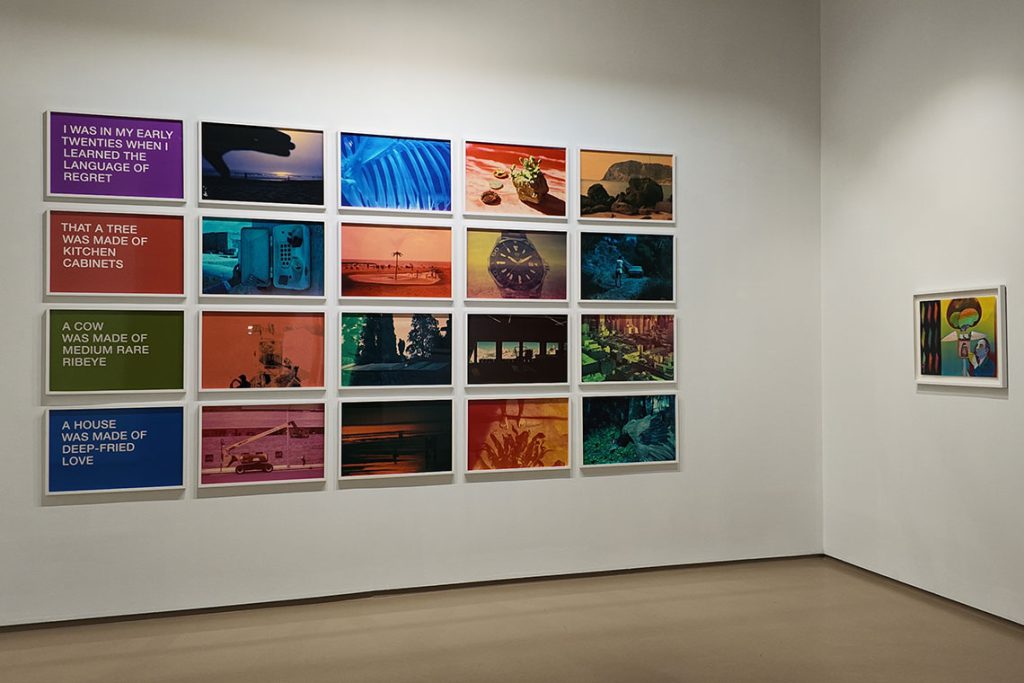
A deep sense of longing arises when experiencing Basim Magdy’s works. For his solo show in Istanbul, the artist probes the poetics and multilayered emotions that pass through one’s mind across works created between 2019 and 2026. Magdy has developed a distinctive visual language, expressed through vibrant colours and particularly in the fluidity between words and photography, as seen in Coming of Age in a Trembling Place (2023). The work comprises 16 photographs arranged in a grid, accompanied by four quotes drawn from the artist’s inner world. One reads, “I WAS IN MY EARLY TWENTIES WHEN I LEARNED THE LANGUAGE OF REGRET”. The emphasis on colour and the use of capital letters lend the text a particular intensity, almost like a bullet piercing the soul.
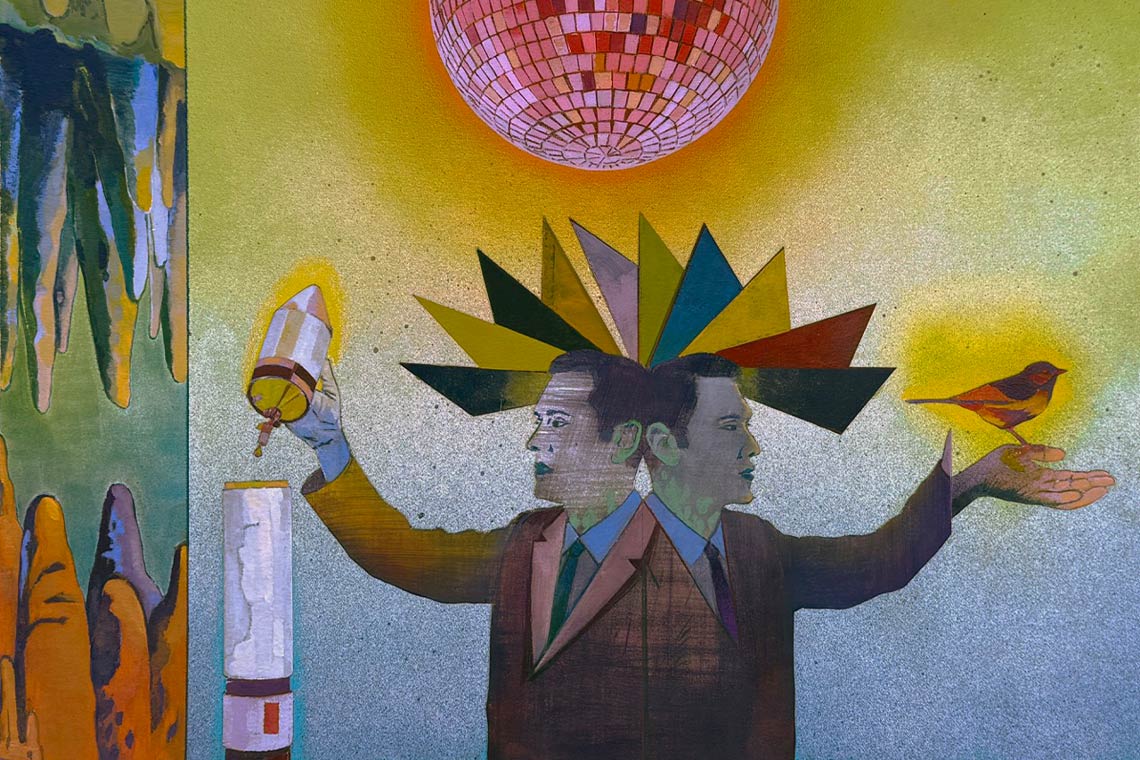
Among the four works on paper, The Rocket Scientist Who Believed He Was a Peacemaker (2026) marks Magdy’s return to the medium, which he last explored in 2013. The collage and painting showcase a mirrored scientist, divided between two opposing impulses. On the left, a hand detaches the rocket’s nose cone from its body; on the right, another hand becomes a pedestal for a bird. Magdy’s vibrant palette lends the composition a playful quality, with a disco ball that almost resembles the sun and, on the left, a form suggestive of either cave cones or glaciers. This visual playfulness gives way to the scientist’s underlying moral dilemma, caught between his consciousness and the belief that the rockets he creates might somehow bring about global peace. Magdy reinforces this tension through the deliberate arrangement of the composition, placing what might be read as the darker, destructive impulse on the left and the more peaceful, almost angelic gesture on the right. The mirrored figures give form to an internal struggle, where the aspiration to create and protect coexists with the capacity to destroy.
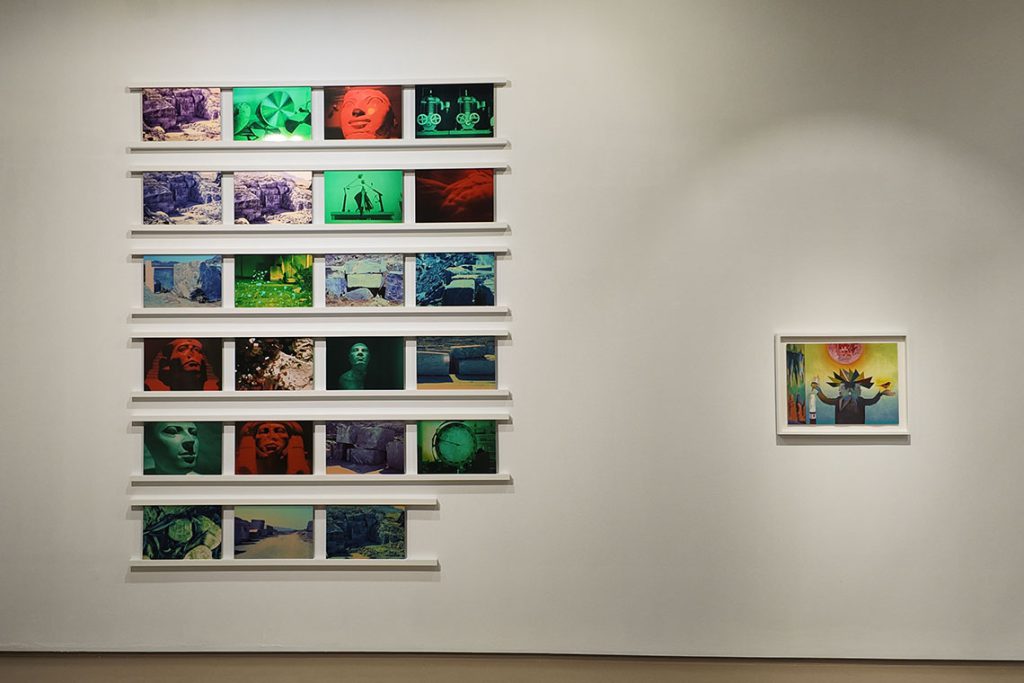
Throughout the exhibition, Magdy takes the viewer into a world of self-questioning, while the exhibition text itself reads almost like a confession, sharing an intimate walkthrough of the ideas and reflections that inform the artist’s practice. This personal account adds another layer to the works, revealing the thoughts and associations that surface behind their making. Created specifically for the exhibition, in A POEM (2026), 23 photographs are arranged in a row, which Magdy describes as “reminiscent of the lines of a poem or filmstrips”. In the accompanying text, he recounts a breakfast conversation with Bruce Jenkins in 2018, during which they discussed Bruce Conner’s experimental film A MOVIE (1958), which later became the starting point of A POEM. His enquiry focuses on the relationship between the survival of traces and the persistence of curiosity. Through photographs of marble quarries, historical artefacts, rocks and minerals, Magdy draws attention to the material traces through which human and geological histories are recorded. In a way, he suggests that history is not preserved simply because objects endure but because someone encounters those objects, asks questions about them and discovers meanings that were not anticipated. His photographs look as though they have been chemically altered, contrasting the elements within or perhaps creating an interplay in the overall scene.
A separate room is dedicated to The Birds Choose the Cards (2024), a film shot on 26 mm and transferred to HD media. In one scene, a visit to a fortune teller in Taipei becomes an attempt to understand the past, only to acknowledge that the present is already complicated enough. When the question of whether war will ever end arises, the response that it will only grow bigger introduces a further state of unease. Through layered images and sounds, Magdy moves between the sea as a site of migration and the spectacle of a colossal cruise ship, interspersing scenes of tourism with more unsettling references to war. The accompanying text references Plato’s allegory of the cave, stating, “We were prisoners chained and forced to look at shadows. The shadows become our light.”
Rather than making sense of the world, Magdy reveals the strange and often unsettling way in which we attempt to understand it. The eternal question remains, circling between the absurd and the profound, searching for meaning in the contradictions themselves.
2019–2026 AD: A Series of Disjointed Ideas Forming a Coherent Train of Thought runs until 24 October
