

Through six new concept watches, Vacheron Constantin invites artists working beyond traditional horology to translate their craft into a new dimension.
For more than 270 years, Vacheron Constantin has cultivated the decorative arts that define haute horlogerie. Yet with the Métiers d’Art Tribute to the Animal Kingdom, the Swiss Maison looks beyond its own traditions, inviting six artists working in disciplines rarely associated with watchmaking to rethink their craft at the scale of a watch dial. Developed through the Maison’s One of Not Many Crafts Programme, the initiative extends beyond a single collection, functioning as a platform that encourages artisans working outside of traditional watchmaking to adapt their practices to one of the most technically demanding surfaces in contemporary craftsmanship.
Christian Selmoni, Maison legacy and style director of Vacheron Constantin, emphasises that “by inviting practices rarely associated with horology onto the watch dial, the One of not Many Crafts Programme is expanding the creative vocabulary of métiers d’art within watchmaking. This approach has encouraged thinking beyond established categories – a form of creative incubation that opens new possibilities for artistic expression within the constraints of watchmaking”. Contained within a 42-millimetre case, each dial becomes a condensed site of artistic expression, where feathers, wood, paper, glass and gold transcend their conventional use to occupy one of the smallest canvases imaginable. Every discipline begins with the hand – setting gemstones or arranging feathers, the gesture remains the same – slow, deliberate and learned through repetition.
Rather than treating the watch as an object of precision, the collection proposes it as a space for artistic experimentation, where contemporary craft and haute horlogerie converge. Working alongside Vacheron Constantin’s watchmakers and métiers d’art specialists, each artist confronted the complexities of translating techniques that are usually made with larger scales onto a dial. The six watches are brought together by the Calibre 2460 G4, whose peripheral display system clears the centre of the dials, preserving the integrity of each artwork.
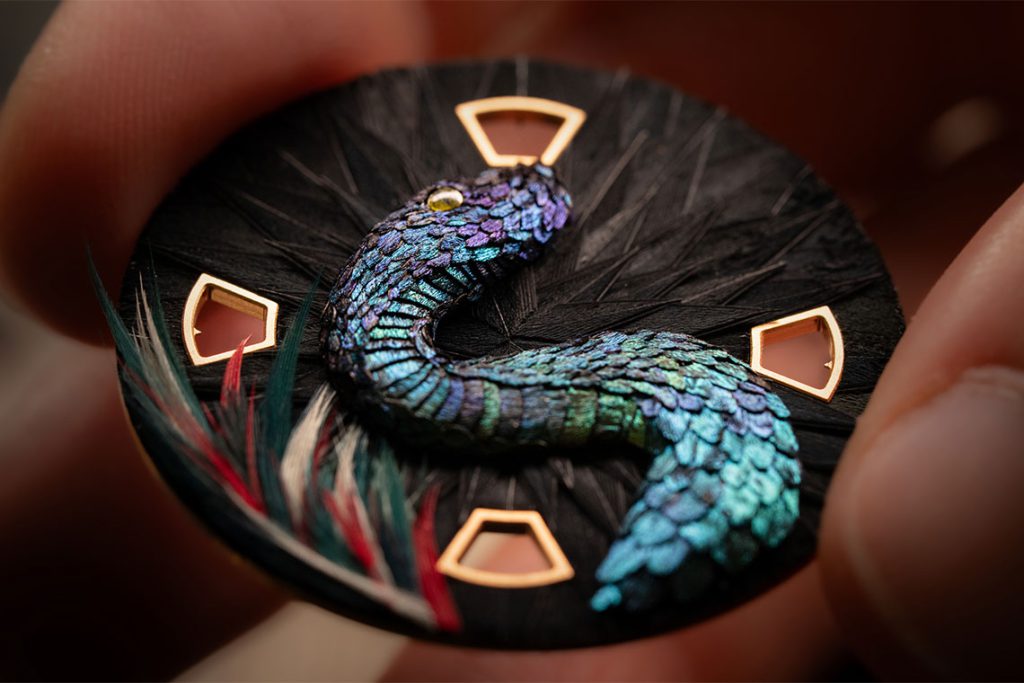
Among the six concept watches, Feather Snake depicts an imagined serpent winding through dense foliage. This illusion is achieved through micro-plumasserie, with the snake constructed from more than 200 fragments precisely cut from seven rare Lophophore feathers. Attached individually into silk paper before being trimmed, the feathers mimic the rhythm of living scales, while the surrounding foliage is composed of goose feathers, creating a rich backdrop. Created over the course of approximately 250 hours, the work demonstrated the level of precision required to adapt featherwork to the technical constraints of the dial.
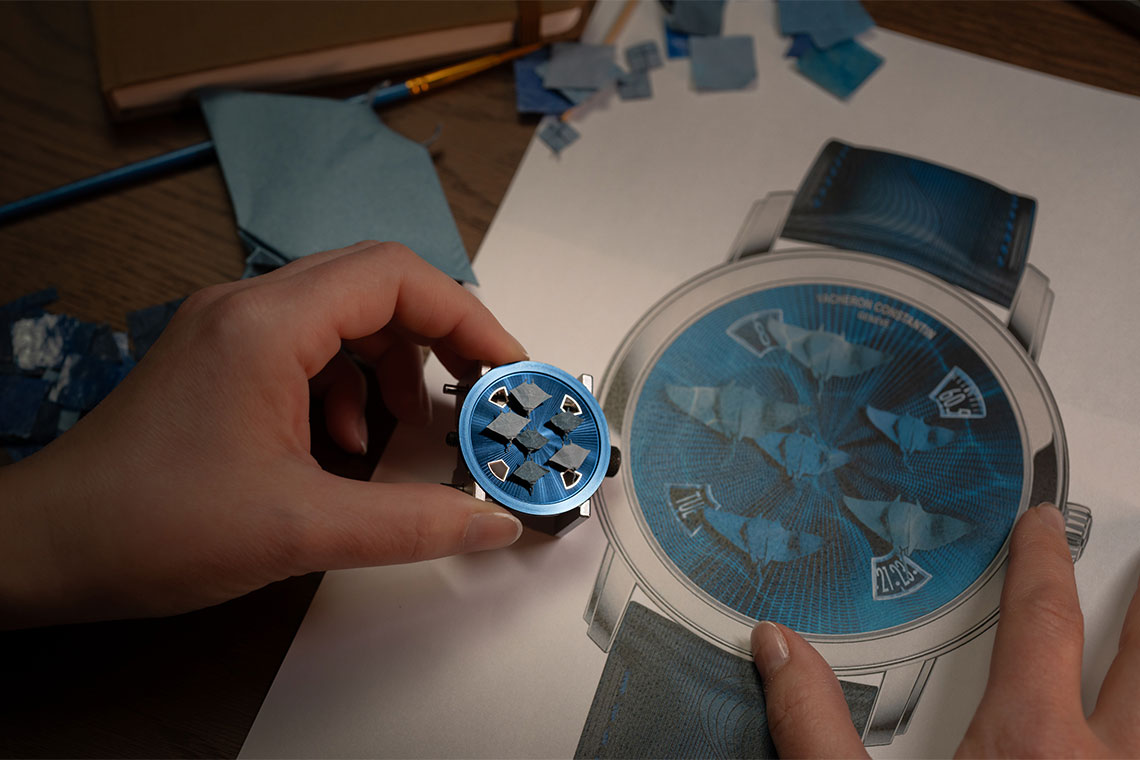
From its title, Glassoctopus presents an almost translucent octopus floating within the dial, capturing the quiet fluidity of underwater movement through sculpted glass. The piece demonstrates how craft can be fundamentally reimagined when confronted with the technical constraints of watchmaking. The collection continues with the Oraygami watch, where six micro-origami folds are intricately arranged across the dial, depicting manta rays gliding through the ocean, each holding a distinct plane to create an unexpected sense of depth. The use of paper extends to Papercroc, where an embossed crocodile emerges gently from the surface of the dial, its soft form framed by delicate foliage almost encapsulating the scene. The whites of the paper create a contrast with the rose gold case.
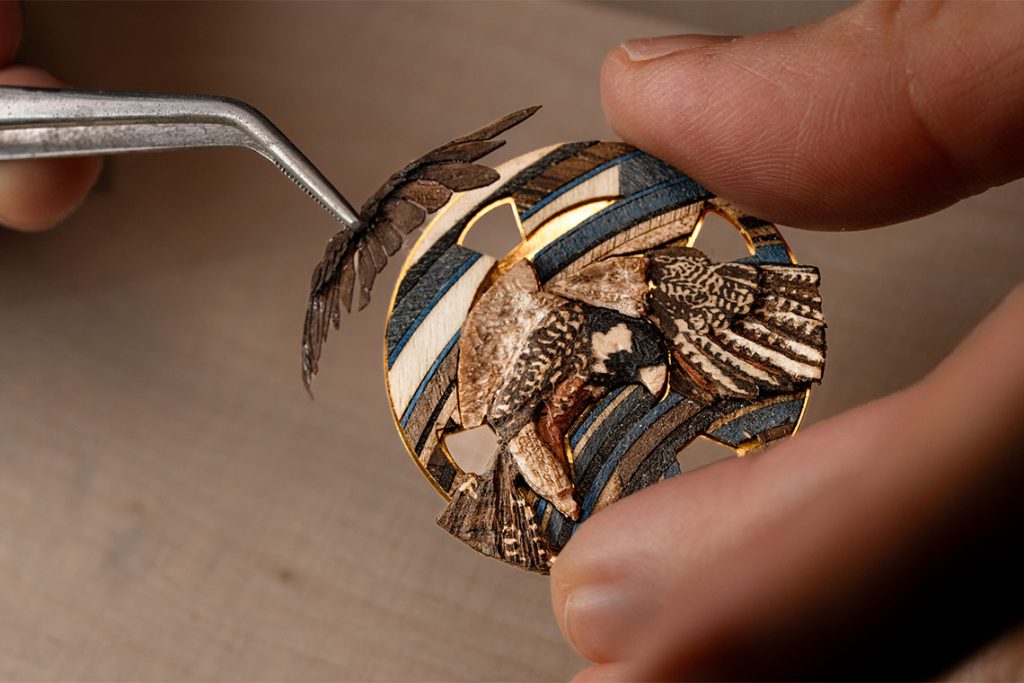
Wood finds perhaps its most natural expression in the Woodenwings, where the material’s grain and tonal variations become integral to the intricate plumage of a falcon. The use of wood allows the organic qualities to shade the bird’s anatomy, with carefully burnt veneers, articulating each texture. Curved strips of wood in muted blues, warm beiges and natural tones complete the background, extending the falcon’s presence into a flowing landscape. Meanwhile, embroidery – a craft most often associated with fabric – is reinterpreted in a striking portrayal of a tiger. Tigerbroidery is composed of meticulously layered gold threads, through which the animal’s face appears in extraordinary detail. Its luminous yellow eyes with green foliage frame the composition, representing a miniature relief of remarkable precision.
While each dial offers a distinct interpretation of the animal kingdom, together they form a broader reflection on the evolving nature of craftmanship. Through collaboration with artists working beyond the conventions of horology, Vacheron Constantin expands the language of métiers d’art, where centuries-old practices are translated into miniature works that balance artistic exploration with mechanical precision.
