

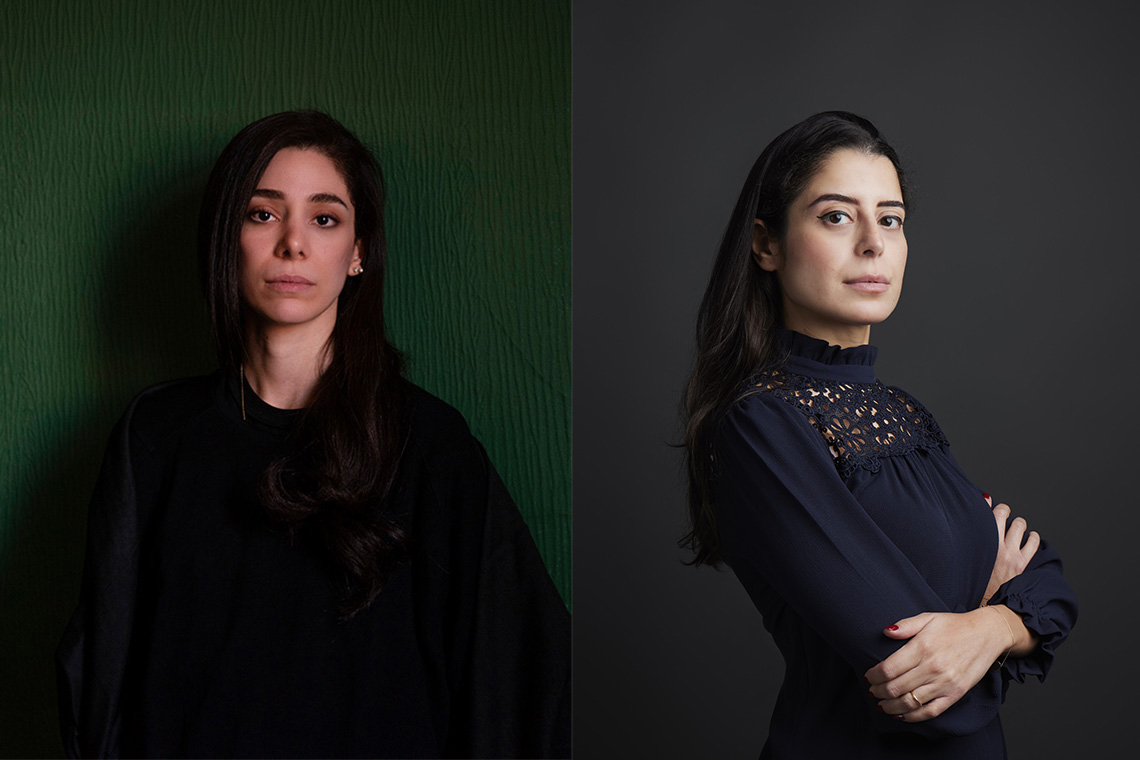
The artist and curator discuss the inaugural Frieze Abu Dhabi Artist Award and the commissioned work, Qubbat Duris.
Canvas: Nabila, what guided your curatorial direction for the award’s first iteration?
Nabila Abdel Nabi: We felt a real sense of responsibility to set the tone for what the award could become. I wanted it to reflect the UAE as a place shaped by movement and exchange, and to commission an artist whose practice approaches the region not as a set of isolated national stories but as a field of connections across time and space. Given the recent events across the region, it also felt urgent to present an artistic perspective that foregrounds our interconnectedness and shared humanity.
I see commissioning as an invaluable model of cultural production, one that accompanies an artist through the whole creative arc, from conceiving a work to finding its material form, and then considering how it is articulated to the world. One of our guiding questions was asking which artist was at a moment in their practice where the support could be materially generative and who also offered an incredibly important perspective for our times that perhaps hasn’t yet been shown extensively in Abu Dhabi.
Dala, what drew you to the thirteenth-century Qubbat Duris for this commission?
Dala Nasser: The Qubbat Duris is a unique Islamic monument arranged out of the ruins of two separate historical sites, with granite columns from Baalbek’s Temple of Jupiter holding up a sarcophagus from an ancient Roman necropolis. It exists as a palimpsest from the second century BCE until today, carrying all the traces in between. Its dome-like structure was meant as a stand-in for a mosque and built so that travellers had a space to pray on their journey from Damascus and beyond to Makkah. History can be read through the labour of cultural production, and within a space where art from all over the world will be on display, the present moment can be traced to the histories endured.
How do you approach curating work that engages with histories of destruction and displacement for audiences with different relationships to those histories?
NAN: We recognise that there is no single audience and no single relationship to these histories. A work like Dala’s Qubbat Duris will be met by people who have lived through the loss it registers, by people who carry it at a generation’s remove, and by people encountering it for the first time. So, rather than presenting destruction as spectacle, or as something that happens elsewhere, I’m interested in work that creates the conditions for shared witnessing, where audiences with different forms of knowledge and proximity can find ways into the work and sit alongside one another in the same space.
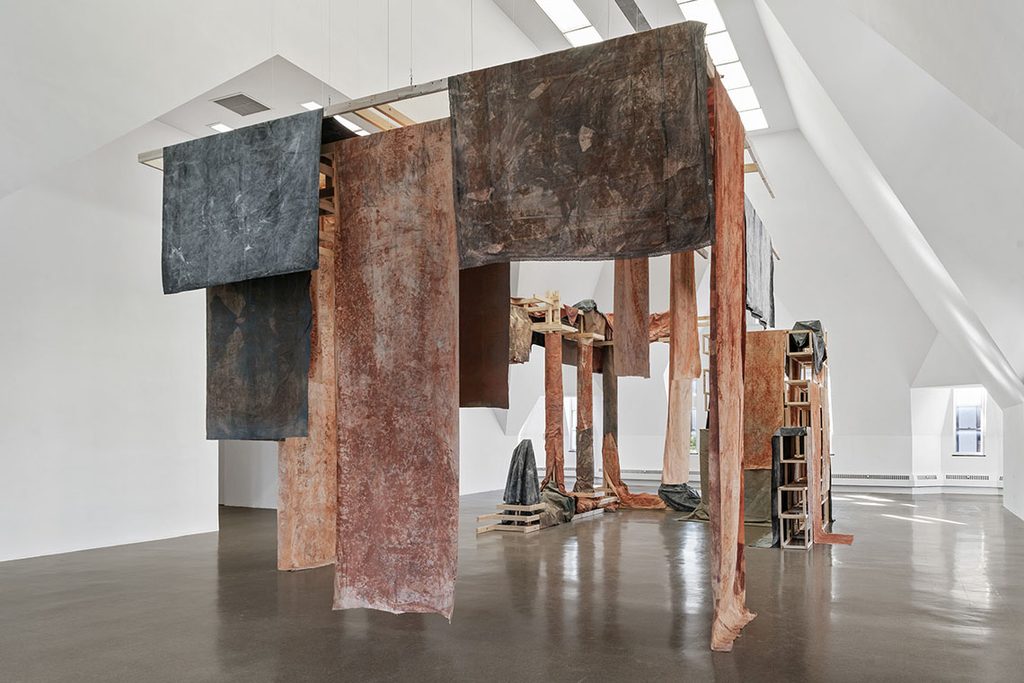
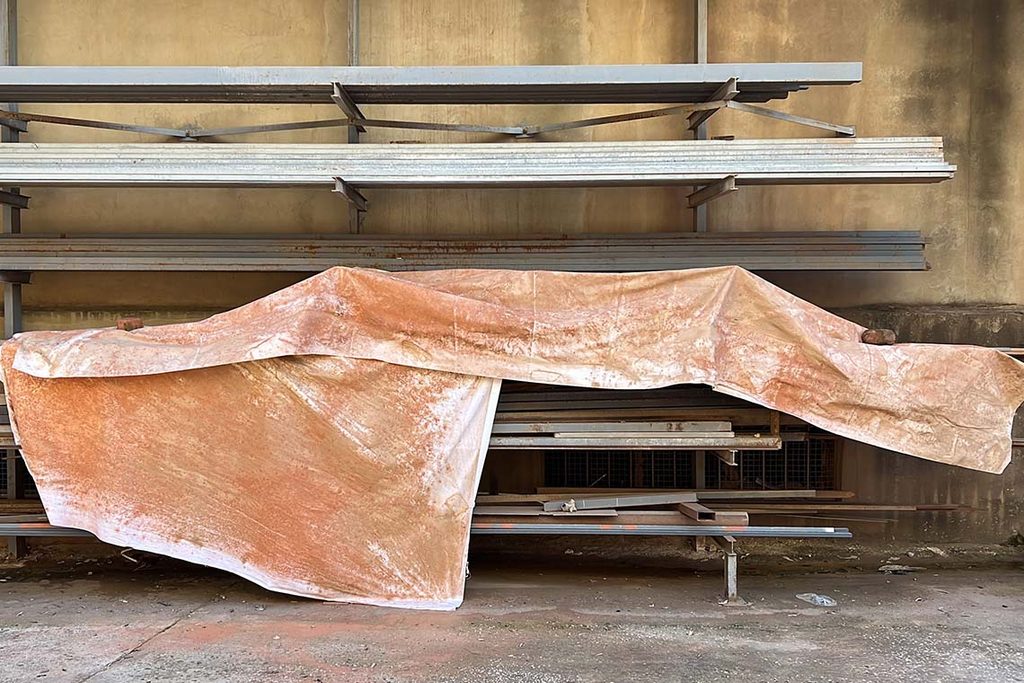
Dala’s practice does this through material rather than image. She doesn’t show us a picture of a ruin, instead bringing us theruin’s surface, pressed into charcoal and worked with ash, raw clay and terracotta, so the encounter is physical and embodied. This is important because it resists the distance that images of destruction can often produce. Qubbat Duris has been damaged on at least two occasions, and archaeological sites and various monuments across the region continue to face destruction through military aggression as well as climate precarity. I think what is powerful is the way Dala’s work holds space for grief and continuity at the same time, because the work is as much about how memory survives as it is about what has been lost.
Dala, as Nabila mentions, your work uses charcoal, ash, clay and terracotta. What role do these materials play in conveying memory?
DN: The materials dictate my approach to the themes in my work. For example, I use cyanotype to depict sunlight – something untraceable – and, by extension, loss. Salt and iron oxide are used to depict the body, as they are of the earth and within us. Terracotta and clay are made from mud rock, charcoal from wood. I use rainwater, sea water, and river water when rinsing dye from my works, ecologies that surround us. Ash is fundamentally the most important material, as it is the output of what remains. Its lightness means it moves in the air like dust. What I use depends on what each work calls for. For Qubbat Duris, I used madder dye, a natural dye made out of roots, to stress the rootedness of history and how places and monuments are linked to the people they are built for.
NAN: In Dala’s rubbings, multiple temporalities also collapse into one another – the deep time embedded in the landscape, the centuries the monument has stood, and the present moment of ongoing loss. Bringing that into the fair atrium for Frieze Abu Dhabi, a city itself shaped by transcultural exchanges and movements, opens up a conversation about our relationships to land, which so often transcend national borders and shape more complex ideas of our shared heritage and shared futures.
Dala, was there a particular moment during your research that changed the direction of Qubbat Duris?
DN: This monument sustained damage during the 2026 invasion of Lebanon, so its importance, historically and in the present day, is one and the same to me. It did not change my direction, only strengthened my resolve in this time of rubble as an artist to continue to build within my practice.
What kind of artistic dialogue do you hope to initiate with this commission?
NAN: I hoped the commission would open a dialogue about how the land remembers and how cultural memory is sustained across generations, and about our relationship to non-human worlds at a ta time when that relationship is in crisis. The atrium of Frieze Abu Dhabi is a space of transit, of people often passing through on their way to somewhere else, and Qubbat Duris transforms it into one of contemplation, exchange and shared witnessing, a place to pause and hopefully also have a dialogue in the more literal sense.
DN: Being able to share the output of my labour is ultimately out of my hands, so I can only hope that my contribution to cultural production forms a part of the wider web of history through which we can look back and read the present moment. Qubbat Duris is meant to act as a humble place of spirituality in the midst of travel and so can be brought to life and activated by the visitors who experience it.
NAN: There is also a transcultural conversation happening across art history. Dala’s approach is informed by movements that have questioned the conventional hierarchies of art-making and emphasised the agency of materials and environments, including Arte Povera in Italy and the New Visions group in Palestine, although they were rooted in different historical conditions. In her work these different artistic lineages come together, reminding us that artistic ideas are developed in parallel and in dialogue across many times and places.
How can an international art fair influence local artistic discourse?
NAN: I think a fair can contribute a great deal when it invests in the production of new work and in the creative conditions around it. Over the past decade I’ve seen the UAE’s art ecosystem grow and diversify enormously, with local artist-led and grassroots initiatives developing alongside the larger institutions, and a growing pedagogical infrastructure, such as the al Mawrid Centre at NYUAbu Dhabi, enabling deeper research into the art histories of the region. An international fair sits within that ecology, and it has a responsibility to it. A commission like this brings an ambitious new work, made in dialogue with the cultural and historical contexts of the region, to an audience of artists, collectors, students and the wider public. It creates a platform where the histories of the regionare not framed as peripheral to an international conversation but as central to it. For me, the contribution lies in establishing here a new platform for ambitious artistic production and in making space for the conversations, research and relationships that continue long after the fair closes.
Frieze Abu Dhabi runs from 19 to 22 November
