

In her solo exhibition at Iris Projects, Eman Al Hashemi turns to the familiar structures of urban life to explore the less visible forces shaping how we perceive and remember our surroundings.
Watching the sun rise and set is, for many, an almost ritualistic experience. There is also a familiar childhood recollection of looking out of a car window and feeling that the sun or moon is following you, keeping pace with the movement of the vehicle. Something of this persistent presence carries through Eman Al Hashemi’s The Horizon We Inherit, where the sun accompanies the viewer throughout the exhibition, appearing across the works in varying scales and forms. Sometimes it is tucked into a composition, at other moments it takes on a more pronounced presence, almost recalling the infant’s face that rises as the sun in the children’s TV show, Teletubbies.
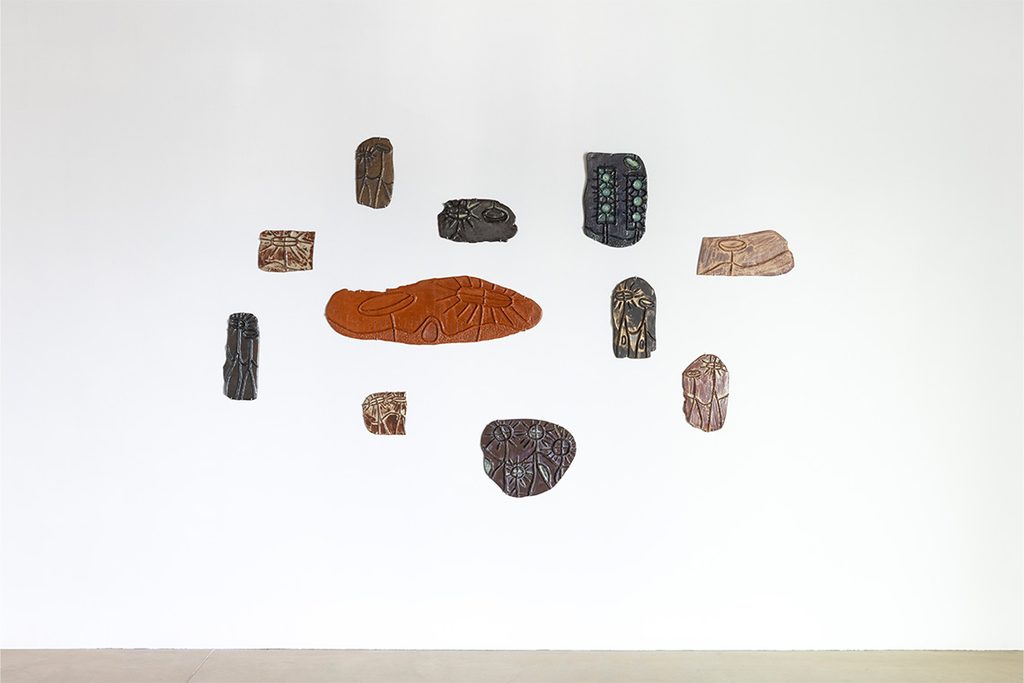
At Iris Projects, the exhibition positions the sun as the focal subject, tracing the relationship between the natural environment and the built landscape. On one wall, a selection of ceramic sculptures reveals familiar features of the city presented in a series of organic-shaped ceramics. The largest of these, When the Day and Night Merge (2026), depicts two figurines representing the sun and moon, alongside streetlights and a roundabout arranged at the base of the composition. Its arrangement brings to mind a passing urban landscape, where streetlights and roundabouts seem to exist alongside the sun and moon in an almost dreamlike continuity. In another work, entitled Can the Sun and Moon Swim Again 4 (2026), a piece glazed in black matt almost recalls the texture of asphalt, introducing a material parallel to the surface of the sculpture and the streets it references.
The recurring motif of the sun stems from an experience that changed Al Hashemi’s relationship with natural light. She recalls spending an entire day working in a windowless studio, only to step outside and realise that the sun had already set. The moment made her question how closely our perception of time is tied to the changing qualities of light. This awareness deepened during hikes in Fujairah, where Al Hashemi came across a sun carving among the Neolithic petroglyphs along the Ain Al Sharyah Geological Trail. Believed to depict the sun’s movement across the sky, the petroglyph offered a connection to how earlier communities observed and made sense of time. It also stayed with Al Hashemi as a visual reference, eventually finding its way into the body of work presented in the exhibition.
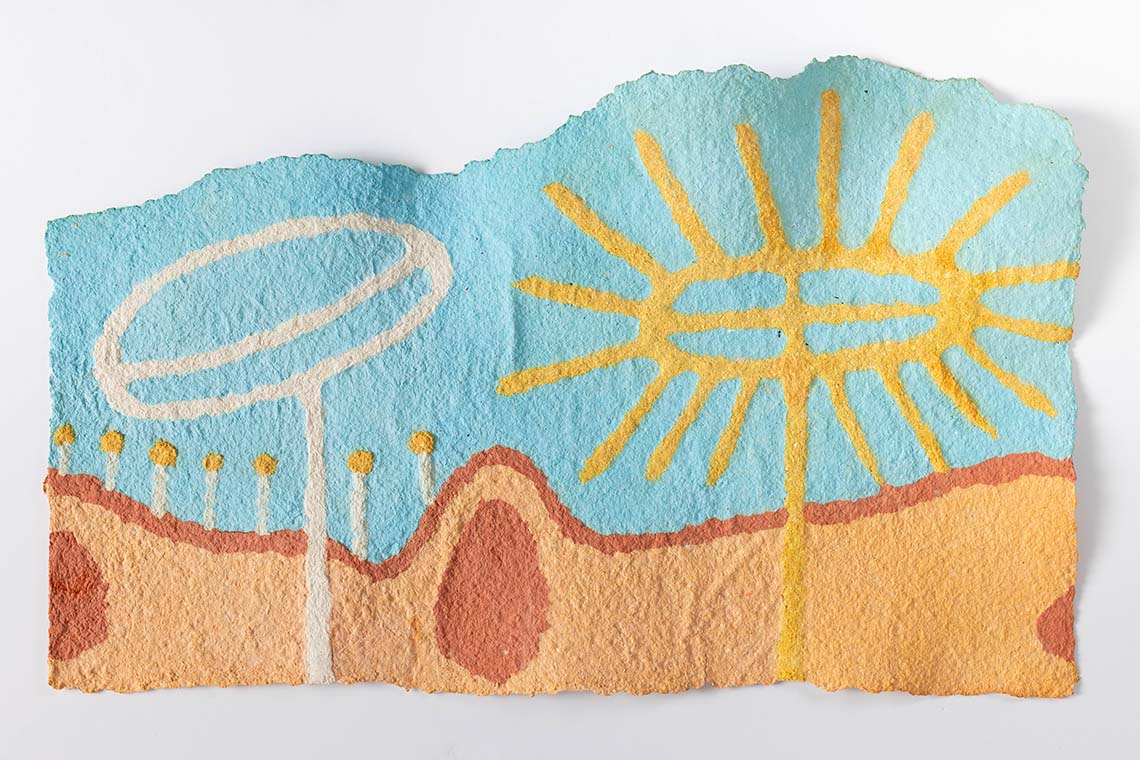
What lends an intimate dimension to Al Hashemi’s practice is her close observation of the environments she inhabits and the encounters that inform her work. The boldly coloured painting Suns and Ladders (2026) takes inspiration from an occasion when the artist watched a technician climb a streetlight to carry out maintenance. What might otherwise have been an ordinary moment of urban upkeep becomes a way to shed light on the relationship between the human body and the infrastructures that shape everyday life. The technician’s ascent introduces a human scale to the city’s often overlooked structures, bringing attention to the people whose labour sustains the patterns of urban life.
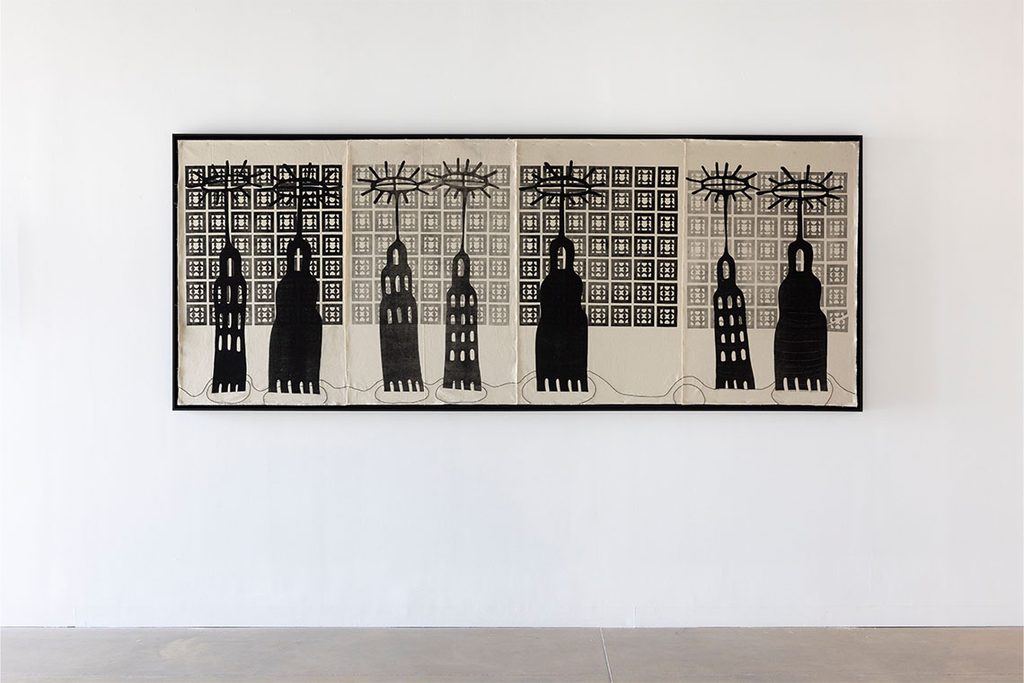
Repetition is another recurring element in Al Hashemi’s work, although the colours shift in Protecting the Suns to the Roundabouts 4 (2026). Departing from an otherwise vibrant palette, the piece is rendered entirely in black and white. In the foreground, an arranged grid initially resembles a tiled surface, but on closer inspection reveals a formation of aeroplanes. Moving upwards, their silhouettes appear to shift from commercial aircraft to military jets, confronting the landscape with the realities of the ongoing regional conflict. The sun motifs are interwoven with architectural structures, while the roundabouts wrap around the buildings below, creating a composition in which the familiar markers of urban life sit alongside a more pervasive sense of unease.
The diversity of materials across the exhibition highlights how Al Hashemi’s sun motifs evolve through different media, each lending a distinct material character. In works on handmade paper, such as The Road to Sunlight (2026), Al Hashemi adopts a more fluid language. The texture almost resembles coral formations, while the suns and moons appear in their traditional colours of yellow and white and the streetlight fixtures almost resemble matchsticks.
Hung on a wall is the glazed ceramic sculpture The Rooster That Never Sleeps – Villa Nine Hears You (2026), which translates another experience from the Al Hashemi’s life. Traditionally associated with daybreak, the rooster’s call marks the arrival of morning, yet its perpetual wakefulness suggests an existence beyond this natural cycle. Much like the streetlights that illuminate the city after sunset, the rooster seems to occupy both sides of the day, unable to distinguish between daylight and darkness. Its presence adds to the exhibition’s interest in the ways in which time is experienced and regulated through both natural and artificial sources of light. If the sun gives shape to the passing of the day, the rooster seems to unsettle the very boundaries by which we measure it.
