

The second edition of the Malta Biennale unfurls through some of the nation’s most treasured historical sites, highlighting the inevitably cyclical nature of conflict and change.
The Malta Biennale is a veritable artistic treasure hunt. Nothing exemplifies this more than Nine Nights of Malta: the journey of a tomato sepal to become a Star (2025), a collection of nine works by Concetta Modica that are scattered across many of the event’s locations, often turning up in unexpected places. In one instance, a blue rock flecked with gold is found displayed next to ancient relics in the National Museum of Archaeology; in another, a work is tucked away in a corner of the Ta’ Kola Windmill on the island of Gozo; and one other is even nestled between large pieces of coral in a glass case at the Grand Master’s Palace.
Modica’s work serves as a driving thread throughout the biennale, explains artistic director Rosa Martínez. As curator of the main exhibition (the biennale also has national and thematic pavilions, which have been individually curated), Martínez views the chosen theme of Clean | Clear | Cut almost as a non-theme; rather, a call to block out the noise, the excess, and bring us back to what is essential, perhaps even elemental, to our sense of being.
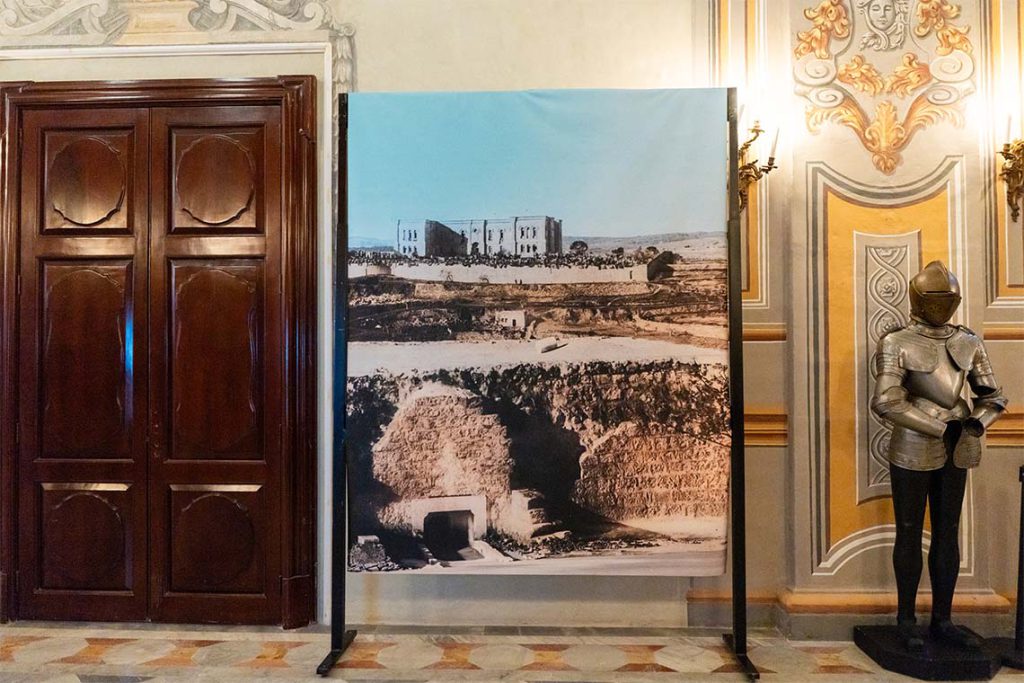
This no-nonsense attitude seeps into every corner of the main exhibition, which is presented across 10 of the 11 individual biennale sites. Mostly, this absence of fuss around staging artworks in typically touristic museums and heritage locales is positive and refreshing. On occasion, however, the artworks fail to compete with their impressive surroundings. In one such instance, a small glass box, red with the real blood of the artist and her daughter, sits ceremoniously atop a table at the foot of a bed in the Grand Master’s Palace. While the work itself serves as a powerful meditation on family bonds, the setting feels distracting and perhaps too on the nose.
On another occasion, this time at the National Museum of Archaeology, the curatorial approach delivers a more lasting impression. In a particularly daring work by Ana Álvarez-Errecalde, the artist photographs herself right after the birth of her daughter, standing at one point with her newborn baby in her arms, umbilical cord still intact; in a second image she sits on the floor, bloody placenta in front of her while holding her daughter in her arms. A video plays nearby, an interview of the artist where the conversation plays out at one point as a sound overlay to a zooming effect onto Álvarez-Errecalde’s placenta. The works, depicting humanity in its most natural and raw state, are almost difficult to stomach.
Such visceral, raw qualities are notable in many of the works presented by female artists at the biennale, although they assume different forms. In the Grand Master’s Palace, Emily Jacir’s Il-Kelb tad-Dar (1994–2026), commissioned for the exhibition, takes on the indigenous Palestinian Canaan dog. It explores the breed’s resilience, as well as its history as a tool of diplomacy and goodwill – a perhaps intentionally ironic statement in a building used for diplomacy of other sorts, reinforced by the presence of a large collection of armour belonging to the Knights of Malta.
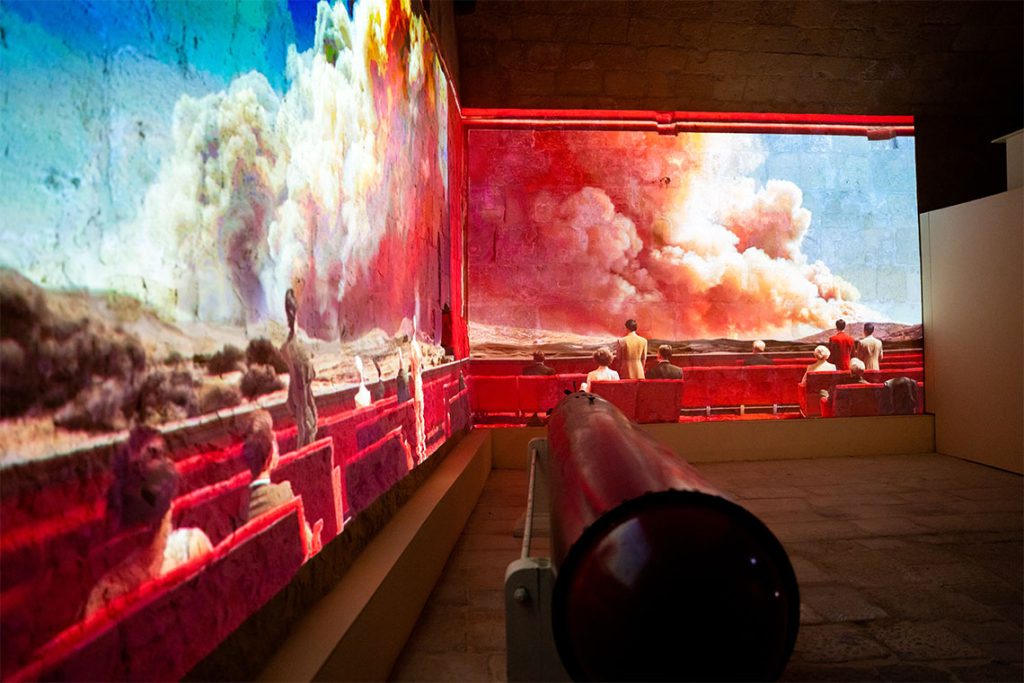
While the biennale sites are cleverly in conversation with the main exhibition, a product no doubt of Martínez’s admitted passion for Malta’s multilayered history, they quickly become mere backdrops when the pavilions are concerned. In Fort St Elmo and the National War Museum, 13 of the event’s 24 pavilions take over the venue. Although each presents a distinct curatorial vision, the biennale tips into a formulaic approach, perhaps due to the sheer number of near-identical small rooms in which the pavilions are housed. One notable standout here is the French Pavilion. Louis-Paul Caron’s trompe-l’oeil video, projected across two walls behind an oversized artillery shell, shows AI-generated scenes of spectators looking at plumes of smoke on a screen from what appears to be the inside of a theatre. Music plays as visitors stand, mimicking the audience in the work, in an unsettling blurring of the lines between reality and Caron’s fictionalised scene.
The stresses of the current geopolitical situation continue to shape the backdrop to the biennale. Several artists have been unable to showcase their work, mostly due to the restrictions in movement imposed since the start of the US and Israel’s war on Iran, the occupation of southern Lebanon and the escalation of violence in Palestine. Where Egyptian artist Basim Magdy’s work should have been, in the courtyard of the Grand Master’s Palace, lie three large wooden plinths, with a simple sheet of paper reading “This work has not reached us due to the ongoing war in the Middle East”. It was Martínez’s decision to purposefully keep these spaces blank, to not obfuscate the reality of the war raging at the other end of the Mediterranean and beyond.
The empty spaces created by these absences hold their own solemn presence. Palestinian artist Noor Abed’s video work, A Night We Held Between (2024), plays in a dark room in the upstairs museum of the Inquisitor’s Palace, a few levels above an unusually well-preserved prison complex dating back to the sixteenth century. As rhythmic rituals and acts of communal resistance move through ancient sites on Palestinian land, a whiteboard with the same sheet of paper, this time for Mahmoud Massad’s work, sits empty. It feels like an unintentional space of mourning, as though the conversation between the two works has been abruptly interrupted.
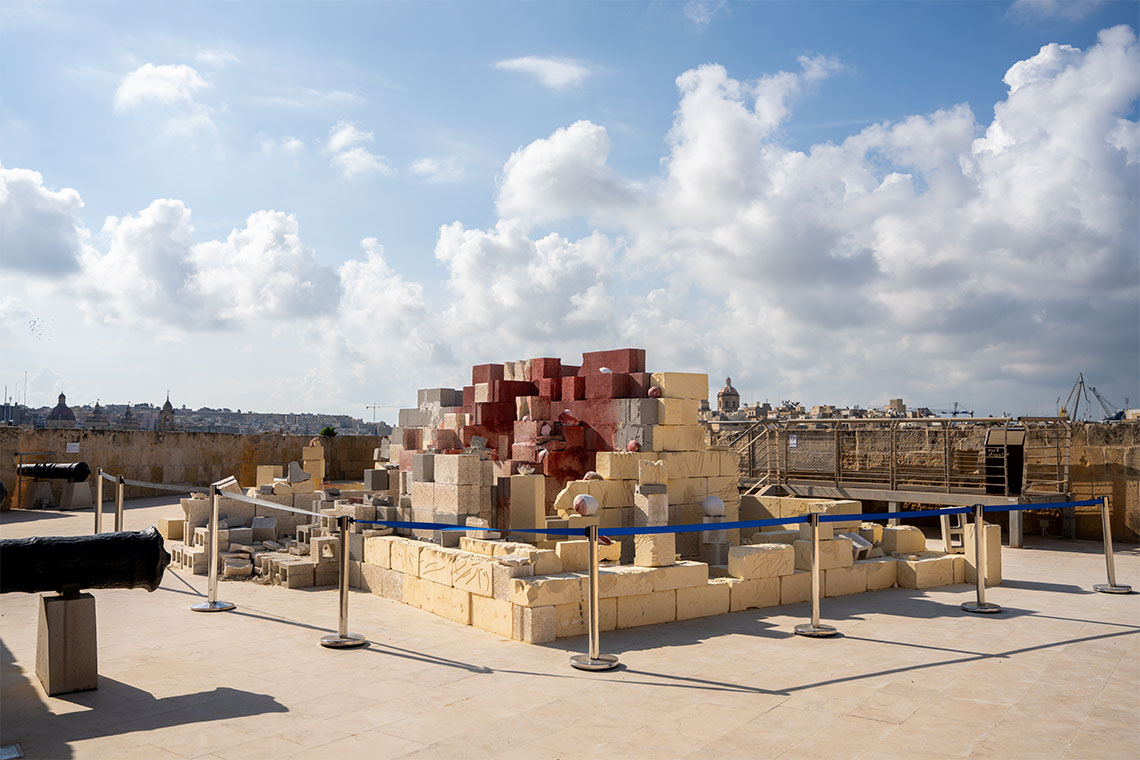
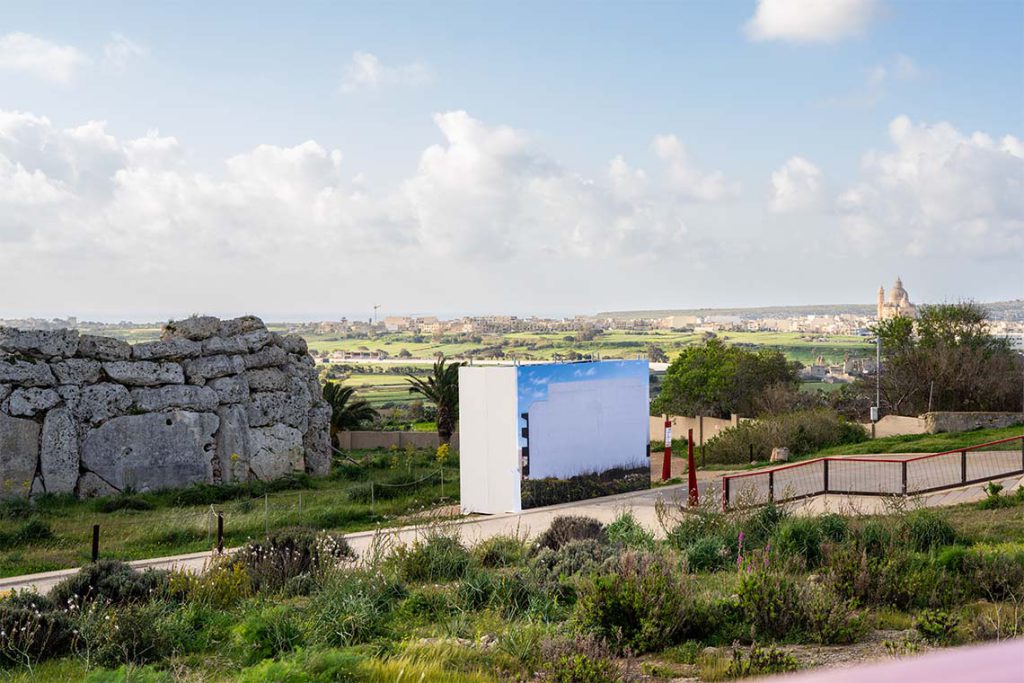
In Fort St Angelo in Birgu, one of the fortified towns of Malta in historically strategic maritime locations known as the Three Cities, Swedish artist Anastasia Ax has stacked a series of bricks on the roof of the fort. Some are crumbled and bleeding red, as if a massacre has occurred – a comment on the destructive effects of modernisation and urbanisation on historical sites. It is as if the stones themselves are weeping as they are being knocked down. The often-nuanced conflict between heritage and modernity is explored further by the biennale on the island of Gozo, home to the Ġgantija Temples, one of the world’s oldest Neolithic sites. The proposed construction nearby of a series of apartment buildings, which would enjoy the privilege of a view over the photogenic ruins, is proving controversial, with Martínez visibly agitated about the potential impact and seeing the biennale as an opportunity to protest. In front of the temple’s back wall, deliberately obscuring it from view, Maltese photographer Therese Debono has erected a large-scale photograph depicting modern buildings and aptly named BLANK (2026).
Martínez’s thoughtful curation of the main exhibition helps ensure that the Malta Biennale provides an antidote to the over-commodification of contemporary art and culture. Malta has a strong and layered identity, pieced together over many years of conquest and occupation, and while forgoing impressive new art facilities such as MICAS in favour of older sites might seem an odd choice for a contemporary art biennale, Martínez makes a convincing argument for history serving as a vital anchor for effective modern-day expression.
