

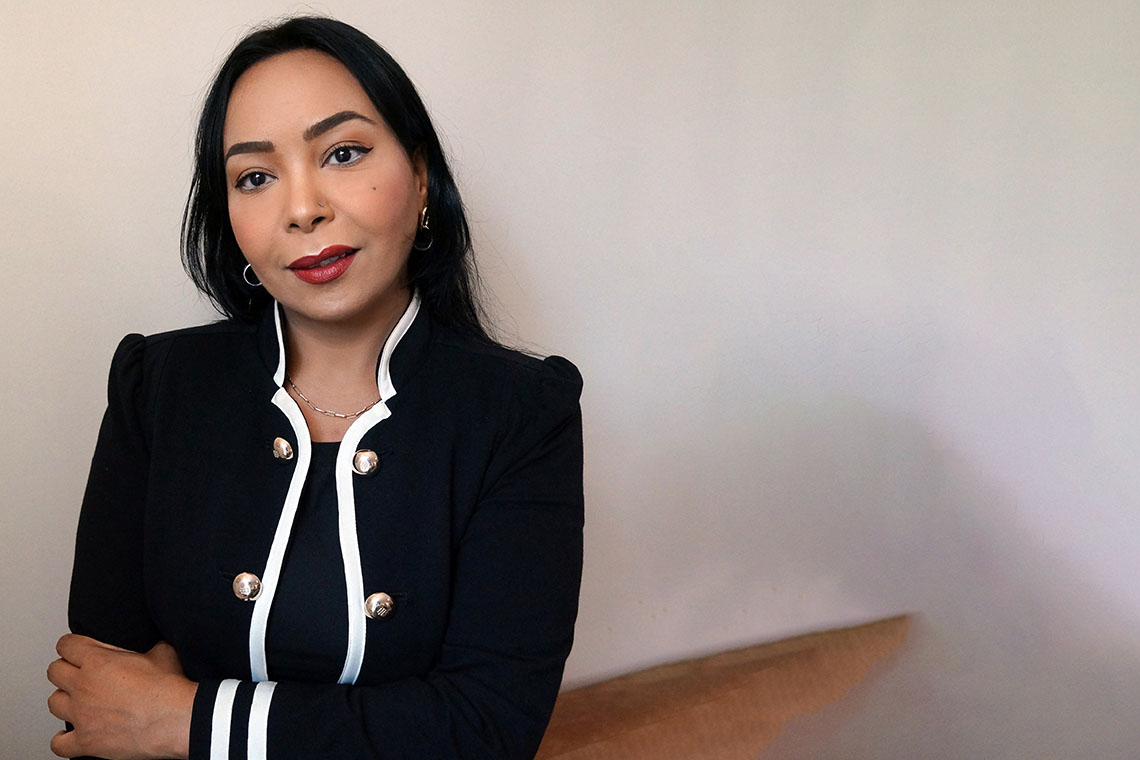
The artist’s methodical approach to creative practice, and often her own body, are the tools of her deliberate investigation of subconscious states and systems of mass organisation.
“For me, the body is not just physical, it’s emotional, spiritual and symbolic,” says Ebtisam Abdulaziz. “Everything we feel inside finds its way to the surface, whether through movement, stillness, breath or silence.” The myriad marks of age, labour and social class on the human body were powerfully conjured in Number and Lifetime, Abdulaziz’s 2005 installation at the 7th Sharjah Biennial. Two large photographs were the centrepiece of an extensive archive of more than 2000 images of hands, collected meticulously from individuals across Sharjah. Each image included the person’s name, age, nationality and profession. “I wanted to show how our bodies quietly carry our life stories,” explains the artist. As Alfred Stieglitz arguably did with Georgia O’Keeffe – Hands (1919), Abdulaziz evades the clichéd use of hand photos to symbolise universal concepts. Through the images’ attendant information, we are compelled to consider how – as expressive sites of identity and creation – the hands of a landscaper, a housewife, the child of wealthy people, truly appear or can appear, forcing us to question ourselves about how we look at the bodies of others.
The US-based Sharjah native uses photography, installation and mixed-media works, and is well known for finding creative inspiration in the logic and structure of mathematics. Re‑Mapping the Arab World (2010–13), for example, rearranges a map of the Arab world into geometric abstractions as a way to understand the artificial borders imposed by colonial legacies and the unequal distribution of visibility, access and resources across Arab nations. But it is Abdulaziz’s performances that offer the boldest challenges to our expectations.
For her, the body can carry messages in ways that words alone cannot. “Even just standing still, breathing, or repeating a simple action can say a lot,” she affirms. For Unashamed, the 2015 piece that is among the artist’s most provocative, her body literally carried the titular word, as she wrote it repeatedly on herself under UV light in a darkened room while wearing a black bodysuit. The work makes clear the state of a female Arab artist who deploys her body in her art, by using language as a way to reclaim her story, she says, and her body “to speak, to push back and to connect with people”. The release of anger and anxiety from her body, she recalls in one interview, was profound. “It is hard to explain my own sense of independence,” she noted, “when people are constantly questioning me.”
Identity politics and cultural confrontation drive many of Abdulaziz’s performances. Islamophobia 2017 looks at how the Muslim body is presented, how it is considered, and how that consideration is manipulated in the media. At a time when the word ‘terrorist’ has preceded or followed the word ‘Muslim’ often enough in the media to colour perception, she defends herself in the performance by writing ‘Muslim’ on a pane of glass whenever ‘terrorist’ is heard in the audio clips she has sourced from news and political commentary. As the audio track grows in intensity, Abdulaziz – herself visibly Muslim – writes faster, both to maintain that defence and in a desperate plea for people to think more critically “about the bodies they see and the stories they assume”, she says.
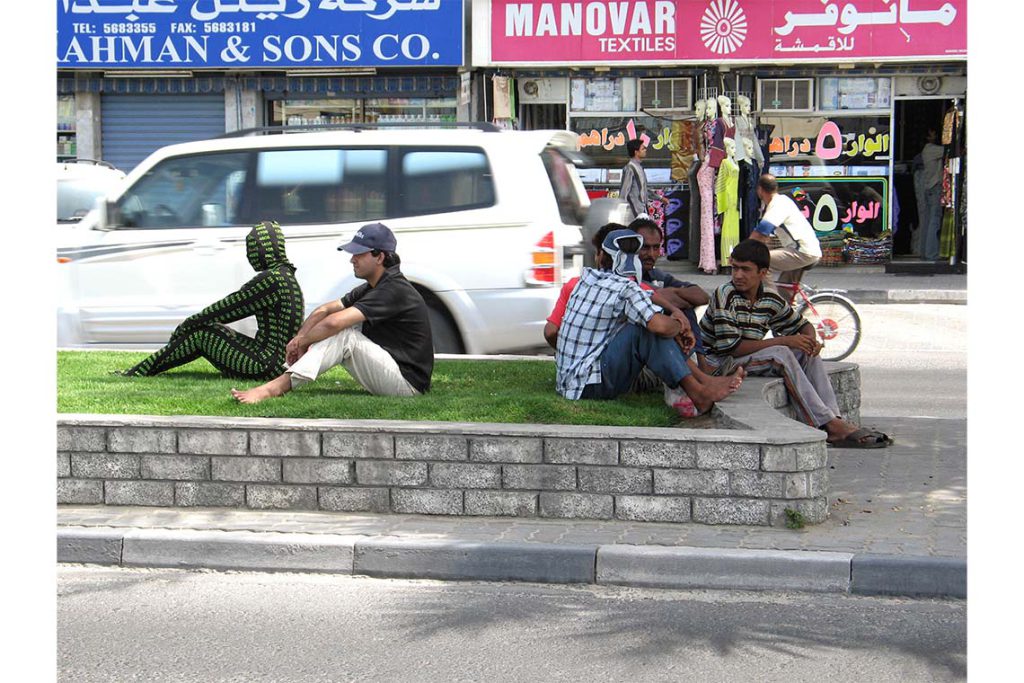
Abdulaziz harnessed both her background in mathematics and the potency of performance in Autobiography 2007, where the artist turns herself into a walking ledger of numbers, wearing a tight black bodysuit covered in brightly coloured numerals representing two years of her financial transactions. Essentially coding her life and monetary exchanges as a visible archive on her skin while she walks (in the video of the performance) past a construction site or through the aisles of a supermarket, or drinks juice in a café, the work vivifies the reduction by consumerist societies of human identities to transactional data. The gesture feels prescient, as the emergent power of social media platforms like Facebook and smartphones to commodify identity through engagement metrics and ad targeting would not be widely or fully understood until years later.
The adorned body is crucial to Abdulaziz’s performance practice, which often involves carrying messages on her body itself. The act of adornment also connects to her cultural background, where clothing carries deep meaning, and she often explores how the body, especially the female, Arab or Muslim body, is seen through certain lenses. “By choosing how I present myself, I challenge those expectations and create space for more complex, honest identities,” she explains. For See Something Say Something (2018), she took self-portraits wearing items of clothing that have, at different times and in different places, been labelled as ‘suspicious’. We see the artist in a hijab, a niqab, a hoodie and a turban, images of adornment that can, and have, triggered fear and misunderstanding and been used for political control. The use of the images in See Something Say Something is art shifting power, with Abdulaziz’s body becoming a site of cultural, emotional and archival significance in which, she says, “I’m asking: who decides what looks threatening?”
After relocating to the United States in 2015 in search of greater space for artistic expression and a wider conversation for her practice, Abdulaziz deepened her enquiry into breath, restraint and spiritual resilience. This has led to more spare durational performances, such as Tied in Tension 2025, which saw her slowly inflate latex gloves with her own breath, binding them together with zip ties and arranging them into a fragile, swelling constellation. The individual breaths can be read as expressions of care, physical effort or simply life, while the zip ties connote control, coercion and power imbalance, inevitably evoking their use as makeshift restraints to bind hands and feet, particularly in law enforcement and military contexts. Quiet, controlled and contained (literally, in a small box in which Abdulaziz sits), the ritual heightens a sense of shared vulnerability, with audiences describing the room as being thick with tension and with some moved to tears.
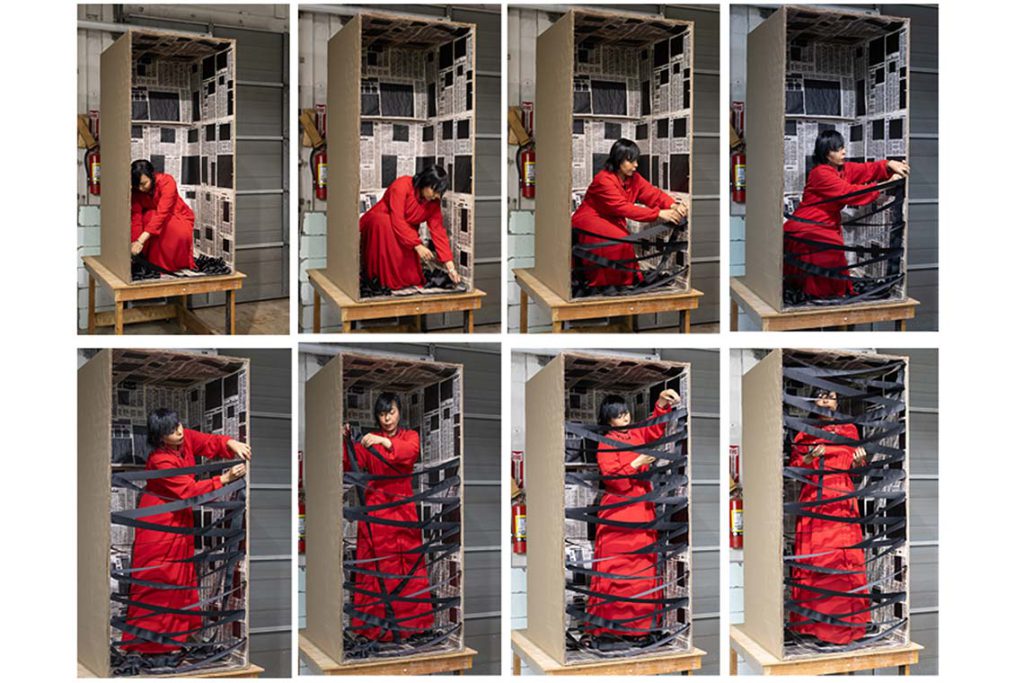
Silent Voices 2024 pushes this concept further in a wordless live performance that stages the struggle between personal freedom and control imposed from outside. Against a backdrop of prop newspaper clippings, the work confronts the pressures of media, education and politics to conform. As the artist methodically weaves a black ribbon back and forth across the opening of her enclosure, she slowly closes herself in with narratives, ostensibly about her, that were not her choice. Abdulaziz’s powerful presence, repetition and disciplined movement recognise the universal desire to be seen as we are, as well as – in a performance that leaves the artist imprisoned by the end – the perhaps frustrating reciprocal need for the acknowledgement of others to validate any expression of who we are.
In works that are often as much personal reflections as they are broader social critiques, Abdulaziz has consistently pushed the boundaries of conceptual art both within and outside the Arab world. “I try to use the body not to perform for others, but to reveal something honest and human,” she muses. Through performance, she says, she uses her body to speak on behalf of, and reflect, the lives of others, to challenge how bodies are judged, limited or silenced – to show “…how one body can hold the weight of many voices”.
