

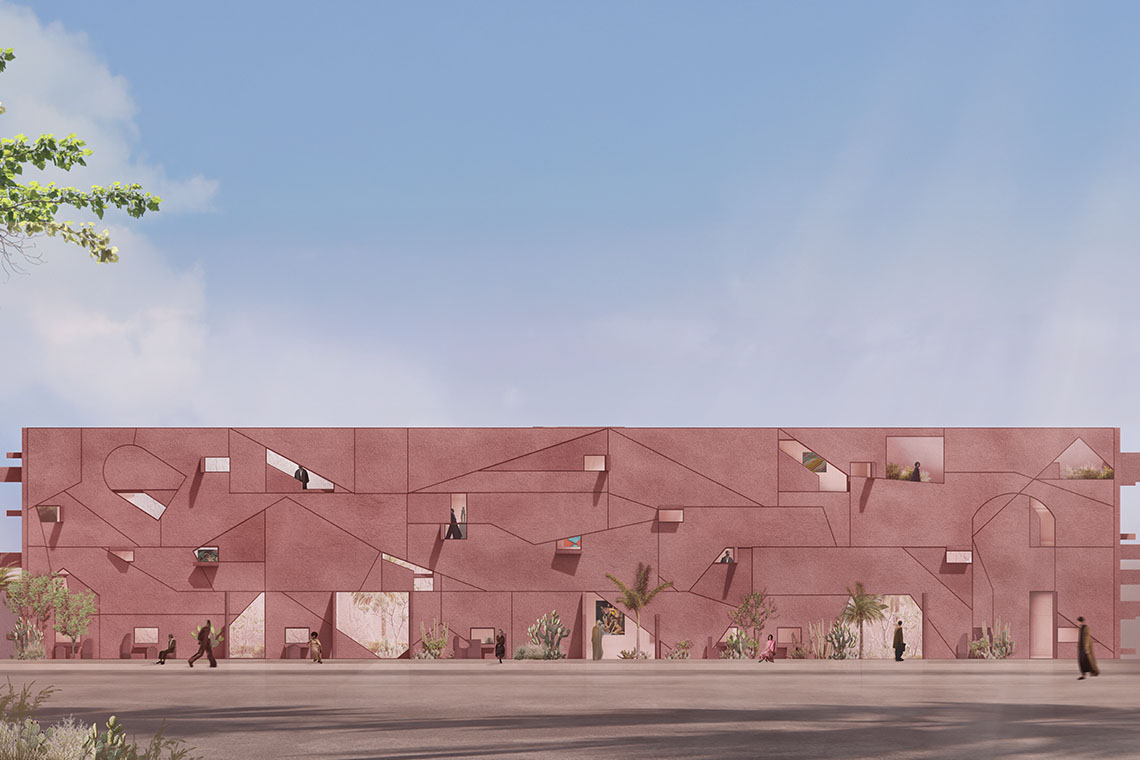
The Elie Khouri Art Foundation (EKAF) has announced the opening of a permanent space in Dubai, designed by architect Sumayya Vally of Counterspace, to be unveiled in late 2028.
EKAF is an initiative from French-Lebanese collector and philanthropist Elie Khouri, and will be led by Caroline Louca following her appointment as director last year.
Khouri commented: “Art belongs in everyday life, not apart from it. My foundation will be a home for contemporary art, open to everyone. A place to inspire, challenge and spark dialogue. Above all, I want to give something lasting back to Dubai and the wider UAE, a country that has given me so much, by helping build a cultural legacy for generations to come.”
The foundation will be housed in a converted villa in Jumeirah 1. Conceived as a space for discovery, art and exchange, EKAF will stage exhibitions and extensive programmes designed to promote public engagement and dialogue.
Vally, whose practice has focused widely on the meeting point between the creation of institutions, architecture and art, will anchor the foundation’s design in the traditional construction of Gulf houses, seamlessly blending the indoors and the outdoors, while also paying homage to elements of Beirut’s urban landscape. The building’s domestic past will coexist with its new function and the surrounding area, creating a space where architecture and the programming of exhibitions contribute equally to the experience of those encountering contemporary art.
Vally shared that: “I think of buildings as having many lives. At EKAF, we begin with a house that has already held a world within it. Its doors, cornices, balustrades, and particular ways of receiving people and separating rooms contain the traces of another life. I am interested in what happens when we take these intimate geometries and give them a new public scale – when the architecture of a room becomes the architecture of a city-facing façade and the memory of a house becomes the beginnings of an institution. I hope that artists, designers, researchers and makers from the region will bring other imaginations into the work, and that the institution will continue to acquire forms and meanings we cannot yet anticipate.”
