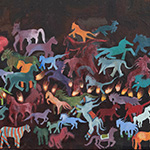

Diaphanous brings together artists whose practices operate at the threshold between psychological interiority and the external, social world. The paintings, sculptures, and textiles in the exhibition are considered as permeable surfaces through which memory, lived experience, and social structures circulate and overlap. Across these works, domestic interiors, bodies, streets, and communal spaces function not as stable settings but as mutable sites shaped by personal history and collective conditions. Reality is rendered as layered and contingent: memory interrupts the present, private experience reframes public space, and social expectations register within intimate environments.
Figures appear suspended, fragmented, or partially absorbed into their surroundings, while spaces remain recognisable yet subtly transformed. In the paintings of Lulua Alyahya, sparse and psychologically charged compositions stage encounters between irony, stillness, and estrangement, while Noorain Inam’s uncanny environments collapse memory, fear, and longing into destabilised dreamlike spaces. Shivangi Kalra’s works foreground emotional and perceptual slippage, presenting bodies and interiors in states of transition, and Leily Moghtader Mojdehi’s symbolic, psychologically dense scenes allow inner states to permeate and reshape visible reality.
Disjunction, temporal slippage, and surreal moments emerge not as formal strategies, but as visual consequences of navigating inherited histories, gendered roles, and shifting social contexts. Fiza Khatri’s practice traces the entanglement of intimacy and social structure through fragmented visual languages attentive to vulnerability and resistance, while Jagdeep Raina explores historical memory and migration through textile, drawing, and moving image, foregrounding the material residue of familial and political histories. Lalitha Lajmi’s spectral figures and psychologically charged domestic scenes dissolve distinctions between dream and lived experience, and Gurminder Sikand’s paintings merge feminist, ecological, and diasporic perspectives through recurring motifs of women and trees that connect personal memory with collective histories.
These works resist fixed narratives, instead articulating subjectivity as something continually negotiated. Within this framework, the works become mediums through which ongoing transformation is registered. The diaphanous quality of these works lies in their translucence: the way inner life and external reality remain visible to one another, separated by a boundary that is thin, unstable, and deliberately unresolved.
Press release from Indigo+Madder
Image: Noorain Inam. Fantasies of persuasion. 2026. Oil and acrylic on canvas. 60 x 150 cm. Image courtesy of the artist