
Walid Raad’s exhibition at Moderna galerija emerges at a moment of increasing violence—not only in the most visible form, the genocidal war that we follow in real time, but also in the growing violence against our histories and subjectivities. The exhibition will take place in Ljubljana, in a space that may seem far removed from the Lebanese context from which Raad originates, as well as from the broader Arab world, with its perpetual wars, social and religious conflicts. However, like the Middle East, Slovenia, and the entire Balkan region, can be described as a place of interrupted histories—unresolved geopolitical, nationalistic, and ideological conflicts that constantly recur.
In Ljubljana, Walid Raad will present works from his three ongoing projects: The Atlas Group (1989–2004), based on his creation of documents related to the protracted wars in Lebanon; Scratching on Things I Could Disavow, which explores alternative infrastructures for the arts in the Arab world; and Sweet Talk: Beirut (Commissions), a long-term documentation of Beirut. All three projects address how ongoing violence affects our collective and individual bodies, minds, and cities. Over the past 30 years, Raad has continued to populate these projects with documents, stories, and characters. His exhibitions often appear as group shows, with Raad himself shifting between roles—sometimes curator, sometimes docent, sometimes one of the exhibiting artists. His installations resemble cabinets of curiosities: collections of loosely related artefacts, many of which are credited to his imaginary collaborators.
In Ljubljana, as part of his art project Scratching on Things I Could Disavow, Raad introduces his Museum of Mortal Guilt. In this work, he expands his temporal, geopolitical, and cultural framework by incorporating aspects of the Slovenian and (post-)Yugoslav worlds. Drawing on the situated museum model developed at Moderna galerija and its alternative principles of historicization, Raad envisions museal parameters, institutional protocols, and art historical narratives that differ from those emerging within the new art infrastructures of the Arab world (Abu Dhabi, Saudi Arabia, Qatar, Lebanon, and Egypt).
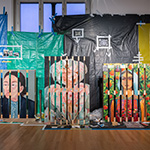
Moreover, the Museum of Mortal Guilt crystallizes his Slovenian encounters, but now refracted through concepts articulated by the writer, artist, and thinker Jalal Toufic in (Vampires). In this book, Toufic proposes that death is not a future event but a condition in which we already exist while physically alive. He also asserts that we constantly receive signals from versions of ourselves dwelling in the realm of the undead. Raad engages with the notion of “guilt before the dead” by documenting and exhibiting the words (curses, swears, gibberish), forms (sweat stains on buildings, vertically doubled and headless figures, seeing with eyes wide shut), and stories (about the painted pallets used by Lebanese militias to ship weapons to Yugoslavia in the early 1990s) that he claims reached him from this realm.
Many aspects of Walid Raad’s art can be connected to Western art historical traditions—such as conceptual art, institutional critique, and archival practices. However, these frameworks overlook a key distinction between Raad’s work and that of other artists working in these traditions. Rather than focusing primarily on the financial, institutional, or ideological forces that shape and conceal histories, Raad’s approach is more attuned to what Jalal Toufic calls “the withdrawal of tradition past a surpassing disaster.” Toufic’s concept serves as an analogue for Raad’s own artistic exploration of color, line, shape, form, story, and gesture. Raad continually asks: How do catastrophes and disasters affect not just people and places, but also formal elements such as colors, lines, forms, and volumes? And how are these affected immaterially, in the sense that they may be extant but not available for creative acts?
Press release from Moderna galerija Ljubljana (MG+)
Image: Walid Raad. Museum of Mortal Guilt: The Paletts. 2025. Photography by Urša Rahne, Moderna galerija Ljubljana