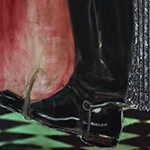

I Saw Myself Playing on The National Team is the first solo exhibition by London-based artist Ruba Nadar. Bringing together new mixed-media paintings and collages, the exhibition introduces a practice grounded in bricolage, where fragments of image and material are assembled into layered, cinematic compositions.
Nadar approaches the archive as a landscape—one populated by personal and collective memories, projections and fantasies, and moments of longing or desire. Her works draw from a wide range of visual sources: intimate moments of everyday life, images cut from vintage sports magazines, digital screenshots, stills from Egyptian cinema, photographs from family albums, and bundles of inherited fabrics. Rather than selecting these materials for the narratives they contain, Nadar is guided by their formal resonances—alignments of colour, gesture, rhythm and texture that allow disparate elements to find balance or tension within a single pictorial field.
Born in London in 1998 to Lebanese and Egyptian parents, Nadar encountered much of her cultural inheritance in mediated forms: family photographs, stories recalled by her parents, and classics of Egyptian cinema. These layered inheritances surface throughout the work’s visual vocabulary. Figures and fabrics appear like filmic cuts—glimpsed across time—producing spaces that hover between daydream and recollection, intimacy and distance.
Sport imagery and apparel is a key motif in the recent work. Growing up shy yet physically taller than her peers, Nadar recalls discovering confidence through athletics—what she describes as the moment of “finding her shoulders.” In her early teens she imagined rowing for the Egyptian national team, a daydream that gives the exhibition its title. The painting I Saw Myself Playing on The National Team references this imagined future: hand-drawn pastel stripes in red, white, black, gold and green evoke the immediacy of a flag, while the phrasing of the title suggests a desire for belonging that remains unresolved.
In the studio, Nadar treats image-making as a process of gathering and reconfiguration. “My work and studio function as spaces of collection and reassembly,” she explains, “where figures and roles shaped by images are reconsidered through gesture, memory, and cinematic reinterpretation.” Through acts of tearing, stitching, stapling and overpainting, she constructs dense, multi-layered surfaces. Within these compositions, fragments pause mid-gesture, glances remain suspended, and narrative threads appear only partially revealed.
The resulting works resist fixed meaning. Instead, they reflect an understanding of identity as something constructed in time through language—shaped by private experience, public imagery and inherited narratives. In this sense, Nadar’s practice echoes the words of the Cuban-born American artist Felix Gonzalez-Torres, who wrote: “We are not what we think we are, but rather a compilation of texts. A compilation of histories—past, present and future—always shifting, adding, subtracting, gaining.”
Across the exhibition, Nadar’s paintings and collages stage precisely this shifting: a movement between memory and projection, image and gesture, fiction and lived experience. The works invite viewers into a space where personal mythologies and collective histories are continually edited and reimagined.
Press release from Andrew Price for Pipeline’s Visiting Curator Program
Image: Ruba Nadar. Rough and Dry. 202. Oil, oil tick, digital collage printed on towel, vintage sequin trim on canvas over MDF. 145 x 85 cm. Image courtesy of the artist