
From February 28 to April 19, Manif d’art 12—The Québec City Biennial takes place at 41 venues across Québec City, Lévis, and beyond, bringing together more than 60 artists from 18 countries.
The Biennial holds a distinction rare in North America: it positions winter not as a backdrop but as a material and institutional condition of production—shaping visits, installations, circulation, and the very timing of the event.
This positioning is rooted in a long history. Since 2000, more than 50 cultural organizations have contributed to establishing Manif d’art as a structuring event. The 12th edition extends this dual scale: a strong local anchoring—through territorial networks, mediation, and accessibility—and national and international reach, supported by artist mobility, the circulation of discourses, and the presence of curators and programmers.
A Curatorial Proposal Grounded in Materiality and Politics
This edition’s coherence is based on the theme Briser la glace / Splitting Ice, developed by Didier Morelli. The theme draws, first, on materiality: freeze–thaw cycles, extreme temperatures, condensation, the resistance of materials, slowed circulation. Yet it refuses to neutralize the winter climate. “Splitting ice” becomes a critical gesture, creating tension between climate crisis and extraction, sovereignties and borders, languages and regimes of visibility.
In the framing texts, winter is described as an “active collaborator,” and the river appears as a historical infrastructure tied to trade, colonization, and mobility.
Several works embody this approach without illustrating it.
At the entrance to Espace Quatre Cents, Jessie Kleeman’s monumental mass of ice—An Iceberg / ILULIAQ—is animated by irregular breaths. The installation functions as a threshold: both a physical presence and a reminder of how the Arctic has become a geopolitical stake.
Outdoors, Tania Candiani offers a situated listening to the river. Inspired by military technologies, her device captures the vibrations of water and ice, inviting a bodily experience in which the river reasserts itself as an agent.
Other works shift the very notion of winter. Minha Park explores artificial snow and its uses in the cultural industry, revealing a standardized imaginary. At Le Lieu, centre en art actuel, Maria Ezcurra has created a pathway using emergency blankets, oscillating among protection, play, and confinement.
The linguistic thread is also reconfigured. Joi T. Arcand inscribes a Cree word in the public space, moving beyond the dominant French–English framework. At La Chambre Blanche, Elias Nafaa presents ice-like glass missiles, directly linking cold materiality with geopolitical violence.
These works seek not to resolve tensions but to keep them active. Water and its states become a shared medium, without reducing the issues to a single interpretation.
This orientation is also reflected in the production of the works: 35% of them were commissioned for this edition. Furthermore, 21% of the artists come from Indigenous communities, situating the question of territory within specific epistemologies and living continuities.
A Tangible Public Impact from the Start
This conceptual density did not remain theoretical—it resonated with the public.
By the midway point, the Biennial had demonstrated its ability to mobilize widely, with sustained attendance and strong turnout at key moments such as the opening.
This momentum was accompanied by significant engagement from younger audiences. Mediation activities reached many children and school groups, confirming the Biennial’s structural role in access to art and transmission of knowledge.
On the digital front, audience growth—driven by a high proportion of new visitors—signals an expansion of audiences and a capacity to reach beyond the usual circles.
A Platform for Professional Exchange and Circulation
The Biennial also asserts its role as an ecosystem.
From March 16 to March 20, Manif d’art hosted 24 international professionals who hold strategic positions, fostering exchanges around the circulation of works and artists. As Claude Bélanger, Executive and Artistic Director of Manif d’art, noted, “These encounters are essential: it is through these networks that works and artists circulate from one location to another.”
Beyond these meetings, the Biennial operates as an active platform for circulation, in which works are embedded in expanded dissemination networks that extend their reach well beyond the event itself.
Producing in Winter: Constraints and Responsibilities
These outcomes do not erase constraints; they make them more visible.
Producing a large-scale winter biennial means contending with materials’ resistance to cold, transport limitations, condensation, and structural adaptation. Added to this are increasingly pressing environmental and economic challenges.
The launch of a Philanthropic Passport highlights this delicate balance between rising expectations—accessibility, inclusion, mediation, outreach—and increasing costs related to production, transportation, and insurance.
Extending the Biennial: A Catalogue to Discover
As this edition draws to a close, the Biennial experience continues through an official catalogue that extends the program into print.
Published by CÉAC in the Manif d’art series (#12), this bilingual (French/English) 530-page volume features essays by Didier Morelli, Léuli Eshraghi, Joana Joachim, and Tanya Lukin Linklater and documents the works exhibited, the artists, and the Young Curators component.
Conceived as both a reference tool and an opportunity for discovery, the catalogue offers a lasting entry point for those wishing to deepen their knowledge of the works, transmit them, or reactivate them in other contexts.
Available in bookstores starting June 2, 2026, the catalogue invites readers to extend the experience—and to inscribe this edition of Manif d’art within the long-term continuum of research, creation, and dissemination.
Soon here : https://manifdart.org/produit/bientot-disponible-manif-dart-12-briser-la-glace-splitting-ice/
About the curator
Didier Morelli is a curator, art historian, cultural critic, and interdisciplinary artist. A visiting professor in curatorial studies at Concordia University, he also received a postdoctoral fellowship from the Fonds de recherche du Québec – Société et culture (FRQSC), which he completed at Concordia University and the Canadian Centre for Architecture (CCA).
His research focuses on second-wave feminist performances and how they subverted urban functionalism in Montreal and Toronto during the 1970s. He also served as a research and curatorial assistant for the retrospective of photographer Evergon at the Musée national des beaux-arts du Québec (MNBAQ) in 2022.
His writings have been published in Art Journal, Canadian Theatre Review, C Magazine, CBC Arts, Esse, Spirale, and The Drama Review (TDR), among others.
Press release from Manif d’art 12—The Québec City Biennial
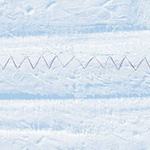
Image: Maureen Gruben. Stitching my landscape. 2017. Video projection. 6 minutes 10 seconds. Image courtesy of the artist and Manif d’art 2026