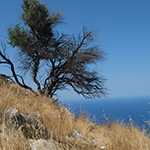

Lily Abichahine quotes a fisherman in one of her notes on Mare Nostrum: “the Mediterranean Sea travels.” This idea has become a structuring principle of the project. Water circulates without borders or passports, connecting places where she has lived and worked as an artist-in-residence: Marseille, İzmir, Palermo and, invariably, her native Beirut. As it moves, it carries traces, histories and ongoing transformations with it.
The sea thus appears as a fundamentally unstable space, eluding the political divisions that attempt to fix and delineate it. If water is the same substance circulating throughout this basin, moving freely and eventually returning to its point of departure, according to what criteria can we distinguish one body of water from another?
As Abichahine explains: “From a legal point of view, land has always had a hierarchy over water.” Yet she questions this very hierarchy. At a time when contemporary art has increasingly turned towards questions of water, she asks: “What if our prism of vision and priority shifts to the legalities of water? What if the space of this Mediterranean water prevails as one, united and whole, rather than in accordance with the land and its divisions?”
This is how Abichahine dives into a world defined by waves of mythology and shores of political dimensions. Interested in the way mythology once functioned as a legal and moral order, as a form of rule before the existence of formal legal systems, she explores geographies of power through history, poetry and the body.
In Choreography for a Woman and a Stone, she connects the vestiges of Palermo to the scars of the Beirut port through her own reworking of the myth of Sisyphus. Tied to a stone positioned at the centre of an 8-by-8-metre stage, she runs in circles for approximately 45 minutes. As she runs, her body leaves visible traces on the ground, transforming repetition and endurance into a physical inscription of memory.
A similar gesture unfolds in Secrets of the Infinite Sea and Exercises in Suffering, where the myth of Prometheus travels between İzmir and Marseille. Carrying fresh animal livers through streets and across historical landmarks, Abichahine places the vulnerable body in direct relation to the histories inscribed in these places. Drawing on divination and haruspicy, she positions herself as a contemporary haruspex, attempting to read the future in animal livers, as if they could reveal the fate of the Mediterranean itself. Perhaps the Mediterranean is the ultimate oracle.
Confronting her own fear of the sea alongside the violence and histories of migration across the Mediterranean, Abichahine transforms walking into an act of endurance and remembrance. Through these performative marches, she retraces, symbolically, the passages of migrants who have marked these territories, inscribing their presence into the urban landscape.
In İzmir, the routes extend through Kültürpark, the site of the former Armenian quarter devastated by the Great Fire of Smyrna, the Purple Castle, the port of İzmir, Foça, Bergama and Ephesus; in Marseille, they extend through the Old Port, Pointe Rouge, Notre-Dame de la Garde and the Parc national des Calanques.
The body must contend with the weight, smell, texture and blood of the organs it carries through the city. The work thus adopts an intensely performative mode: the body is not merely a vehicle for the action, but the site through which discomfort, duration, endurance and the material presence of flesh are negotiated in public space.
This trajectory will extend to Tantalus, between Athens and Alexandria in 2027, and Atlas, between Tangier and Gibraltar in 2028, continuing the project’s movement across the Mediterranean through further mythological figures and geopolitical territories.
Abichahine uses myths not simply as metaphors for contemporary struggles, but as living structures through which histories, territories and systems of power can be revisited. Connecting cities and myths with the contemporary reality of the Mediterranean Sea, Mare Nostrum poetically traces the flux and reflux of a fluid reality in which ecologies, histories and politics continually meet, overlap and transform one another.
Text by Yasmine Helou, Curator
Image: Lily Abichahine. Choreography for a Woman and a Stone. 2021. Image courtesy of the artist