
Fondazione Prada will present Over, under and in between, a site-specific project conceived by artist Mona Hatoum for its Milan premises, from 29 January to 9 November 2026. Actively reacting to the exhibition context, Hatoum develops a three-part project, in which each segment gravitates around thought-provoking themes that reflect on the turmoil of our times and the precariousness of our existence.
The three installations comprising this solo presentation explore three archetypal elements of Hatoum’s artistic vocabulary: the web, the map, and the grid. Their presence reactivates the space of the Cisterna building, which housed the silos and tanks of the former alcohol distillery, once located on the Fondazione Prada’s compound, by taking advantage of the height, volume, and shape of its three rooms. The three independent works embody ideas of instability, danger, and fragility to varying degrees of intensity and sensibility, creating a dialogue with space, and particularly the viewer’s physical experience.
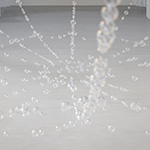
In the entrance room of the Cisterna, a large-scale constellation of delicate, transparent, hand-blown glass spheres threaded through wires forms a spider’s web suspended overhead. In the last few decades, Hatoum has used the web motif in various materials and scales to explore themes such as entrapment, idleness, neglect, familiar ties, and connectedness. In this case, she captures the profound ambiguity of the web and the coexistence of repulsion and fascination it evokes.
As underlined by the artist, “A web can be seen as a looming net which suggests oppressive entrapment, while also providing a home or a place of safety. To me, the large web overhead also has poetic, even cosmic significance. The beautiful, delicate glass spheres are an apt reference to dew drops, evoking their fragility and sparkling quality. They also resemble a celestial constellation. I personally like to see it as an allusion to the interconnectedness of all things.” The spider’s web also refers to the act of weaving, which, according to Sigmund Freud, is a feminine art that creates beauty from the body itself. For this reason, it can be seen as having a further double meaning —as both a suffocating network of fear and a matrix of creation. In her text commissioned for the publication accompanying this exhibition, American psychoanalyst Jamieson Webster describes the web as “Both a map of relation and a diagram of fear.”
The concrete floor in the central room of the Cisterna is covered with large areas of translucent red glass balls arranged in the shape of a world map. Political and geographical borders have been intentionally ignored here, with only the continents delineated. More than thirty thousand glass balls, which are not fixed to the floor and can be identified as separate entities, form an unstable configuration that the artist describes as “a loose and undefined territory,” which is potentially susceptible to destabilising external forces.
As Austrian architect and theorist Theo Deutinger states in his text written for the exhibition publication, “A globe is not a map. A globe misses flattening and with it the ability to fold it up or roll it and to put it in the pocket. And the globe does not allow us to see planet Earth all at once. A map is Earth’s skin, peeled off and flattened.” However, the visualisation of the world as a map is not entirely neutral, as it has historically incorporated political power dynamics and reflected systems of domination. This is why Hatoum made the subtle yet conceptually rigorous decision to use the Gall-Peters projection rather than the more traditional Mercator projection (1596) when creating this map. First presented by James Gall in 1855 and reintroduced by Arno Peters in 1973, this map rectified the distortions of relative sizes of certain territories present in the Mercator projection, which rendered regions of the Global South—such as Africa, South America, and Southeast Asia—disproportionately smaller than their actual size.
A towering, kinetic installation entitled all of a quiver responds to the monumental height of the third room of the Cisterna. Consisting of nine levels of open, stacked cubes, the gridded metallic structure mimics scaffolding or the skeleton of a building with its rigid geometry. Resting on the floor and animated by a motorised mechanism, the installation slowly oscillates between downward collapse and re-erection. Sounds of creaking and clanking accompany each row of cubes as the structure sways and zigzags down as if slumping—almost like a body—towards destruction. Once it reaches a certain level, it suddenly begins to sway back upright and then “quiver” right before reaching stillness and resuming its height of 8.6 meters.
all of a quiver demonstrates Hatoum’s fascination with Minimalist aesthetics and her ability to transform modular and basic structures, such as cubes and grids, into living forms. These forms are rooted in bodily experience and evoke a plurality of emotional memories and feelings, including unease, claustrophobia, and a sense of no escape. With its cyclical movement, this work symbolises a state of precariousness, a never-ending suspension between opposing human conditions, such as construction and destruction, levitation and collapse, resistance and fragility. As Lebanese architect Lina Ghotmeh writes in her text, all of a quiver “teaches us that to stand is not to conquer instability, but to inhabit it. By demonstrating an openness to change rather than a need to master it, the trembles of all of a quiver are a lesson in humility. The work embodies what I consider the essence of architectural thinking: it shapes space, it choreographs perception, and it invites the body into a dialogue with form and time.”
The exhibition is accompanied by an illustrated publication in the Quaderni series of Fondazione Prada. It features three texts by renowned scholars and theorists, Theo Deutinger, Lina Ghotmeh, and Jamieson Webster, that explore Mona Hatoum’s exhibited works from a variety of perspectives, ranging from psychology to geography and architecture.
Press release from Fondazione Prada
Image: Mona Hatoum. Web. 2025. Clear glass spheres and metal wire. Dimensions variable. Installation view at Elleboogkerk, Amersfoort, The Netherlands, 2025. Photography by Robin Meyer © Mona Hatoum. Image courtesy of the artist and Kunsthal KAdE