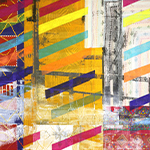

Skin of Dreams marks Shezad Dawood’s first mid-career retrospective. This timely solo exhibition, curated by Jessica Cerasi, is presented at Cultural Foundation Abu Dhabi, from 26 March to 13 September 2026, bringing together over 40 works focussing on the last 15 years of Dawood’s artistic output.
Spanning painting, sculpture, monumental film installations and interactive virtual reality works, Skin of Dreams explores the breadth, diversity and evolution of Dawood’s art-making process. The exhibition presents the first in-depth survey of his painting practice and debuts the final two episodes of his epic ten-part film series Leviathan Cycle, which began in 2017.
Anchored in research, Dawood’s works draw on diverse references from history, literature, architecture, music, science and technology, allowing the artist to make fantastical connections and leaps. The exhibition highlights two major avenues of research that have shaped his practice:
Modernist Architecture and Ecology, both of which Dawood approaches through the intersection of Cnon-Western traditions with established canons, to explore alternative histories and futures.
Conceived in dialogue with Cultural Foundation’s unique architecture, the exhibition responds to the building’s blend of Bauhaus clarity and Islamic geometric patterns, attending to light, proportion and integrated ornaments. Works are installed to open cross-views between spaces, playing with the rhythm of the galleries and distinctive elements such as large glass fronts, brass doors with mashrabiya motifs and mosaic tiles, set in deliberate contrast to the building’s raw concrete columns. Paintings, installations, video projections and sound establish a continuous exchange between Dawood’s vision and the architecture that hosts it. A modern-heritage landmark shaped by the founding vision of the late Sheikh Zayed bin Sultan Al Nahyan, Cultural Foundation remains a cornerstone of Abu Dhabi’s cultural life and continues to realise the country’s cultural ambitions.
Many of the works on view are grounded in South Asian histories and traditions, most notably the use of ralli textiles from Pakistan as the surface for many of his paintings. These found quilts were hand-stitched by artisans in the 1970s, and carry traces of their household use, speaking to ideas of lineage, memory and care. Their reinterpretation as paintings is one example among many of Dawood collaborating with thinkers and makers of the past and adapting their outlook to contemporary concerns. Among these, questions of cultural translation and rearticulating our place in the natural world, feature prominently. The exhibition’s title, Skin of Dreams, is a phrase used to describe the cinema screen, and is drawn from the title of one of the key works in the exhibition, conjuring the porous boundary between imagination and reality.
The premiere of episodes 9 & 10 concludes Dawood’s groundbreaking ten-part film series Leviathan Cycle, which debuted at the 57th Venice Biennale in 2017 with the first three episodes. The series is set several decades into the future, with each episode a snapshot into how climate change and scientific developments may have. affected life on Earth. Despite its dystopian and fantastical appearance, the series was developed in collaboration with oceanographers, marine biologistsand neurologists, and is premised on scientific research.
Set in South Korea, Episode 9 explores the ethical ramifications of using genetic engineering and artificial intelligence to preserve biodiversity and keep delicate ecosystems in balance. It posits that marine science can have medical implications for humans, resulting in augmented post-human life-forms. Filmed in Dawood’s family’s home city of Karachi, Episode 10 takes place in what remains of South Asia after the world has ended more than once. A dreamlike and psychedelic sequence of events blends folk tales of legendary creatures with the metaphor of mangrove networks for the interconnectedness of all things, to imagine how humans might merge with the sea.
Moving from film to virtual reality, in Encroachments (2019) Dawood creates a VR environment which invites participants on a surreal journey through several real places in the artist’s memory. Drawing on personal recollections of childhood visits to cultural spaces in Pakistan, the work explores the country’s entangled relationship with the US since its partition in 1947. The experience archives and preserves a series of cultural spaces that have come under threat and may no longer exist, from Lahore’s renowned Urdulanguage bookshop Ferozsons, to a speculative reconstruction of the 1959 Richard Neutra-designed US Embassy (later Consulate) in Karachi.
Curated by Jessica Cerasi, independent curator and Head of Programme at the Bagri Foundation, Skin of Dreams offers an in-depth look at Shezad Dawood’s dynamic painting practice within the context of his filmmaking. Presenting 28 works from across his 30-year career, the exhibition features paintings the artist calls “openers” — pieces that marked key artistic breakthroughs. Dawood works on stitched ralli textiles, layering screen printing and hand painting to create vibrant, textured compositions. Since 2016, he has incorporated rough-weave canvas reminiscent of sack cloth used in trade between Global South countries, and often overlays his works with appliqué textiles, expanding his dialogue between material, history and form.
Works on view include Dawood’s early experimentations with painting such as Flow My Tears the Policeman Said (2010), one of his first works to incorporate ralli textiles, and Island I (2011), an early example of the artist’s incorporation of photographic imagery. Through Pierced Flesh and Skin of Dreams (2014) comprised of five suspended panels is a painterly installation that can be viewed from all sides, encouraging the viewer to walk around and in between. Semi-figurative screen-printed and hand-painted motifs juxtapose found imagery drawn from anthropology, film and archaeology, with Dawood’s own childhood family photographs in a creative process the artist describes as “filmic composition in space”, alluding to the process of film editing.
Many of Dawood’s works reference architectural histories, from the work of Czech-American architect Antonin Raymond (1888-1976) to Bangladeshi architect and urban planner Muzharul Islam (1923–2012). The exhibition features two works from Dawood’s Integrations series which takes its title from ‘Les Intégrations’, an artistic project founded in the 1960s by Moroccan architects Abdeslam Faraoui and Patrice de Mazières, that sought to bring art into everyday life. Inspired by this utopian ideal of art and architecture shaping daily life, in each work in the series Dawood pays tribute to a particular Modernist building in the Global South that now sits in disrepair, an archival act of homage.
The exhibition will be accompanied by a monograph published by Skira, in partnership with Cultural Foundation Abu Dhabi. The publication is the first survey dedicated to Dawood’s practice since 2014 and will include essays and interviews by the exhibition’s curator Jessica Cerasi, as well as curators Nicolas Bourriaud and Zoe Whitley amongst others.
Press release from Cultural Foundation
Image: Shezad Dawood. Anselm Chapel, Tokyo. 2016. Acrylic on vintage textile. 157 x 238 cm. Image courtesy of the artist and Jhaveri Contemporary