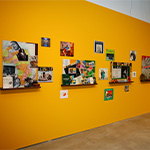

Tabakalera inaugurates Standing Here Wondering Which Way to Go by Franco-Algerian artist Zineb Sedira (Paris, 1963). The exhibition, curated by Rita Fabiana and Ane Agirre Loinaz, proposes a reflection on the utopias of the sixties in Algeria, on the African continent and in the diaspora, as well as on the international liberation movements that positioned culture as a tool for social transformation.
Sedira’s artistic practice addresses migration, memory and cultural transmission. Through collective and personal — sometimes autobiographical — accounts, she questions the dominant narratives of official history and proposes new interpretations of identity and resistance.
Art, memory, and resistance
Algiers, the capital of the new state, emerged as a revolutionary meeting point for many of the global anti-colonial, anti-imperialist and independence movements that arose in Africa. This exhibition project takes as its starting point the first Pan-African Cultural Festival of Algiers (PANAF), held in 1969, which brought together political leaders, artists and intellectuals from Africa and the diaspora. The festival turned Algiers into an international cultural and political epicentre in the sixties and seventies.
The exhibition examines the role of art and culture as instruments of solidarity, emancipation and the construction of a collective identity. In that context, Algiers consolidated itself as a key centre of militant cinema after the creation, in 1965, of the first film archive on the African continent, which promoted international co-productions and new forms of political cinema. The film Festival panafricain d’Alger (1969), directed by William Klein and produced by the Algerian State, is a central piece of the exhibition. The work acts as a historical archive and as a conceptual trigger for the exhibition.
The title of the exhibition, Standing Here Wondering Which Way to Go, comes from a song performed by African American gospel singer Marion Williams during the festival. The phrase refers to a moment of
An exhibition with four scenes
The exhibition is structured as an installation that makes use of video, photography, objects, documents and music. The journey through the exhibition is organised into four scenes that connect past and present:
● Way of Life: a life-size diorama that recreates the living room of Sedira’s London home in 1960s style. The space acts as an intimate archive and links political history with personal memory.
● For a Brief Moment the World Was on Fire: a series of photomontages and objects that combines magazines, newspaper clippings, photographs, political statements and archival materials gathered by the artist. The work ties together personal and collective memories and evokes the creative energy of Algiers in the years immediately following independence.
● We Have Come Back: a selection of protest and militant songs from the artist’s personal record collection.
● Mise-en-scène (“staging”): an audiovisual piece constructed with negatives from revolutionary films projected at the Cinematheque of Algiers during the sixties and seventies.
The project also includes works and materials by photographer and filmmaker William Klein, British visual artist and writer Jason Oddy and French-Algerian filmmaker and researcher Nabil Djedouani, as well as photographs by several unknown Algerian authors and a selection of images by photographer and anti-colonial activist Boubaker Adjali, taken in Angola and Mozambique in 1970.
The exhibition is co-produced alongside the Gulbenkian Centre for Modern Art (CAM) of Lisbon, where it was presented last year, as well as having the support of the Institut Français.
Case studies: Equatorial Guinea and the Canary Islands
The Tabakalera exhibition includes two case studies linked to the anti-colonial struggles of Spain’s colonial past:
The first brings together graphic and bibliographic materials on the independence process of Equatorial Guinea, a Spanish colony between 1778 and 1968. Highlights include photographs of the 1962 referendum, the country’s presence in PANAF and the figure of the Minister of Culture and painter Leandro Mbomio Nsue, known as the “Black Picasso”. The section is complemented with the poetic work of Raquel Ilonbé, the first Equatorial Guinean woman to publish in Spanish, whose writing asserts memory and female self-recognition.
The second case study deals with the Movement for the Self-Determination and Independence of the Canary Archipelago (MPAIAC), founded in Algiers in 1964 by Canarian politician and activist Antonio Cubillo with the support of the Organisation of African Unity and the Algerian government. Among the materials on display is the vinyl record Nuevo Cauce by the group Taburiente, key Canarian protest music of the seventies.
Programme of activities
The aforementioned film, Festival panafricain d’Alger (1969), by William Klein, will be screened at the Tabakalera cinema on 21 February, a session that will be attended by Zineb Sedira. In addition, Tabakalera will offer a screening of The Battle of Algiers (1966) by Gillo Pontecorvo.
Furthermore, Tabakalera will organise a programme of activities that expands upon the content of the exhibition: visits in dialogue, art workshops for families and introductory sessions on contemporary art.
Press release from Tabakalera
Image: Zineb Sedira. Installation view of Standing Here Wondering Which Way to Go at Tabakalera, 2026. Image courtesy of Tabakalera