
Textiles have long accompanied people through movement and history, folded, carried, and passed from one generation to another. Their intimacy with the body extends from clothing and protection to comfort, touch, and memory, while the marks of handling, labor, and time become records in themselves. Through stitches and lines, fabric trace terrain, mark boundaries, and mend ruptures. Bringing together works by Marianne Fahmy, Omar Abd El Baqi, Aisha Azab, Gözde İlkin, Rawan Abbas, and Layla Tag, the exhibition explores fabric as a material through which bodies, landscapes, and histories intersect.
Marianne Fahmy uses hand-weaving on monk’s cloth, a material associated with leisurely craft, to configure images of a probable future while consulting the past. Her hand-stitched tapestries draw from vintage Alexandrian coastal postcards motifs and colour palettes from ancient Greek frescoes, and architectural plans of Alexandria’s water cisterns. Anchored in the city’s Hellenistic past, the works unfold against a desert backdrop, imagining a displaced Alexandria shaped by memory, migration, and adaptation, where fragments of the city’s histories persist beyond their original landscape.
Omar Abd Elbaqi’s Panoptic considers how informal urban spaces, unofficial and unplanned by the government, are formed through networks of adaptation and can produce their own forms of authority. Suspended prints on organza silk, held together using the sirma stitch, map the routes surrounding Cairo’s Sayeda Zeinab neighborhood. Fluid, vegetal forms grow into and leach off one another, reflecting how communities not only reshape their surroundings but also form new social structures; for example, coffee shops extending into the street become sites of surveillance through gathering and visibility. The translucent fabric suggests these structures are present yet partially concealed.
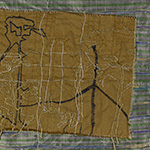
Aisha Azab translates traces of human intervention in the environments she inhabits. During a residency in Cumnock, Scotland, she struggled to connect with the unfamiliar landscape. Particular details became points of attachment: a group of trees standing apart from the surrounding hills. A tour guide’s remark that “the mountain can’t repair itself” offered a separate point of departure: a juxtaposition she wanted to explore. Through etching, repetition, and stitching, she turns these observations into a personal system of marks and a way of mapping place.
Gözde İlkin works with repurposed domestic fabrics—bedsheets, pillowcases, and tablecloths—collected over time or given to her by family and friends. Her attachment to these materials is rooted in the constant movement and uprooting she experienced growing up, where domestic objects became a way of recreating a sense of home wherever her family settled. Through painting, stitching, dyeing, and patchwork, İlkin transforms their stains and textures into forms drawn from topographies, human bodies, and animals, creating a repository for memory and belonging.
Layla Tag’s relationship to textile is intuitive yet gradual: slowly gathering and repurposing old fabric scraps, doilies, and embroidery-magazine sheets passed down her grandmother. Embroidered red thread runs throughout all her pieces, disrupting established patterns and delicate water color paintings. The presence of her stitches indicates where her needle has punctured a surface, as well as her efforts to mend and repair them. Produced as a means to work through trauma, Tag’s work brings together intimate histories of domestic labour, the body, and grief.
Rawan Abbas explores textile as a temperamental material, investigating its ability to conform to the body. Working with fabric manipulation techniques such as smocking, which gathers and compresses fabric into a three-dimensional elastic surface, Abbas transforms textiles and scraps sourced from dressmakers and seamstresses. Her soft sculptures often begin as two-dimensional pieces of fabric before shifting into abstract, volumetric forms, moving from something designed to clothe the body towards something that evokes it. The scraps carry traces of cutting, fitting, and making, becoming participants in an ongoing process through which fabric is continually altered by touch, technique, use, and the bodies it encounters.
Press release from Gypsum
Image: Aisha Azab. An ode to a foreign tree. 2026. Stitching and wire on fabric. 35 x 63 cm. Image courtesy of the artist and Gypsum