
Urdu Worlds is the UAE’s first contemporary art exhibition dedicated to the Urdu language. Curated by Hammad Nasar, the exhibition is a visual conversation around language between Ali Kazim and Zarina, and the debut institutional presentation of Kazim’s works in West Asia. The show explores how language provides the tools with which we create and shape our internal ‘worlds’. Words, rather than simply describing our surroundings, give rise to our private lived experiences and shared cultural understandings.
Despite their distinct personal histories and artistic practices, the two artists are united by a profound sensitivity to the Urdu language. Born in Aligarh, India, Zarina’s itinerant life across continents led her to find home in Urdu, weaving its script, proverbs and poetry into her delicate print works. Multimedia artist Ali Kazim, based in Lahore, Pakistan, grounds his ‘Urdu world’ in a sense of place while exhibiting an eclecticism of influences that reflects the composite and layered history of the language.
Urdu Worlds highlights the power of art as a bridge to access the imaginative worlds of artists though we may not share a written language. Inviting viewers to adopt the unfamiliar vocabularies of these worlds, it raises questions about the appropriation of language by institutions to construct narratives of belonging and exclusion. The exhibition draws attention to the ability of words to articulate identity, and the consequent urgency of maintaining a connection to our native languages in an era of migration and exile.
Zarina’s presentation in Urdu Worlds is focused on two bodies of works – ‘Urdu Proverbs’ and ‘Home is a Foreign Place’ – which exemplify her project of Urdu world-making. ‘Urdu Proverbs’ consists of ten woodcut prints based on a set of common expressions in Urdu that are included as an integral part of the work, and is presented in facsimile in the exhibition. As a linguistic device, the proverb epitomises how language can manifest worlds, composed of cultural cues and references that do not always translate into English; yet ‘Urdu Proverbs’ translates the untranslatable through visual interpretation. A seminal work of the Ishara Art Foundation and the Prabhakar Collection, ‘Home is a Foreign Place’ consists of 36 woodcuts visually depicting words in Urdu that the artist associated with home, including ‘sky’, ‘rain’, ‘fragrance’ – and ‘language’.
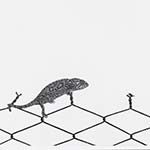
Within the exhibition, Zarina’s print series act as a central island within an expansive sea of Ali Kazim’s paintings, drawings, sculptures, prints and videos made over the last two decades. His inner world is manifested in his depiction of land as a carrier of memories and a site of co-habitation. If ‘Home is a Foreign Place’ is a lexicon for home, then Kazim’s new body of work ‘Alphabets’ is like a dictionary of South Asian urban and pastoral landscapes. Presented for the first time at Ishara, this series of 19 etchings and aquatints was developed for the forthcoming book ‘Ali Kazim: Alphabet Book | Urdu Qaida’ by Kazim and Hammad Nasar (Ochre Books, 2026). ‘Tteela’, another key work, is a large-scale four-panel work on paper showing a landscape undulating with mounds of sherds, or fragments of archaeological objects – a reminder that we continue to co-habit the world with past generations long after they are gone.
On the Ishara Art Foundation’s mezzanine floor, a special reading room for the exhibition explores Zarina and Ali Kazim’s deep connection to literature, through selections from Kazim’s ‘Alphabets’ suite and a collection of books that visitors can peruse. Titles, in Urdu and English, include ‘Urdu kay aik so aik mahavray’ (‘101 Urdu Proverbs’), a volume of Urdu proverbs compiled in 1991 by Zarina’s sister Rani and illustrated with the ‘Urdu Proverbs’ portfolio; ‘Ali Kazim: Alphabet Book | Urdu Qaida’ by Ali Kazim and Hammad Nasar (Ochre Books, 2026); and ‘The Conference of the Birds’ by the 12th-century Sufi poet Farid-ud-Din Attar.
In different textures, colours and forms, Urdu Worlds explores the potential to move from words to worlds. By creating a dialogue between the practices of Ali Kazim and Zarina, starkly distinct in visual presence yet closely connected in their restraint and simplicity, the exhibition opens a passage between two thoughtful and complex inner worlds.
Artworks for Urdu Worlds have been loaned from Cristea Roberts Gallery, Durjoy Bangladesh Foundation, the Ishara Art Foundation and the Prabhakar Collection, Jhaveri Contemporary, Sharjah Art Foundation, and the private collections of Clemy Sheffield, Dr Furqaan Ahmed, Hasan Askari, the Hon Tessa Fane, the Jones Family Collection, Keir McGuinness, Moni Mohsin and Shazad Ghaffar, Sasheen and Shehzad Anwar, Sonam Kapoor and Anand Ahuja, Taimur Hassan, and Zafar Ahmadullah and Tarika Singh.
The exhibition has been generously supported by J. Safra Sarasin (Middle East) Ltd., Emirates Insurance, Moni Mohsin and Shazad Ghaffar, and Taimur Hassan, with logistical support from Jhaveri Contemporary.
Press release from Ishara Art Foundation
Image: Ali Kazim. Girgit. 2025. Etching and aquatint on Somerset satin white 300gsm paper. Paper: 44 x 49 cm, image: 30 x 35 cm. From Ali Kazim’s Alphabetsprint portfolio, 2025, printed by Simon Lawson Prints and published by Cristea Roberts Gallery, London. Photography by Vipul Sangoi. Image courtesy of the artist and Cristea Roberts Gallery