

The artist’s inner universe is a changing one as she continues to develop a room of her own.
Whenever Farah Al Qasimi visits her parents in Abu Dhabi, the Brooklynite artist chooses to sleep in her sister’s childhood bedroom. She is not sure where all her rock band posters have gone, but her parents’ decision to ‘update’ her room in a grey palette puts her off. “My sister’s room has still retained a little bit of that colourfulness,” she tells Canvas. Beyond simply representing the likenesses of Ozzy Osbourne or Metallica, for Al Qasimi – much like any millennial – those posters represented senses of belonging and rebelliousness alike. A capsule of self-expression on steroids against a world that refuses to cooperate, a teenage bedroom is a land of yearning for both acceptance and refusal. The artist refers to American photographer Adrienne Salinger’s seminal 1995 publication, In My Room: Teenagers in Their Bedrooms, for a “rich material” of “needing constant external reaffirmation of who we are back then”.
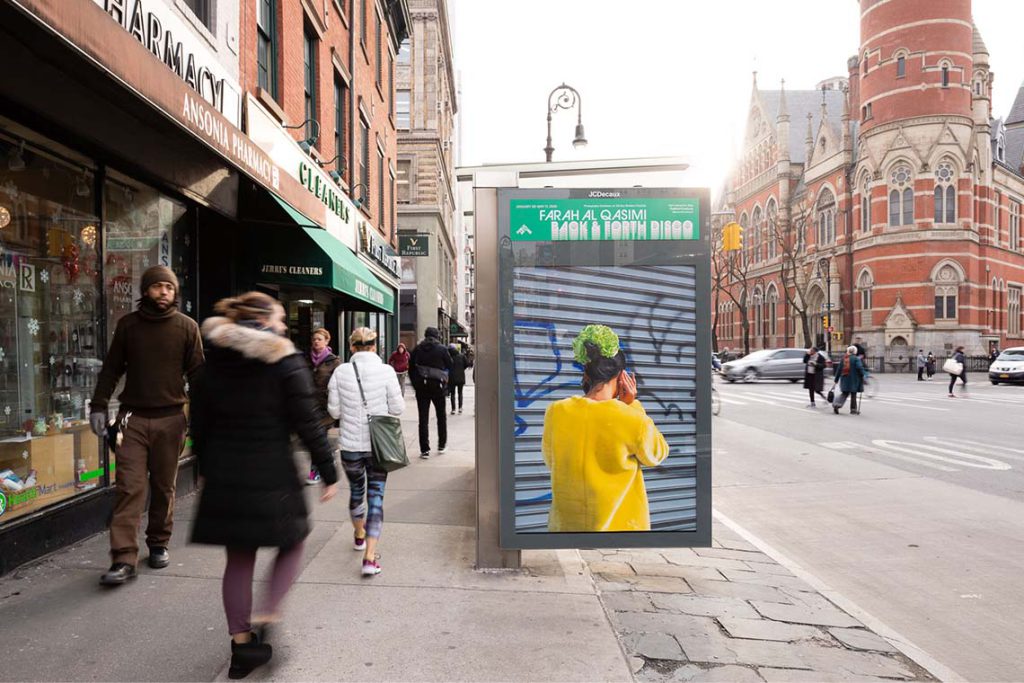
Al Qasimi’s upcoming exhibition at the Savannah College of Art and Design (SCAD) museum, entitled Psychic Repair, captures these moments of combat between self-assurance and doubt through densely layered photographs of interiors, as well as short films. “Teenage years are when we try and claim our stake in the world as somebody separate from the family,” she adds, “and when the bedroom becomes a place of autonomy”. A burning urge for individuality while finding comfort in belonging to the larger herd is not unlike the immigrant experience that Al Qasimi’s explosive photographs also capture. Back and Forth Disco – her 2020-dated Public Art Fund exhibition which placed 17 of her commissioned photographs on bus shelters across New York City – had
documented predominantly Muslim-owned local businesses with their tightly orchestrated interiors. Across 100 bus stops, Al Qasimi’s images of barbershops, street corners and stores monumentalised subjects such as a young woman wrapped in a leopard outfit and headscarf checking herself in a hand-held mirror and a local store’s resident cockatoo perched on a hand with bright red nail polish.
Al Qasimi’s upbringing with an Emirati father and a Lebanese mother, between the UAE and the USA, is echoed in her images brimming with unique and unabashed forms of self-making. “I had angst growing up about being between two cultures,” she recalls. Today she finds “being a chameleon” helpful as a photographer who shoots a dense variety of personalities and situations. “I am in the mountains one day shooting a tribe, and the next day I can be photographing a gritty urban bar,” she explains. “My relationship with home never feels fully resolved,” she says, yet cherishing this duality as a source of self-challenge.
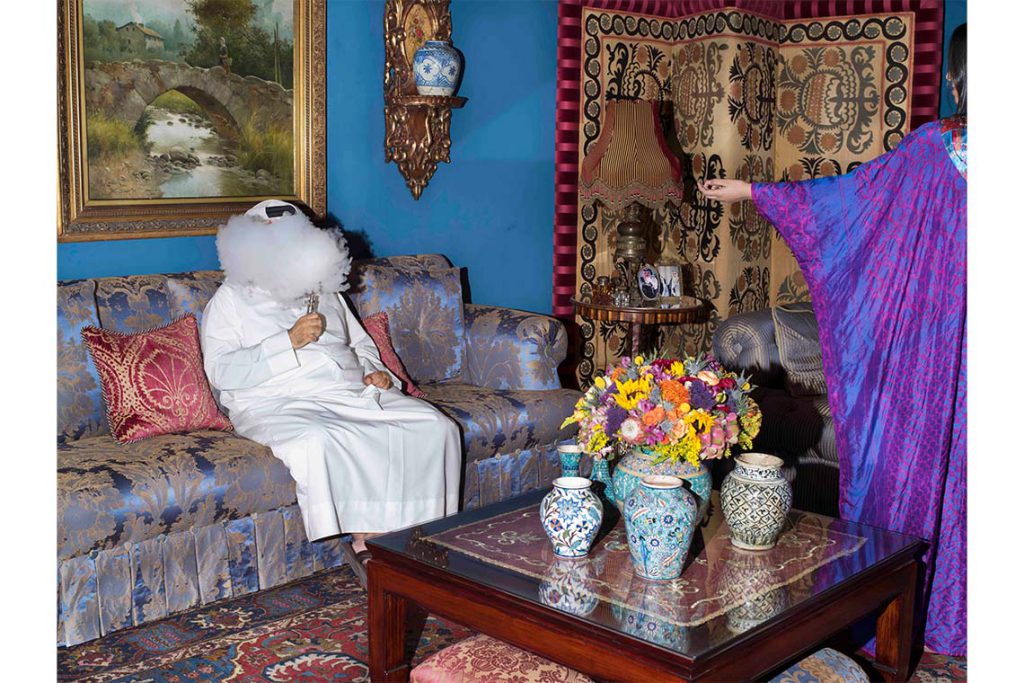
Al Qasimi came of age at a time when the UAE was transforming into an oasis of opulence, excess and new-found forms of wealth-signalling. The dazzling colour spectrum of the Gulf’s transformation – think influx of expats with jobs in technology alongside a burgeoning local fascination for the high end – is funnelled into the artist’s images of textured interiors with theatrical stagings. On a knife’s edge between a showy artificiality and audacious personal taste, these often domestic and occasionally commercial spaces host grand collisions between the everyday and the obscure, with the familiar and the odd wrapped around each other. A solo presentation by Al Qasimi as part of Tate Modern’s free collection display in the Artist and Society section featured her photographic work from the last decade, such as Living Room Vape (2016), which shows an Emirati man whose face is veiled by a puffy cloud of smoke while the room surrounding him and a woman in a purple robe explode with patterns on every decorative item. She considers the intentional staging in her stills as a “form of
honouring the composition” while challenging the linear path that art history has pursued in terms of categorisation and hierarchy. “Colour photography was not considered high art for a long time because of its closeness to the world itself,” she explains.
In the light of cutting-edge technologies such as AI, the representation of a sublime reality gets murkier, and in this vortex of authentic and crafted creativity, Al Qasimi tends to “complicate the mechanisms of image making” through references to historical paintings in her interior juxtapositions. She adds that her enquiry also leads to the question of “what a historically good composition is”, often asked through the lens of a dominant Western art history. Against the whirlwind of surveillance enveloping our daily existence, these interiors seem to shield their subjects with intensely patterned rugs and well-cushioned upholstery. She adds that her decision to often picture her subjects looking away from the lens taps into a refusal of identification and exchange. “Between surveillance and algorithmic advertisement, the people in these images turn away from the camera – although they might be swimming in an excess of products,” she says.
Taste, in this direction, is part of a continuum which Al Qasimi explores through images that refuse immediate decoding or easy fascination. “The viewer is forced to choose what to pay attention to when someone else is also vying for attention out of sight,” says the 2025 Guggenheim Fellow about her images, as well as the wallpaper installations which have been wrapping them in the last few years. A recent solo exhibition, entitled Desert Hyacinth, at Istanbul gallery Sanatorium, featured photographs of the UAE with a shifting focus on empty interiors, architecture and nature. The wall coverings ranged from a close-up of sweaty skin to lushly layered drapery and another zoomed-in detail of fabric with floral patterns. “I sometimes want to commit to a hostile take-over, especially if I am working with a white cube,” quips the artist.
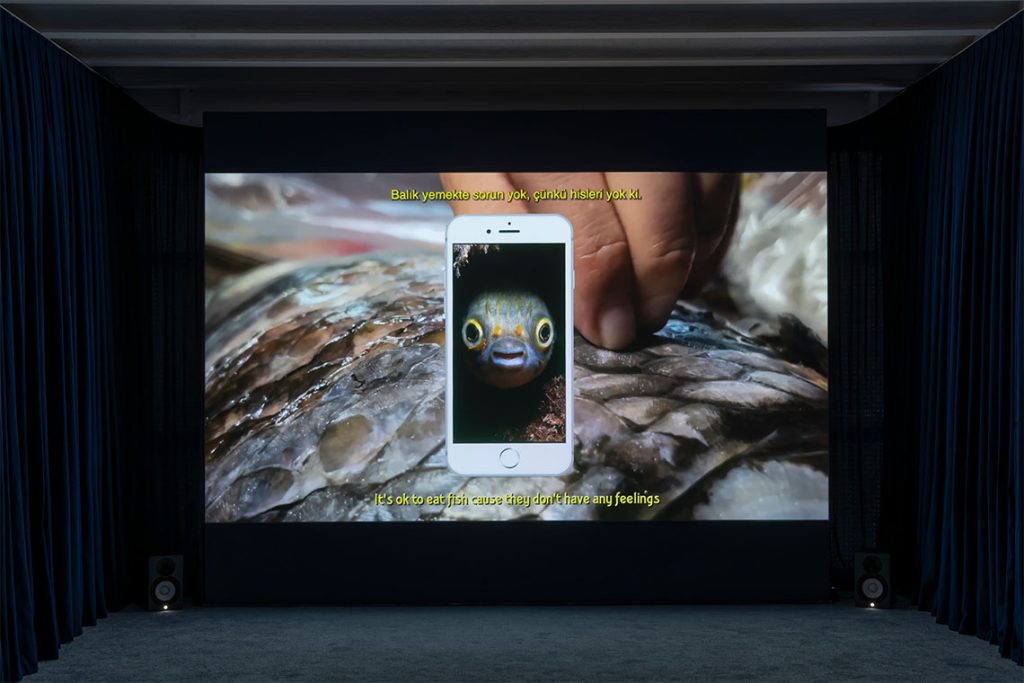
In her SCAD show, Al Qasimi will explore the shortening of our attention spans, and an architectural statement challenges this enquiry with an immersive orchestration, a landscape of varying textures and provocations. Occupying the museum windows on the building’s facade and an interior gallery with photography as well as a suite of short films, the show will investigate the very analog feeling of existence in and out of changing realities against a sweeping wave of online data flux. The films feature songs composed by Al Qasimi herself. “Music helps me get into the right headspace,” she says. Whether listening to Julee Cruise’s moody albums or creating her own tunes, she utilises sonic powers to make final decisions on an image. The idea of exhibiting films which feature her own lyrics is new territory, but she sees a correlation between her nursery rhyme or punk melodies echoing along with moving images, some of which are about the ability of plastic dolls to hold spirits. “How could a psychic energy hold onto something like plastic, so slippery and not as porous?” asks the artist.
Al Qasimi considers herself a “product of 1990s excess and a certain postmodern maximalism”. She may no longer have her rock icons on the bedroom walls of her Brooklyn home, but that is where she has the instruments to make the scoring for her films. It is her studio, where she often plays her electric guitar and synthesiser keyboard. “When I look around my studio, I see so much imagery on the walls,” she says, and wonders what the room would look like cleaner. But, as she adds about re-assessing her instincts, “Sometimes it is better not to have all the answers.”
This profile first appeared in Canvas 121: If Walls Could Talk
