

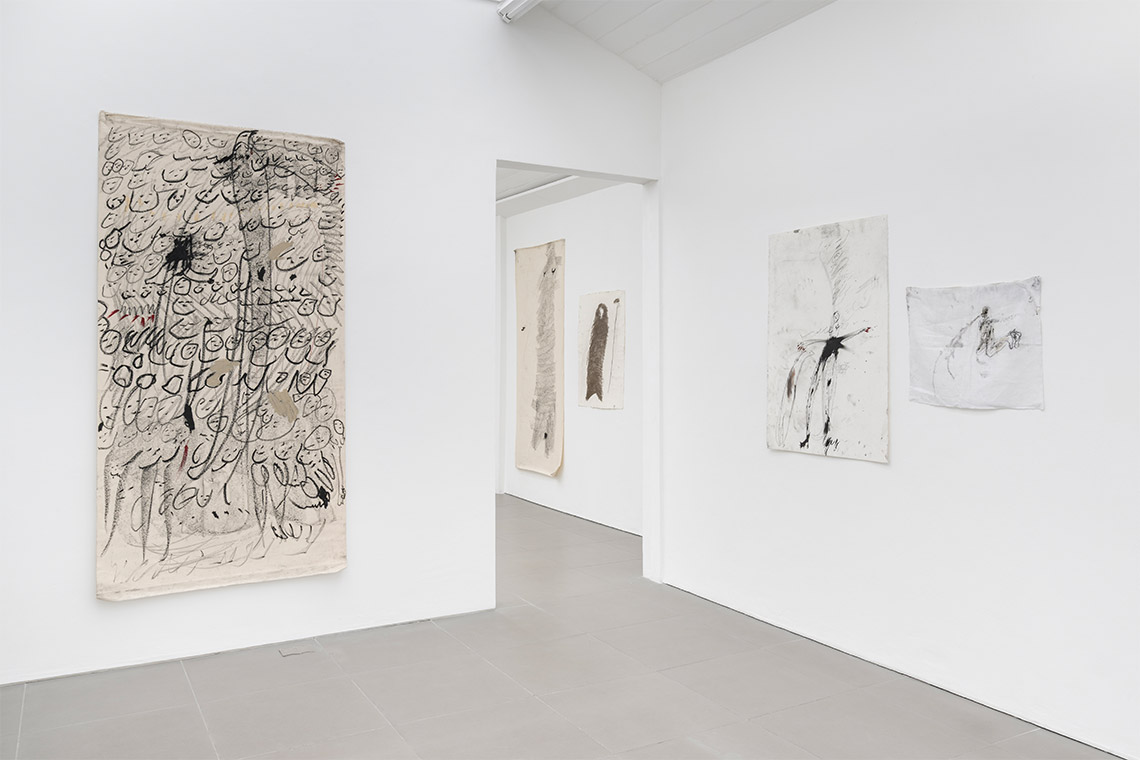
The Iranian-born, Bordeaux-based artist’s first UK solo exhibition transmits a familiar sense of frenzy and urgency we have come to feel in the everyday.
At East London’s Cell Project Space – a respected contemporary art gallery known for championing more experimental, process-driven and unconventional practices – Armineh Negahdari is presenting The Living River, a solo show of drawings produced this year. The show is named after a line from the Iranian poet Shams Langeroodi’s Lotus of the Swamp, which encourages trying to find and sustain joy and beauty wherever you are planted. The poem’s natural imagery is less representative and more philosophical: ‘Every river / flows into its own lake. / The living river is not reborn from longing. Water cannot be folded / and poured into another river. / One may simply be glad to be a river.’ Negahdari takes the river not as a subject, but as a condition and method.
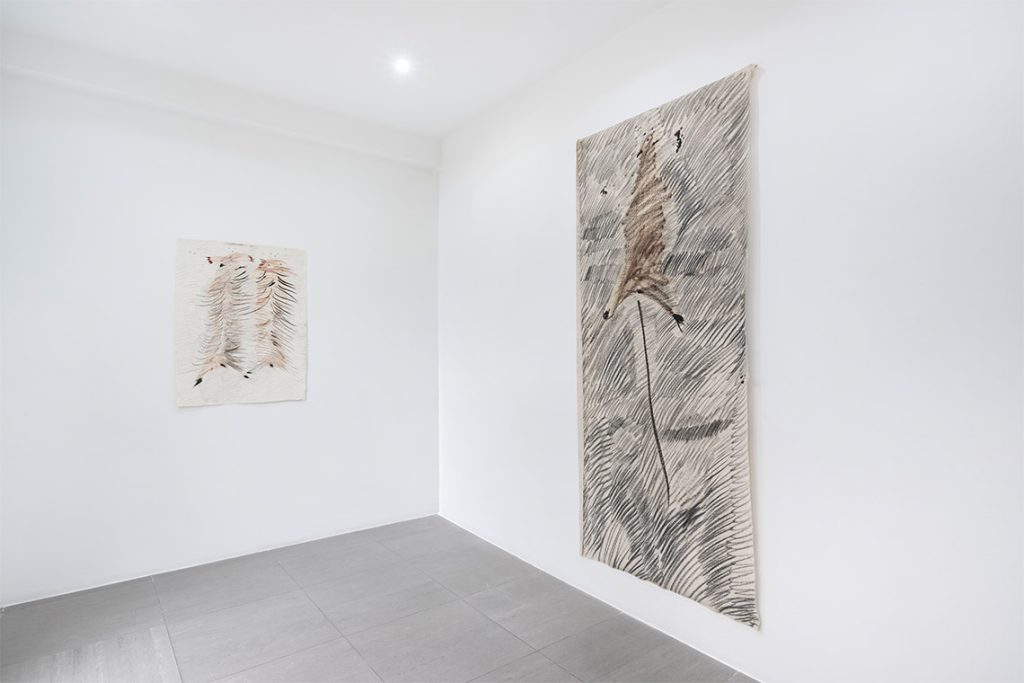
A sense of relenting to the flow and continuity of time, just as a river or a body must, and meeting it with the full force of our emotional expressions, pervades the artist’s work. In the small, opening room of the show, the viewer is almost taken aback by the sprawling scrawling of the large Tous et un (2026) and Habité par le vent(2026). In the former, you might see a splayed animal pinned down on soil; in the latter, you can conjure from the furious lines two rising tower blocks or even a pair of angry lungs. But just as in Langeroodi’s poetry, these gestures at figuration don’t serve any ‘point’ or intention – they’re a formal provocation. In this first room, the works tell you to abandon the search for any fixed image or meaning and instead follow the lines to where they may take you in your own consciousness.
This may not be an immediate realisation for every viewer, nor is it particularly aided by the fairly bloated exhibition text, loaded with abstractions and poetics. The gallery’s upstairs space, where the majority of the works are displayed, feels more effective. A clean, linen-white light suffuses the room, against which Negahdari’s drawings can scrabble, shout, and nearly throb off the walls. You might be reminded of William Kentridge’s animated sketches and drawings for projection, which always feel as if an electric charge is running through them.
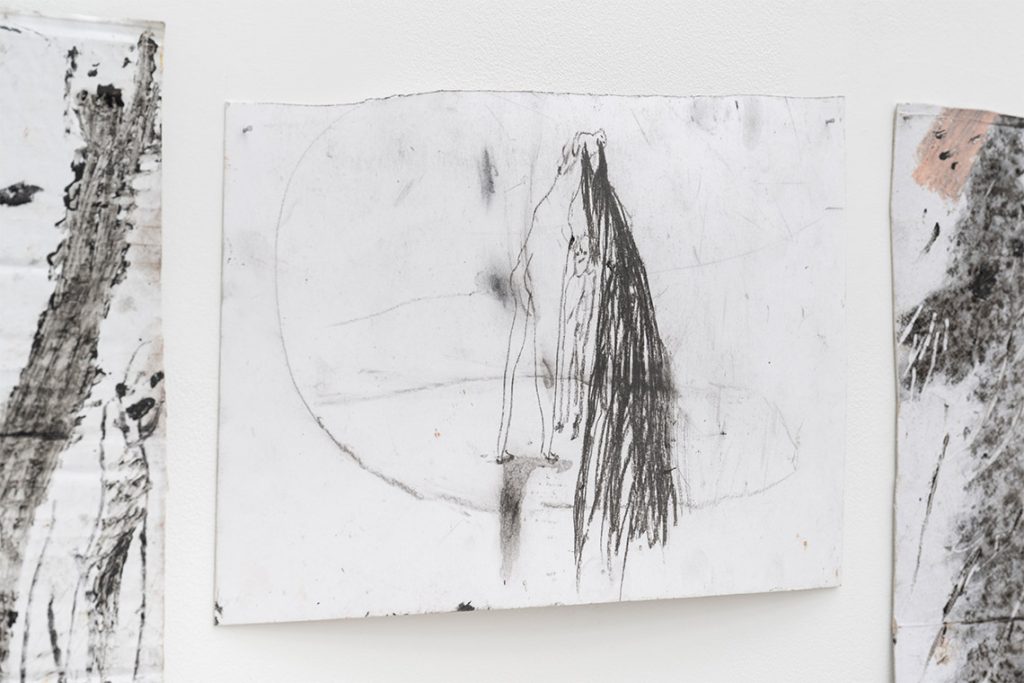
Like Kentridge’s work, Negahdari’s practice values traces, lines, repetitions, revisions, the quotidian and the passage of time. In a video for Fondation Louis Vuitton – where she is concurrently having her first solo show in France, entitled What Colour Is Your Sky Today? – the artist discusses drawing with no prior plan in mind. Using oil, graphite and charcoal, she intentionally leans into not following any intention. Imprecision, spontaneity, automatic impulses, and setting the ego or even rationality and reasoning aside are guided by an improvisational, intuitive drawing process that yields to the
moment. The hand precedes the idea, only pursuing what Negahdari describes as “a physicality as credible as a body, as powerful as a mountain.”
Materials from everyday life are Negahdari’s surfaces, such as bedsheets, scraps of fabric, wrapping paper and cardboard. When you’re looking at works such as Enveloppés l’un par l’autre (2025), Notes du corps(2026) and Du cocon à l’envol (2026) then, a similar frenzied need to put a hand down to paper, or whatever material you have lying around you, arises, as if to exorcise your own expressions from your body – of anger, despair, frustration, meandering, disillusion, melancholy. This pressing sensation is so familiar after experiencing the COVID lockdown and then graduating into a digitally-saturated polycrisis. Where do we put down all our overwhelming, unprecedented feelings? Where can we let them flow? How do we make them mobilise rather than paralyse our bodies? In the gallery, perhaps your fist will curl, your arm flexes… the urge to make your own marks may course through you, to see what they might show you about your own state of mind.
Negahdari wants to offer us the proposals of form. In these works, every line, every body, every face or creature or material or landscape is in a state of smudge – unfixed, unstable, morphing, melding, in flux. You might spot Persian characters melting into the basic strokes forming a face. In Glissant vers la nuit (2026), a small explosion of the deepest black blooms out of a person’s body. Is it a depiction of psychic or physical violence? Is it internally or externally inflicted? Is it a literal explosion, and we are seeing the annihilation of another nameless human, except this time it’s not on a screen? The raw, spare, unpretty rendering mirrors the nature of intense emotion itself, where no expression or feeling can be fully encapsulated in a neat or logic-bound image.
The Living River has been curated by Cell Project Space’s director Milika Muritu in collaboration with Anne-Sophie Dinant, and was complemented by an accompanying one-day film programme at the Ciné Lumière, screening work by iconic experimental filmmakers such as Abbas Kiarostami and Agnès Varda. The aim was to draw attention to parallels between Negahdari’s practice and the language of cinema, emphasising common elements of restraint, poetry, texture, repetition, minimal forms and interest in everyday life. This connection to film strengthens The Living River’s offering and deepens the comparison to Kentridge.
Here, lines and surfaces of all kinds are their own living things, always in movement, unable to grasp certainty. In an interview for M—A (A SPACE BETWEEN), Negahdari says: “…poetry, for me, is the search for truth by way of a detour. But we never arrive at certainty. Certainty is an illusion.”
The Living River runs until 9 August
