

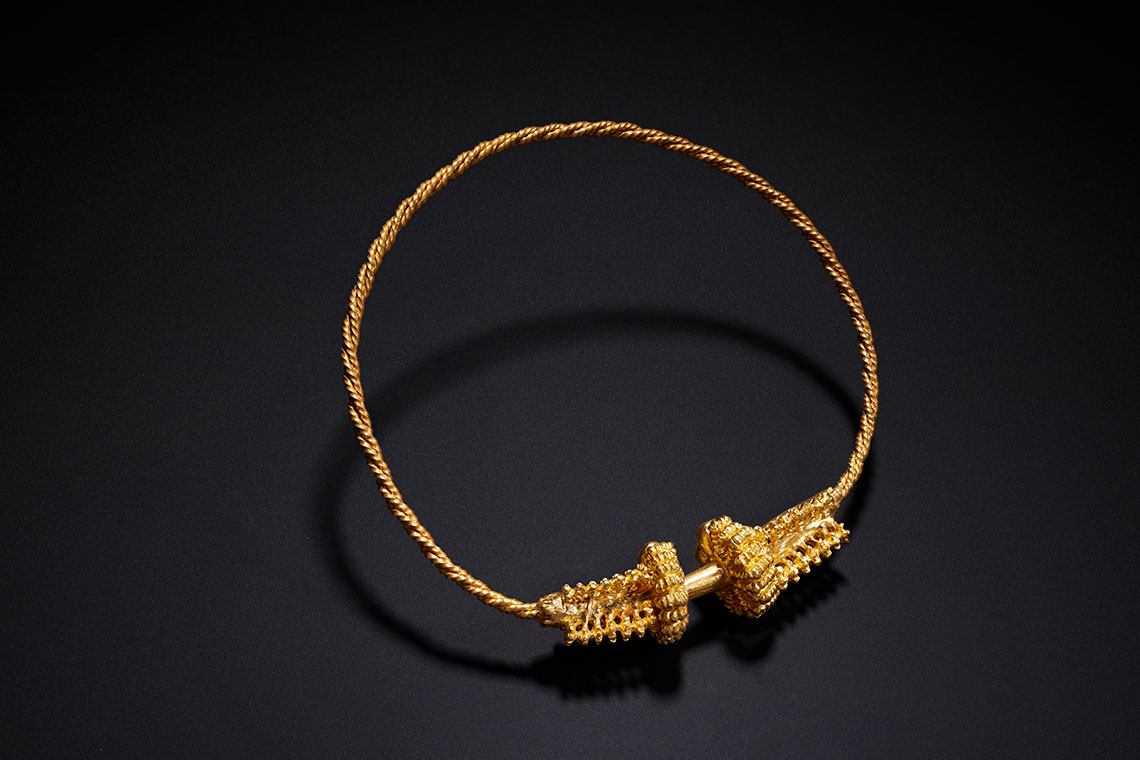
L’ÉCOLE, School of Jewelry Arts in Dubai presents Recreating Gesture: Crafting a Gold Necklace from The Iron Age, a captivating journey through the rich history, master craftsmanship and archaeological wonders of gold.
Unveiled as part of Dubai Design Week at their campus in Dubai Design District (d3), L’ÉCOLE, School of Jewelry Arts supported by Van Cleef & Arpels – welcomes visitors to Recreating Gesture: Crafting a Gold Necklace from The Iron Age, a remarkable exhibition that offers Middle Eastern audiences new insights on an experimental archaeology project to rediscover the lost goldsmithing techniques of early craftsmen from the Second Iron Age (450–25 BCE).
Building upon the success of previous shows in Paris, Lyon, Seoul and Shanghai, the exhibition embodies an important strategic research project for L’ÉCOLE. By combining archaeology and the history of techniques with their own expert goldsmithing craft, the institution seeks to enhance understanding of the skills of an ancient culture by reproducing the Celtic Torque of Montans, originally discovered in 1843 and dating back to the Second Iron Age, in the first exhibition of its kind in the Middle East.
“Museums already use reproductions to compare and embody objects which cannot travel,” Emmanuelle Amiot, Senior Research Project Manager at L’ÉCOLE, School of Jewelry Arts, tells Canvas. “However, this exhibition allows us to enter the process of research and, at the same time, to understand how a goldsmith of that time or an archaeologist look at an artefact, how they interpret the results of its analysis and use these to reassess the object. It is quite rare for such a project to map out the ‘gestures of creation’ of the original piece.”
Another unique dimension to the project is the opportunity it offers to spark a truly international conversation. “One of our challenges is to see if the research – and indeed the work of art itself – can strike a chord across diverse cultures,” Amiot continues. “The point is that the extreme refinement of the piece is shared as a human-made treasure, not only among European and Celtic people but also globally. Such resonance is truly amazing, and I hope the audience will be sensitive to that as well.”
More than 2000 years ago, ancient Celtic craftsmen created torques – a distinctive style of socially and religiously significant ornamental neck collar – that demonstrate a truly exceptional level of refinement. The original Torque of Montans is believed to have been created during the third century BCE, yet is so sophisticated in its design and construction that even specialists in the field of Celtic gold were not immediately able to understand how it was produced. Following initial research, it became clear that the piece could only have been created using an unusually high level of manual dexterity and finesse, but technical analysis was not sufficient to understand the full picture. Instead, the knowledge of craftsmen was necessary to fill the gaps that historical and archaeological expertise could not explain.
This exhibition also provides Middle Eastern audiences with an opportunity to immerse themselves in the profound historical connections that goldsmithing has across their own region of the world. Recent research has revealed links between Celtic torques and the Middle East, with new discoveries linking them to ornamental collars found in areas such as the Levant and the Arabian Peninsula, demonstrating thousands of years of regional goldsmithing heritage – including a surprising number of techniques that remain in practice to this day.
“Sites like Saruq al-Hadid and Mleiha in the United Arab Emirates come to the fore as centres of craftsmanship, including goldsmithing,” says Sophie Claudel, Director MEIAT of L’ÉCOLE, School of Jewellery Arts. “Both land trade and maritime trade in the Mediterranean and the Arabian Gulf enabled the circulation of precious metals, gems and jewels between and amongst civilisations such as Ancient Mesopotamia, the Phoenicians, the Achaemenid Empire and Hellenistic and Roman societies. Indeed, we have inherited rich archaeological sites that teach us today about the glories of the past.”
In partnership with Dubai Culture and Arts Authority (Dubai Culture) and Athar Dubai, the exhibition features live, interactive goldsmithing demonstrations alongside a vibrant cultural programme of talks, book highlights and special events for all audiences. These draw connections between the Celtic torque, regional goldsmithing heritage and key archaeological finds across the UAE, underlining the global importance of the objects and their history. To further deepen the sense of exploration, visitors can also experience three newly translated Arabic episodes of L’ÉCOLE’s podcast – Voice of Jewels – within the exhibition space.
Recreating Gesture: Crafting a Gold Necklace from The Iron Age runs until 24 April 2027
