

In her new exhibition at Pilar Corrias, Hayv Kahraman asks what it means to grieve not just personal loss but the severing of body from land, self from ancestry, the human from the more-than-human.
The gallery walls of Pilar Corrias are painted a deep, enveloping blue, and the effect is immediate: we are all at sea. It is a fitting environment for Hayv Kahraman’s new body of work, which takes grief, displacement and the dissolution of the self as its guiding currents – and which arrives freighted with the weight of recent, personal (and repeated) catastrophe. In January 2025, the Eaton Fire swept through Altadena in Southern California, rendering Kahraman’s home uninhabitable. Her daughter was the same age that Kahraman herself had been when, as a child of ten, she fled Iraq with her family during the first Gulf War. The circularity is devastating; it is also, in Kahraman’s hands, generative.
What cannot be said will be wept at Pilar Corrias takes its title from an aphorism often attributed to Sappho, and the work that follows is preoccupied with that which language cannot hold. In the artist’s own statement, she writes of “a disconnection from my environment, from the natural world, from the human and more-than-human and from a kind of knowing behind knowing” – a rupture that she identifies not only in the violence of forced displacement but in modernity’s quieter insistence on separability, on the isolated self. The paintings are an attempt at repair, or at least, perhaps, at reckoning. Painting, she writes, “becomes a site of devotion, a practice through which relationality is cultivated and deepened and where grief is allowed access and is given form.”
That form, here, is consistently female. Every figure across the show is a woman, each body rendered with Kahraman’s characteristic fine-lined elegance – a lineage that runs from Persian miniature through Pre-Raphaelite painting to something entirely her own. Their swimsuits are patterned with Kurdish textiles and tapestries, some of the designs rooted in the shape of the female form itself: a quiet recursion of body and cloth, self and tradition.
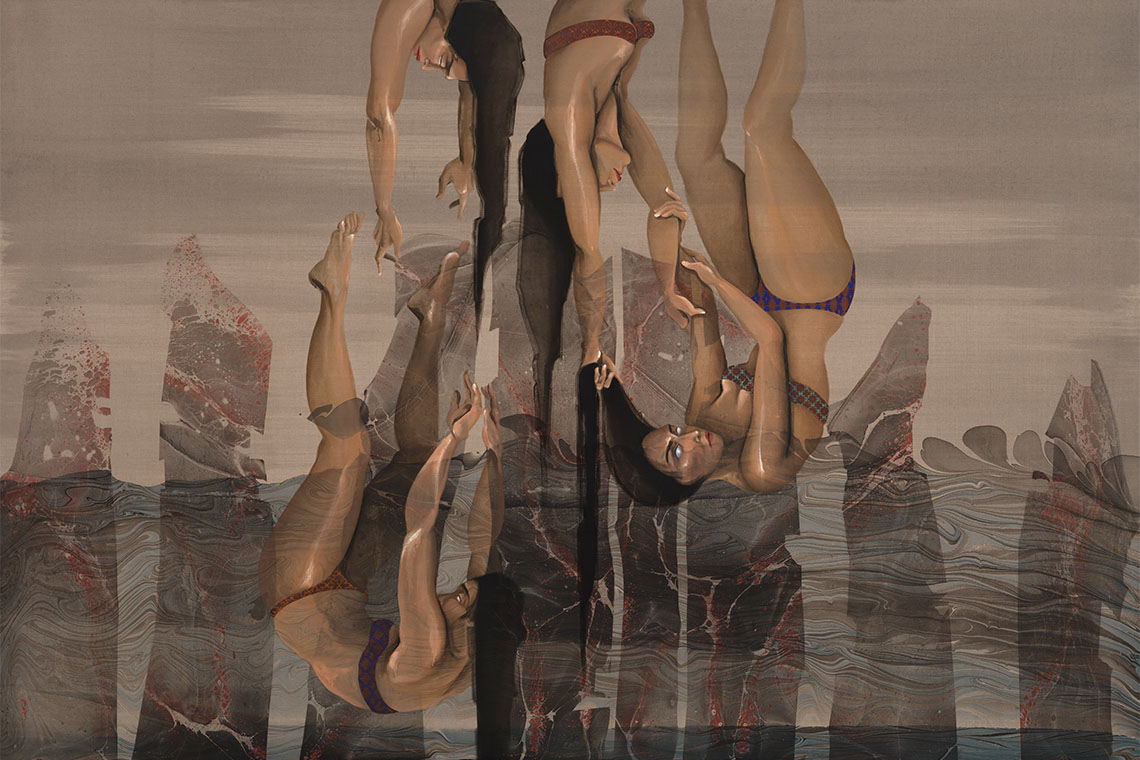
The women squat, kneel, fall, dive, lie in seemingly choreographed positions. Crucially, most of them do not meet our gaze. In Ancestral Tides (2026), figures fall onto what look like rock formations, their bodies slightly translucent – the horizon bleeds through them – with small flecks of red on the stone beneath, a suggestion of violence absorbed rather than fled. The hair of the falling women ripples into the same formations as the rock itself, flesh becoming landscape, the body returning to terrain. The blank, inward-turned eyes that appear across many of these works operate on several registers at once: they signal an interior looking, a visionary state, but they also speak to something more contemporary and unsettling – the iris scan at a border crossing, the surveillant systems that parse and record the bodies of those seeking passage. The white-tipped fingertips carry a similar charge; the women are erased from the biometric record, anonymous, and therefore, paradoxically, free.
The marbling technique that Kahraman has developed is central to the show. She partially submerges her linen canvases in water and pigment, allowing the material process to mirror what the paintings depict: immersion, suspension, surrender to forces beyond the artist’s full control. The results shimmer between liquid and atmosphere, the surface of the sea and the surface of memory. In the artist’s words, “the materiality of marbling, submerging the canvas in water, feels ceremonial and becomes a place where spirit might surface”. The procedure’s unpredictability is not a flaw but rather purposeful – in yielding control, Kahraman finds something closer to the “ancestral knowing” she describes, a knowledge that exceeds linear logic.
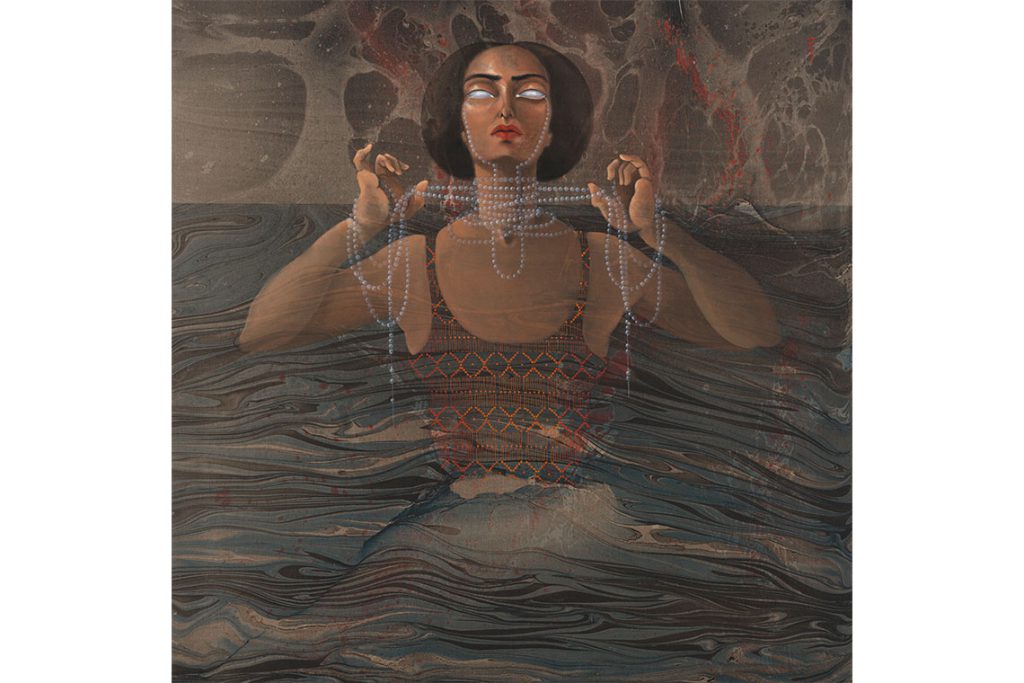
Tears appear everywhere in the show, but they rarely stay as tears. In Figure Threading Tear Beads (2026), a single woman gathers droplets onto a thread, turning sorrow into ornament and bereavement into practice. In Four Figures Kneeling (2026), a column of women stacked one above the other are connected by these same strands, the tears becoming a kind of thread that binds them across time and body. Choke and Tear Beads (2026), one of the show’s most quietly alarming works, features a solitary woman whose tear strands have accumulated into a multi-layered necklace wound tightly at her throat. There is ambiguity here about whether what encircles her is adornment or restraint, a question the exhibition keeps open rather than resolves.
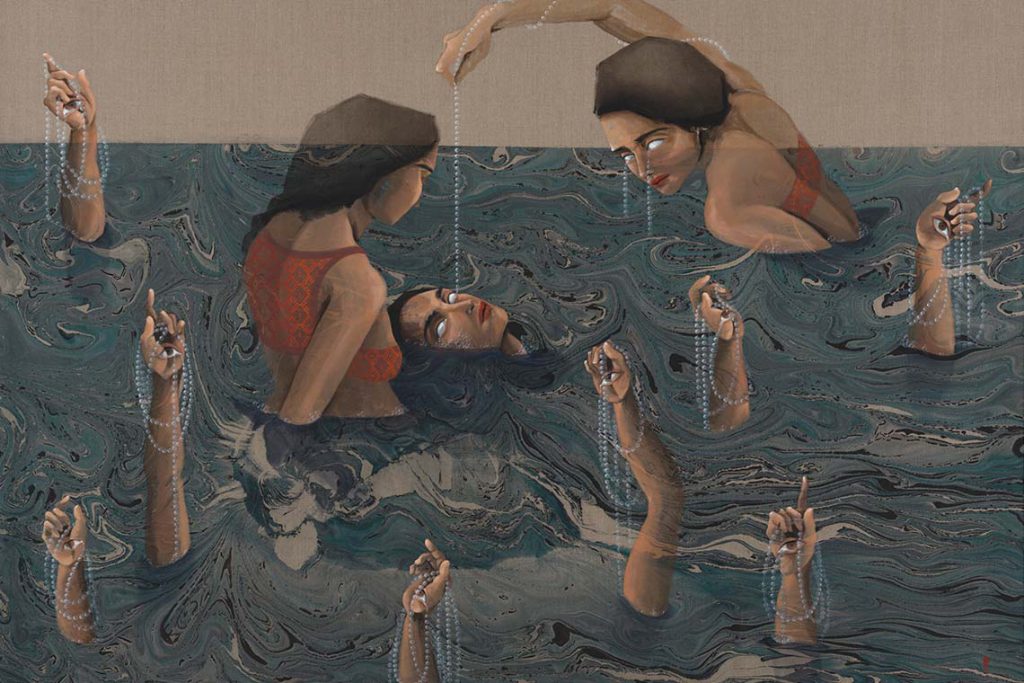
Among the most striking works upstairs is Three Figures in Spiral (2026), where the watery blues give way to ashy greys and browns, three women contorted and joined at the hair in a tight circular coil. The shift in palette is jarring when surrounded by so much blue – this is fire residue, the sediment of what was lost, grief that has not yet dissolved into water. Nearby, Brittle Star (2026) arranges its figures with heads at the centre and bodies radiating outward like the arms of that spineless, ocean-dwelling creature, which navigates without a centralised brain and survives by shedding its own limbs. There is something in this that speaks to the distributed, embodied knowing that Kahraman is reaching for – intelligence that lives in the extremities, not the executive faculty. The women here seem more passive than elsewhere, but nature blooms around them, suggesting survival as entanglement rather than resistance. Eyes in Waters (2026) may be the exhibition’s strangest and most arresting image: eyes emerge from the water on disembodied hands, an unmistakable echo of the Hand of Fatima, the palm-shaped talisman recognised across the Middle East and North Africa as a ward against the evil eye. The image is ancient in its resonances and disquieting in its dislocation – sight displaced from the face and held in the palm, seeing and protecting simultaneously.
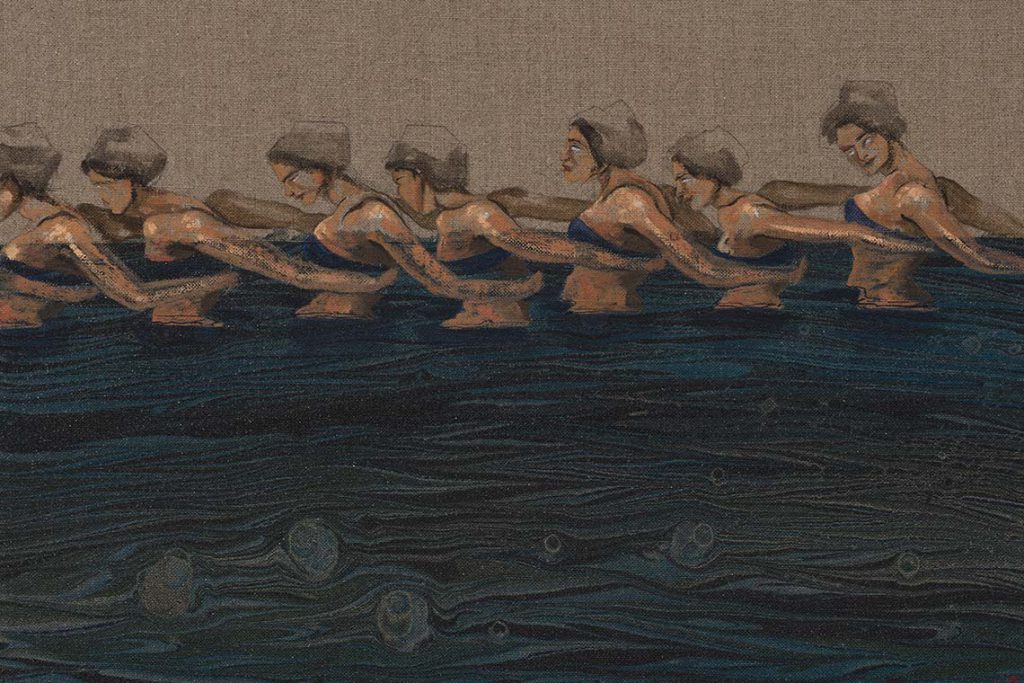
Downstairs, the mood shifts again, becoming at once more intimate and more unnerving. The women here wear what appear to be old-fashioned swimming caps, some figures topless, the body more exposed and more vulnerable. The swimming-cap detail is a small but telling strangeness: it belongs to a mid-twentieth century world of regulated leisure, of bodies permitted into the water only on certain terms, under certain conditions. Ocean lines (2026) has the quality of synchronised swimming – women standing in a chain, each reaching back to grasp the one behind her. It is an image that holds two readings simultaneously and refuses to release either: solidarity and entrapment, a strong human chain and a chain gang, collective strength and collective captivity. Kahraman consistently leaves this kind of ambiguity unresolved, and it is where her work strikes the viewer as most alive.
Squatting figure and tears (2026) upends the logic of the whole show: a woman sits in a lotus position with the blue field above her rather than below, tears beaming upward from her palms into the sky. The world is inverted, or perhaps corrected – the body no longer submerged beneath the water but grounded beneath something vaster, the atmosphere itself becoming ocean. It reads like a figure sending something back: grief returned to the sky, or prayer ascending, or simply the insistence that the flow of feeling need not run in only one direction.
Kahraman writes of seeking “not resolution, but a kind of preparation, yielding me to sit with the undeterminable”. It is a difficult and necessary distinction. These paintings do not offer the consolation of conclusion, but offer instead the consolation of form: the confirmation that even what overwhelms can be worked with, held in the hands, laid down in pigment and water and linen, and offered to whoever comes to look. In a burning world, the sea holds everything. Anything, too, might be washed away.
