

Ali Cherri’s first exhibition at Almine Rech’s New York space expands the artist’s examination of war through a soldier’s internal perspective with a rich material palette.
There is a chorus of sinister laughers in Ali Cherri’s exhibition, Last Watch Before Dawn, at Almine Rech in New York. They stare down on us from their ascended positions with their massive grins slit as wide as deep wounds to release some light – their hollowed squinty eyes tease and hiss while their bronze breeziness does combat with their hellish origins. Cherri’s oxidized bronze, steel and wax wall sculptures from the series Nocturnal Light (2025), shadow his show of large clay and sand sculptures, intimate watercolor drawings, a large wood relief and a film. Their refusal of empathy likens the lit mask sculptures to the scrutinising spectators of a freak show, whose hunger demands their money’s worth. The Lebanese artist positions the figures as the Greek chorus alert to observe our wandering of the show, where absence and eeriness fill the gallery’s large Tribeca space.
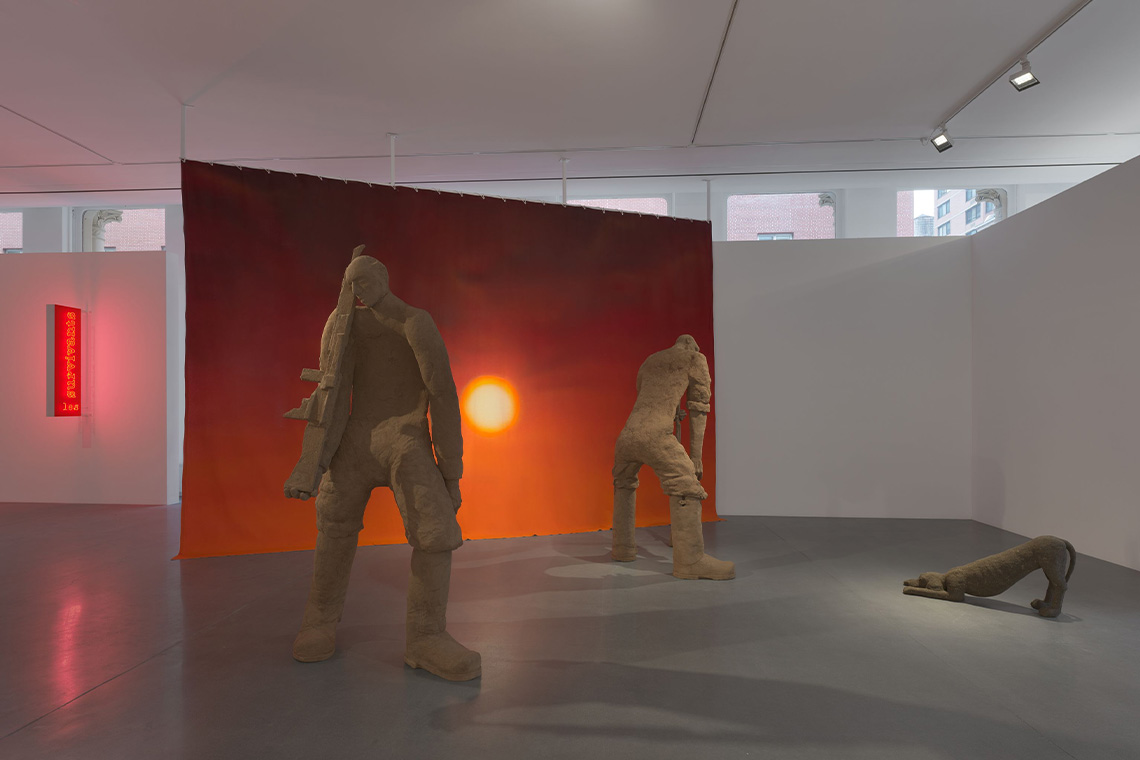
A solemn return to earth is a lingering search in Cherri’s practice, most physically in his clay sculptures of life-size or larger-than-life figures, which often negotiate between being an exhausted soldier or an aloof bestial creature. The Paris-based Lebanese artist’s spectral figures, such as the show’s layout of two gargantuan soldiers and a timid dog entitled Wake up Soldier, Open your Eyes (2026), are spectral in their detached interiority. Pensively looking down, the fighters drop their shoulders as they hold onto their remaining will to serve. The burden of their weapons has worn them down as much as their contemplation of each step. A large print of the sun backdrops the juxtaposition, heating the soldiers and the stretching canine with its blaring stillness. The fiery dusk paints the corner where the installation is perched into an orange blare, bearing a desert-like barrenness which also spills into a long stretch of drawings on the opposite wall. Overall entitled To Save What Can Be Saved (2025), the disarming illustrations of soldiers in repose possess a diaristic rawness and immediacy that feels both reactionary and shy.
The drawing practice which Cherri took on during the pandemic feels like a mature route for a sculptor of intimately constructed clay forms. The contrasting miniature scales of the drawings to the sculptures perhaps help the artist to meditate his thoughts on three dimension in the tactility of paper. Also in contrast to his sculptures’ mythical compositions – such as animal bodies with deity heads or humans with elongated limbs – the drawings hold vivid connections to the real world. The soldiers in the show’s drawings, for example, each assume a gesture of rest. They contort their bodies to accommodate positions of ease, which challenges the combat positions made evident by their weapons. The arms which the young men clutch like prized possessions feel alarming, not only in their suggestion of killing but also in their owners’ relinquishment of control for the sake of sleep. As they descend to rest, the soldiers’ green camouflage attire does little to hide them from the eye of the enemy. Off-duty on the battleground, they manoeuvre the dream-state where borders do not make the call. As we – the viewers – observe their malleable formation on paper, our eyes cannot help but wonder whether they are indeed lifeless, bodies whose souls are long lost into the ether.
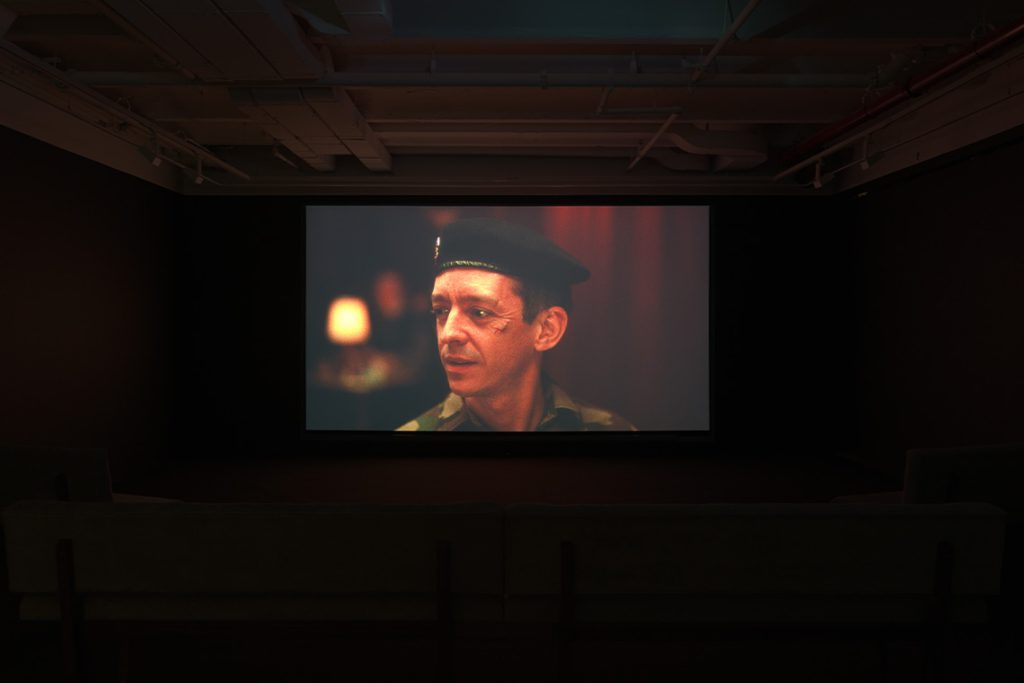
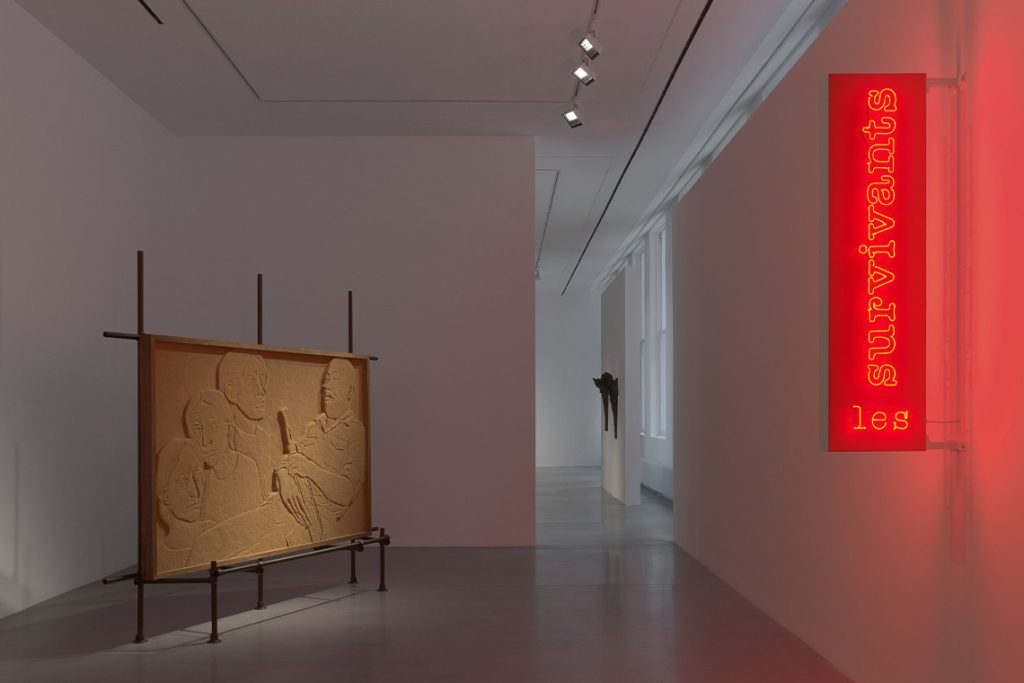
The alchemic heft of Cherri’s clay sculptures and the subtle marks of the drawings on paper lend themselves to a similar potential of loss. Les (Sur) Vivants (2025) is a neon text sculpture which plays with the French words for “the living” (les vivants) and “the survivors”, the work’s title. The simple differentiation by the addition of sur ridicules the grandiosity of being alive and coming out as not dead from a war. Towards the back of the gallery, two bronze masks with bothersome laughters usher the viewer to the basement, where Cherri exhibits his latest film, The Sentinel (2026). The 29-minute-long sequences trace a young big-eyed soldier whose injury leads him to leave his place of duty. Along the way, he encounters the show’s large sculptures, like an alien sighting, and ends up at a basement bar named Les Survivants. There, a bar singer leaves the stage to point out to the soldier the locale’s odd lanterns, which are none other than the haunting masks across the gallery. Leaving the gallery’s basement feels not unlike the soldier’s eventual departure from the gloomy bar, devotedly heading back to his duty. The iron-heavy call of his military obligation is embodied in yet another face hung above the staircase. Chuckling with menacing eyes and a widening mouth, it swallows the light with its monstrous appetite.
Last Watch Before Dawn runs until 26 February
