

The latest iteration of Desert X AlUla unfolds across the area’s desert canyons, offering artists boundless scope to enact their wildest fantasies, albeit with varying results.
Desert X AlUla is an event quite unlike any other. While large-scale public art exhibitions take place all over the world, there is something particularly bracing about admiring a series of artworks while contending with the elements in the desert landscape of AlUla.
Of course, one can always choose to view the installations from the relative comfort of a golf buggy, shaded and somewhat protected from the surrounding sand save for a few clouds of dust along the way. An altogether more rewarding experience, however, comes from traipsing through the sand on foot to get closer to the artworks.
AlUla is a dreamy landscape, with the natural valleys and plateaux of rock formations that emerge from the desert plains enough to tickle anyone’s imagination. This dramatic setting appears to be the guiding thread for the fourth edition of Desert X AlUla, curated by Wejdan Reda and Zoé Whitley with art direction by Raneem Farsi and Neville Wakefield. The English title of this year’s edition, Space Without Measure, is derived from Kahlil Gibran’s book from 1920 The Forerunner, in which the acclaimed Lebanese poet and writer “speaks of dreams being the space without measure”, as Whitley explains to Canvas.
The link to the landscape is evoked through the Arabic title, سديم لا يعد, also derived from one of Gibran’s texts and which, according to Reda, specifically “references in various ways [man’s] connection with the landscape, as well as linking it to the imagination and memory”. The age range across the 11 participating artists this year is unusually diverse, with some well into their “wise age”, as Whitley terms it, lending their hand to Desert X AlUla alongside other (younger) current superstars of the art world. The one directive given to this varied cohort, according to Whitley, was to encourage them to “imagine things that would allow their dreams to come true, to ideate things that perhaps had been on the page, or for things that they conceived, maybe even decades ago, to take form and take root here.”
The resulting artworks are a mishmash of artistic fever dreams, some bolder than others, which both blend into and honour the landscape while also finding new ways to interpret the materials and tools it provides. The most immediately striking are Mohammed Al Saleem’s towering metallic structures, immediately visible in the distance from the visitor centre constructed for this year’s edition. The only works not conceived specifically for the exhibition, they have nevertheless never been seen in public before. Although not originally designed for the AlUla canyons which they currently line, they seem to be at home there, greeting visitors along the way.
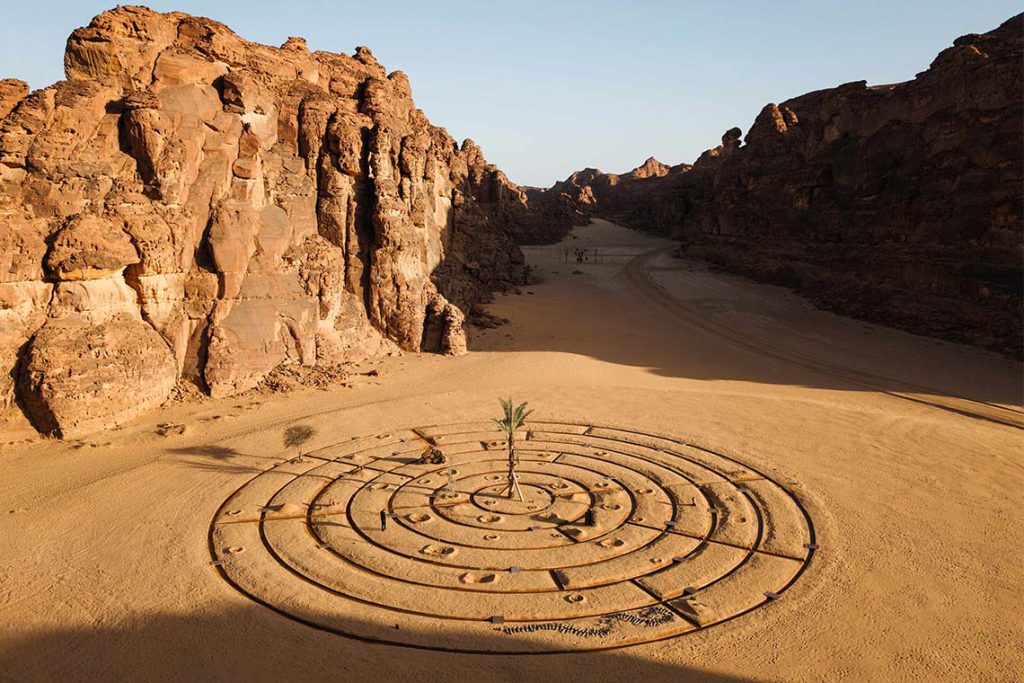
Many of the works, whether in organic or inorganic materials, appear to have sprouted directly from the earth. Take Mohammad Alfaraj’s What Was the Question Again?, a man-made oasis of concentric circles dug into the sand, filled with water and encircling a lone palm tree made from remnants of its peers. If dreams are the question here, then Alfaraj delivers an answer, his installation appearing much like the mirage that would be conjured up in the bleary eyes of desert wanderers.
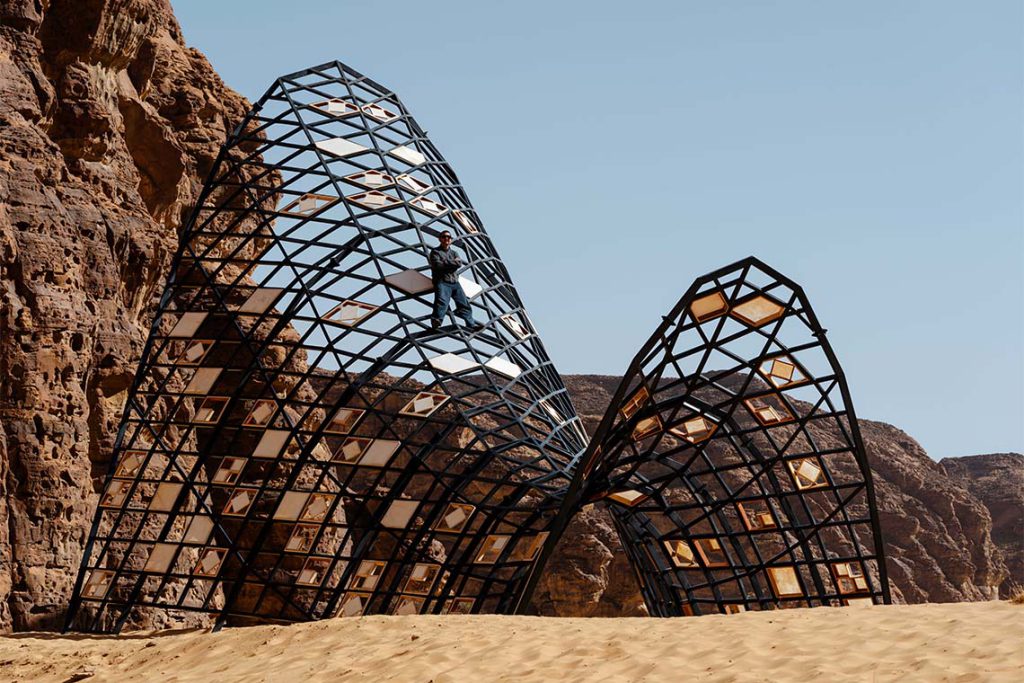
Further along, Sara Abdu’s wavy pyramids, made from both local and Yemeni sand, rise up from the desert floor. While carved too precisely to look natural, they still serve as a reminder that the desert itself provides ample material. It may seem obvious to work with sand in this context, but surprisingly few artists have chosen to do so, favouring either other found materials around AlUla or disregarding local elements altogether. Héctor Zamora has sought to combine the organic and local with the inorganic, stretching cuts of leather to make tar drums across the bars of a climbable steel structure, which waves across the top of a hill yet suffers from being rather distant from the other artworks.
The location of certain pieces means that immediate visual or sensorial reward is not always possible. Visitors are forced to actually engage closely with the works in order to truly experience them, whether that means wandering off-road to wade through Ibrahim El-Salahi’s forest of Haraza trees, or getting up close and personal with art collective Bahraini-Danish’s Bloom, a monumental black installation which takes the shape of abstracted desert flowers casting wide shadows onto the ground. Despite its intimidating size, there is something intuitive about its design that invites physical engagement, as with a large black wheel that can be turned (if one has strength enough) and which prompts delighted smiles and laughter from both children and adults alike.
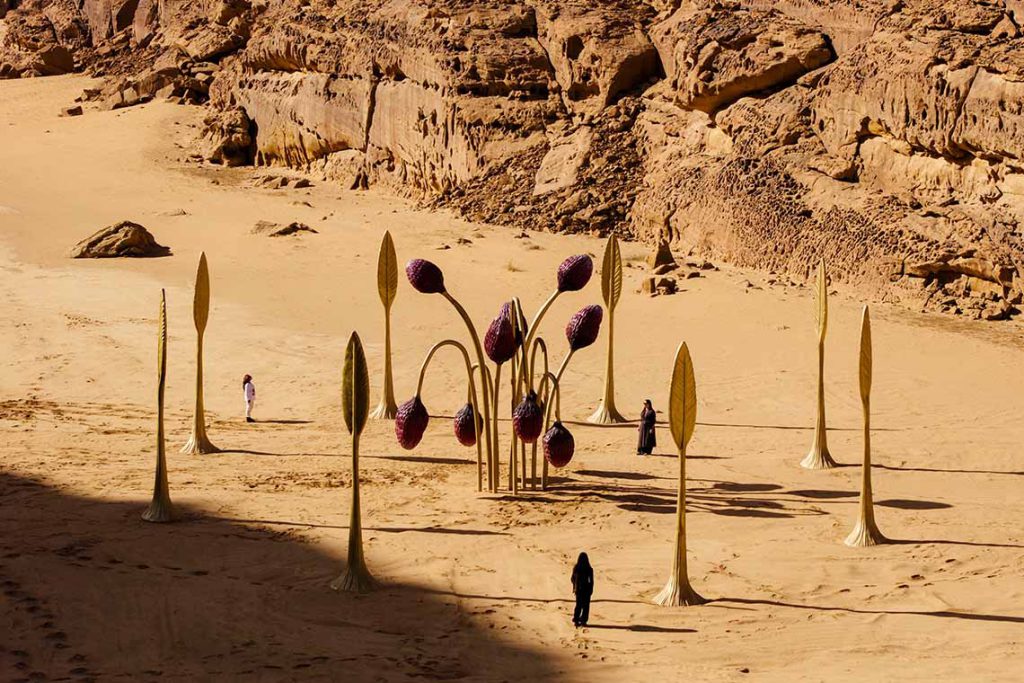
This sense of play, which in some ways is really what giving into pure imagination is about, is expressed in its fullest glory in María-Magdalena Campos-Pons’s Imole Red. Another impressive installation in terms of scale, it features a bouquet of oversized allium flowers, surrounded by stalks of golden leaves. The flowers are varying shades of deep red, becoming more entrancing the closer one gets. Although they should be incongruous in such an arid landscape, they somehow appear more comfortable there than Abdu’s sand structures, the sleek buds emitting a “so what, of course we’re here” attitude.
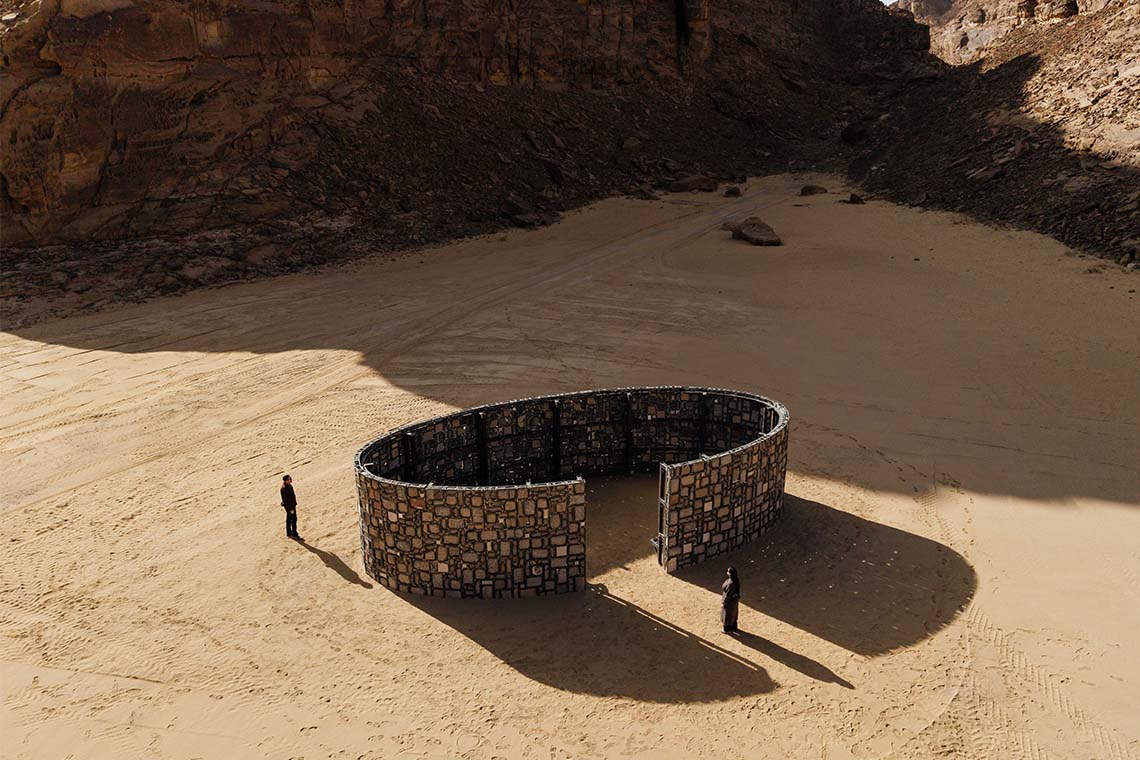
Some of the installations suffer from being dwarfed by the impressive natural surroundings, reducing their initial impact, although closer inspection reveals welcome moments for rest and meditation. Take Delhi-based artist Vibha Galhotra’s Future Fables, an oval shelter made from construction debris gathered in AlUla, which provides protection from the elements and allows visitors to walk inside its walls and even sit on benches. Or Basmah Felemban’s Murmur of Pebbles, almost hidden from sight as it blends into the crock behind it but which on closer inspection discloses hidden carvings in the oversized black pebbles that are scattered around the central stone – a smooth structure save for the wide grooves in its sides and for the fact that it seems to have been cut up and put back together again.
The only work which risks being overlooked, with only a signpost to indicate that there is something to experience, is Tarek Atoui’s The Water Song. To the naked eye, the installation looks like a series of pipes that have been discarded in a gully of the valley. But if one happens to walk by at the right moment, the valley begins to rumble and shake, as sound emitted from the pipes echoes across the surrounding rocky walls. It is a deceptively simple installation, yet deeply impactful. Water Song demands attention, the sonic volume making it impossible to speak – one simply stands there, mesmerised by Atoui’s harnessing of the desert environment to play on the senses.
The importance of paying attention to the specificity of place when conceiving large-scale land art is nowhere more apparent than in the reconstruction by Agnes Denes of her famed The Living Pyramid, installed in the Daimumah Oasis, far away from the rest of the presentations. By using local plant species which will continue to grow over the course of this pyramid’s existence, she has underlined the ephemeral yet constant character and rhythm of the desert environment.
While this year’s Desert X AlUla offers ample opportunity to engage with the desert landscape and to escape into each artist’s dreamland, it also reveals that impact does not have to be managed purely through sheer scale and competition with the landscape. The impressive AlUla canyons have always encouraged artists to think bigger, whether in terms of size or concept, highlighting how success in the realm of land art will always require an additional degree of finesse and carefully considered originality.
