

Marfa’ Projects celebrates its first decade with Marfa’ 10, an international group exhibition that highlights the supportive networks that sustain the gallery’s practice.
The current exhibition at Marfa’ Projects marks a significant milestone for the Beirut-based gallery. A full decade has passed since its founding by Joumana Asseily in 2015, and while a ten-year anniversary may not register as a long span for an international gallery, within Lebanon’s recent history it carries significant weight. Since its inception, the gallery has been forced to navigate the 2019 revolution, the collapse of the financial system, the effects of Covid-19 and the 2020 port blast. The latter, which killed more than 200 people, tore through the gallery and destroyed the space.
Determined to continue its mission, the Marfa’ Projects team rallied to reopen. On 21 May 2021, the gallery welcomed audiences back with Water, a group show organised in collaboration with Galleries Curate. With physical gatherings limited due to the pandemic, the exhibition was shared virtually through the gallery’s global network. Those connections again proved essential during Israel’s most recent war on Lebanon, as peers across the art world offered tangible support through gallery-share initiatives, including Condo in London. For Asseily, these actions underscored the fragility of independent gallery ecosystems and the central role of solidarity in sustaining them.
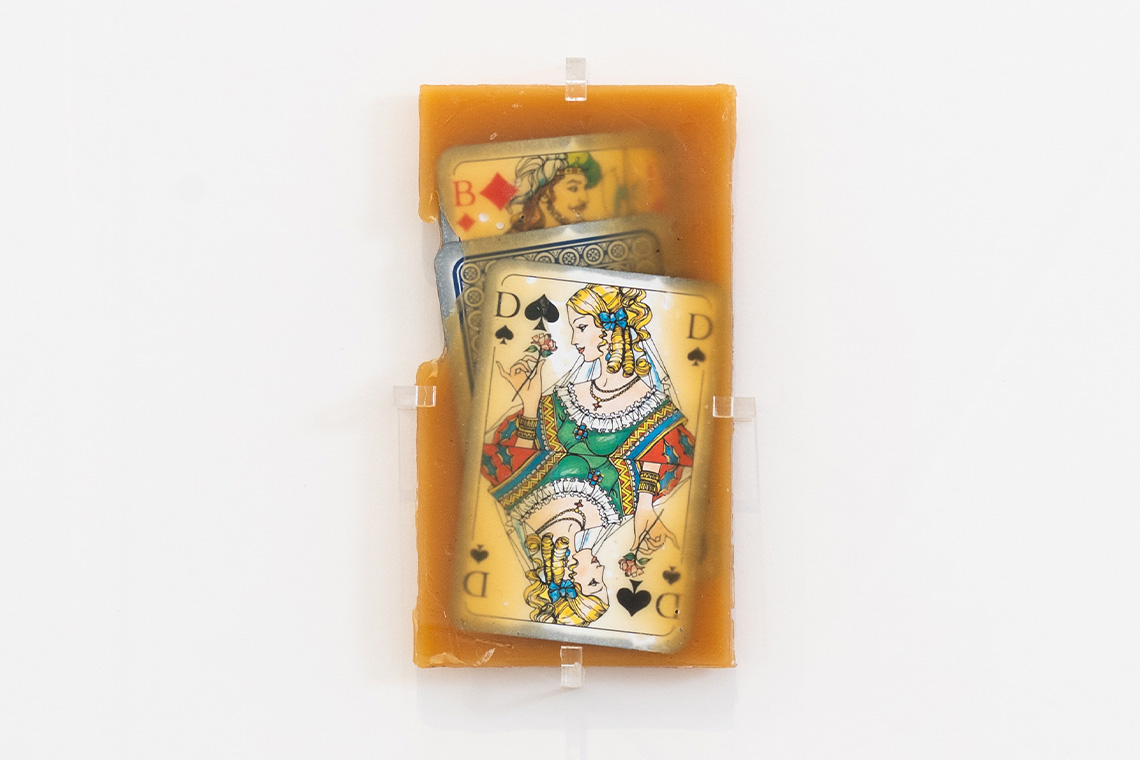
Today, Marfa’ 10 honours this network directly, bringing together works consigned by 18 galleries from around the world. The resulting exhibition celebrates not only the endurance of Marfa’ but also the collective structures that have sustained it. This spirit of cross-cultural exchange is immediately evident upon entering the space. Seta Manoukian’s What is the Best Way (2024) features two acrylic paintings, each one depicting vibrant mountains rendered in pinks, blues and greens. Anchoring one wall, their luminous palette creates a sense of calm. Nearby, Alvaro Barrington’s We Be Jammin, North Star, G (2023) pulls visitors in an entirely different direction. Bottega Veneta leather and other fabrics are stretched tightly across a painted steel pan, forming a precarious star-like structure that evokes improvisation and tension. Paola Yacoub’s Jeux de Guerre (2025) disrupts the narrative further, presenting skat playing cards, their French suits encased in wax. The gesture is subtle yet charged, transforming objects associated with leisure into sealed relics embodying strategy and chance. By placing artists from different geographies and generations side by side, Asseily creates a distinctly collaborative atmosphere. The space becomes shaped by density and heterogeneity. Rather than centring a singular narrative, the exhibition instantly foregrounds interdependence.
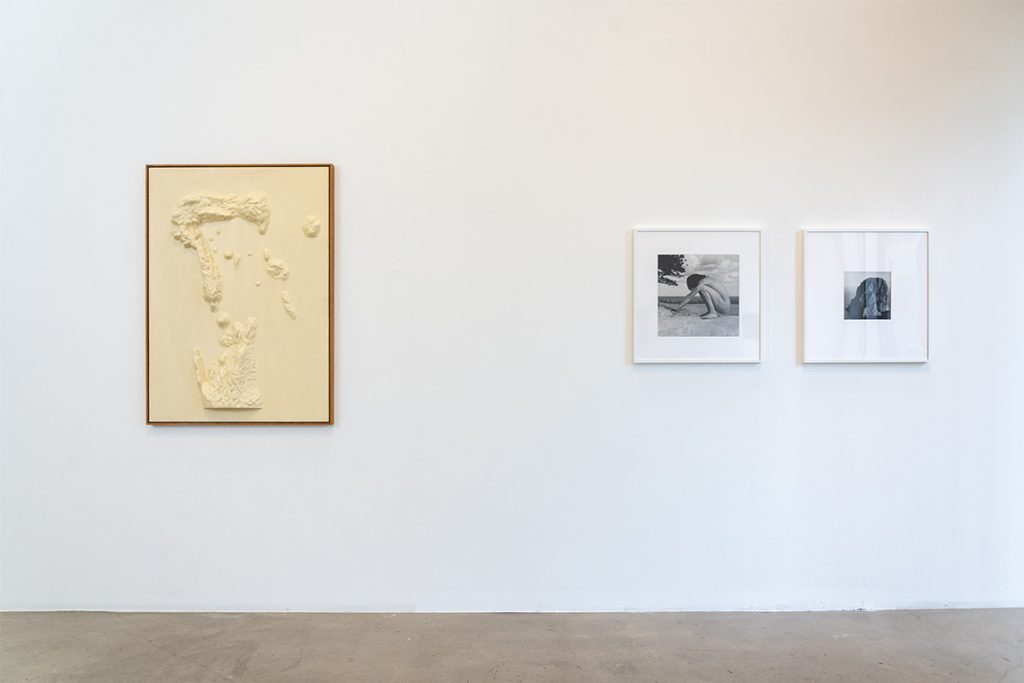
Elsewhere, contrasts continue to accumulate. Olivier Millagou’s Peinture Périmée (Rose) (2023) depicts a hand holding a rose, rendered in acrylic and expired expanding foam. The image feels faintly melancholic and forms part of the artist’s Peinture Périmée series, which uses animals, flowers and insects as symbols of the fragility and irreparable damage of the Anthropocene. These themes are compounded by Robert Mapplethorpe’s Lisa Lyon (1982), presented courtesy of Galleria Franco Noero. Depicting a nude woman in a downward pose, head turned inward and hair obscuring her face, the work conveys a sense of introspection. Meanwhile, Joanne Burke’s Festival 7 (2025), a wall-mounted bronze sculpture, glitters in opposition. Delicate lashings and indentations catch the light, producing a surface that oscillates around Burke’s fascination with transformation.
Together, these works suggest a form of collective presence rather than one of thematic uniformity. Each of the pieces retains its autonomy, yet their proximity to one another creates a sense of community and mutual reinforcement. Further contributions from Sadie Coles HQ, Experimenter, Emalin and other galleries underline this theme of reciprocal support. Other works in the exhibition are markedly celebratory in style. Ulrike Müller’s Signs and Shields (2024), with its enamelled steel surface and abstract shapes in dark browns, vibrant yellow and soft pink, introduces rhythm and colour. Elsewhere, a nude woman reclines on a tiger-skin rug, balloons superimposed over her body, her gaze unapologetic. This piece, entitled Sex, Spies, and the Suicide Dancer – Angelika (2016) by Raed Yassin, is daring and playful. These more animated works, jovial and lively in nature, cleverly create an atmosphere akin to a birthday gathering.

While the main focus of the exhibition is celebratory, the works are not entirely removed from the local context. This is especially true for some of the artists represented by Marfa’ Projects, whose work occasionally introduces a more reflective register. Stéphanie Saadé’s zinc weathervane sculpture Losing North (2018) is installed outside the gallery, referencing the Lebanese Civil War through its slow, directional movement. This period is evoked again in Vartan Avakian’s The Revenge of Geography (2013), which draws from the Lebanese action films of the 1980s, produced amid civil war. Avakian constructs maps of fictional urban spaces, using the work to expose how mapping often reflects wistful desire as much as hard fact.
Urban memory is woven throughout other pieces, too. Mohamad Abdouni’s Gold Tan (2018) captures a banal Beirut scene: a photograph depicts covered porches, stripped materials repurposed for shade and a rug hung out to air. Right in front of the picture sits Ahmed Ghossein’s A Sealed Gallon (2023). Composed of resin-filled water bottles, the piece references the petrol shortage of 2020, when Lebanese citizens were forced to line up for hours on end to purchase petrol at inflated prices. By transforming these vessels into contained witnesses of scarcity and control, Ghossein nods to the crises which have plagued Lebanon for the last several years.
Through both these celebratory and more reflective pieces, Marfa’ 10 affirms art’s ability to act as a connector within complex contexts. Hamish Pearch’s Couple (200 million years on earth) (2025) encapsulates this sensibility perfectly. Two turtle-like forms in slightly rusted silver carry matches stuck to their backs in pink sticky tack. The sculpture is both whimsical and thoughtful all at once; the matches suggest the potential of crisis and danger, while the pair of turtles highlight themes of endurance and companionship. Ten years on, Marfa’ Projects remains an example of where persistence, unity and collective care have sustained survival.
Marfa’ 10 runs until 15 January
