

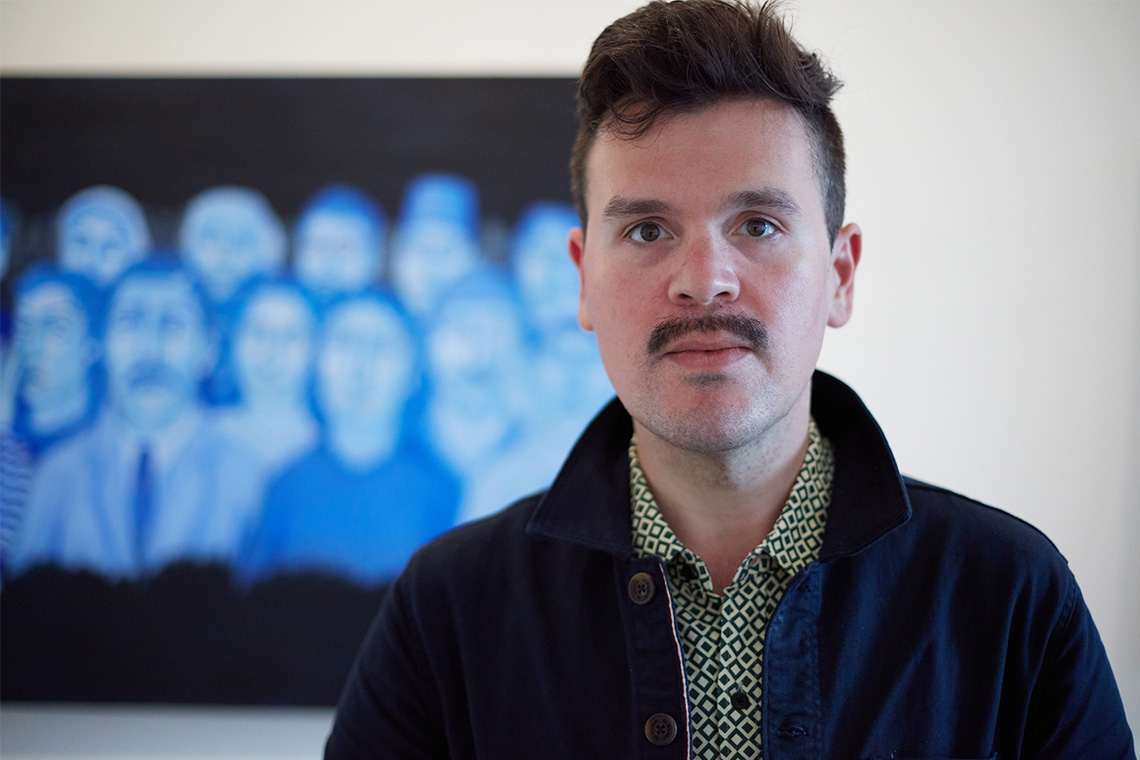
The Los Angeles-based former journalist and painter discusses the role of food symbolism, family and liberation politics in his work.
Canvas: What is the importance of depicting food in your practice?
Massoud Hayoun: I am an emotional eater. When I see others eat, even total strangers, it inspires in me feelings of empathy. I use food because in my previous incarnation as a journalist, the big question was how do we get people to care about what’s happening to people in seemingly irrelevant walks of life – people from far-flung places around the globe. I’m hoping food is a common language that can reach the desensitised.
Food is also so painful to me. My cooking shortened my grandma’s life. Empirically. I had made my grandmother brik – Tunisian potato parcels that are likely the descendants of samosas, via the Eastern Arab nations that make samboosa / samboosek. Shortly after I made them, she needed gallbladder surgery, and the doctor told us she couldn’t have any more fried foods, which she so rarely did in those times. I just wanted to try making brik, and she wanted one for old time’s sake. She didn’t survive the surgery. So, to say the least, food is both a source of inspiration and pain to me.
How do you feel about the efficacy of food iconography – like watermelons and pomegranates for Palestine – as a form of resistance?
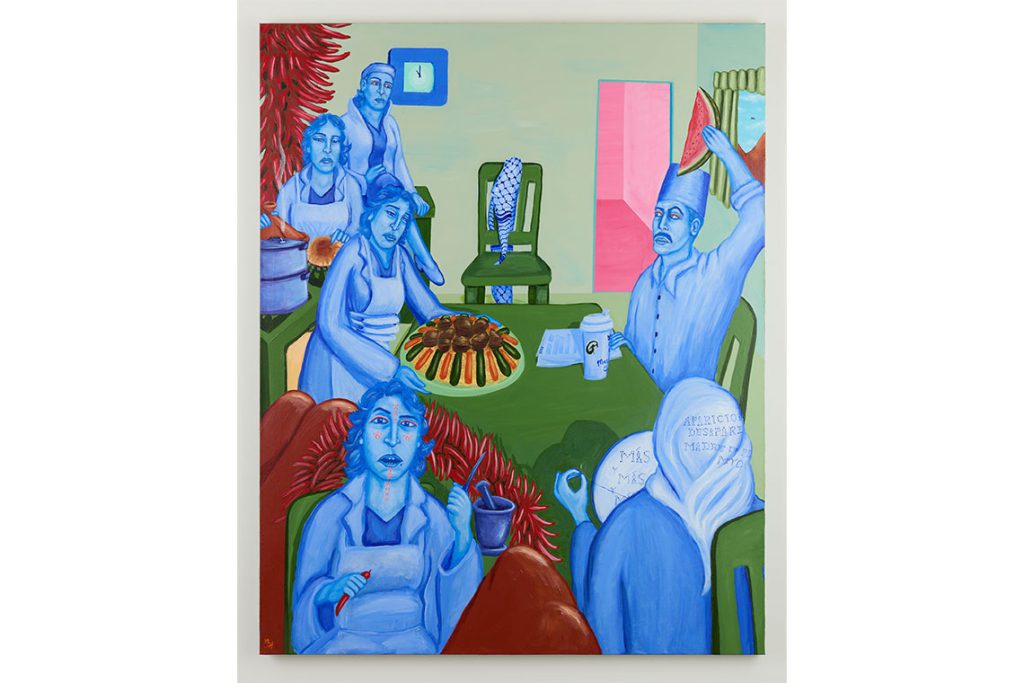
With the genocidal starvation of Gaza, food as a symbol was revealed to be as painfully bourgeois and meaningless as it fundamentally is. In The Master’s Tools – referencing the iconic Audre Lorde work – I meditate on the ways symbols like the watermelon, popularised on social media, fall short of the actual concrete action we must take when confronting genocide and autocracy internationally. I am brandishing a watermelon slice on my forehead in that work, knowing full well that I have done nothing real to stop what is happening in Palestine. But then, painting itself is a bourgeois exercise. One painting in which I feature Ho Chi Minh dining with my grandparents is titled after a Mao Zedong quote: “The struggle isn’t a dinner invite, an article, a painting”. On that table is an imagination of the field of Ninh Binh, teeming with the actual revolutionaries who won their country’s freedom from the French and then the Americans.
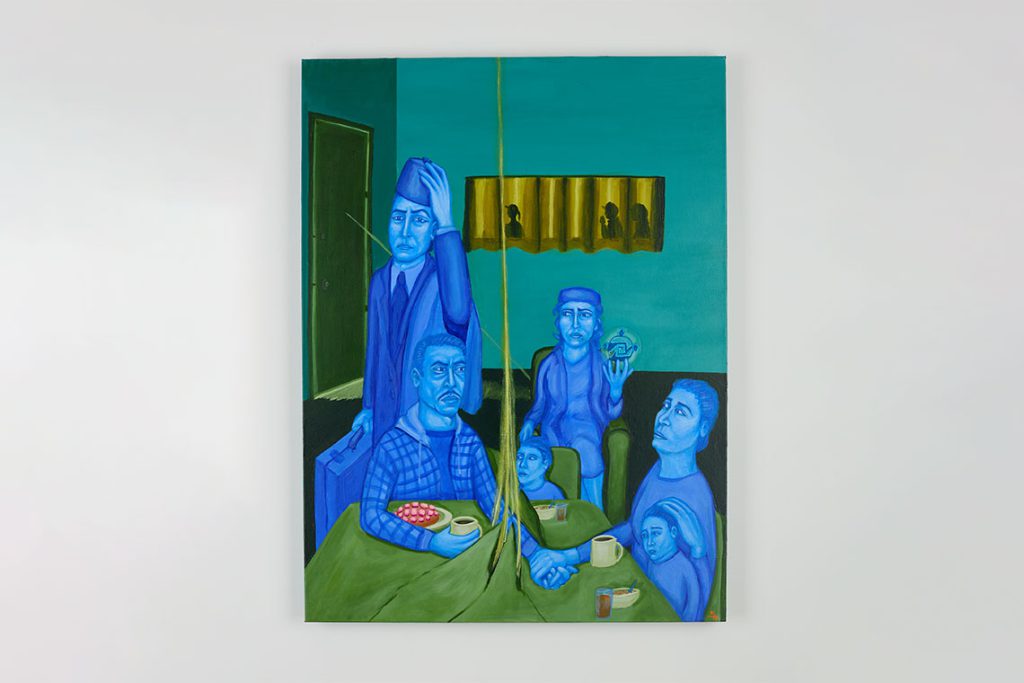
How is the dining table a symbolic vehicle or catalyst in your work, like in Anatomy of a Raid (2025), which portends an ICE raid at the breakfast table?
I like tables. I like to sit and have long conversations with people whose company I enjoy – people with liberation politics – and share food and thoughts with them. I love to eat from the same dish. We are sharing in our humanity when we are tasting the same things. Still, I am aware of the limitations of my symbols of hearth and home. That will shape my practice moving forward, much as I will never abandon the language of food in my work. Regarding Anatomy of a Raid, the USA these days is a society that prizes traditional nuclear families based on Christian principles. I am pro-family in the way that my adversaries are pro-family. I hope to break through to my adversaries by showing them a symbol of hearth and home and its destruction in the form of that table. But for lack of being able to break through to them, I am highlighting their hypocrisy.
Several of your close family members often feature in your paintings. Why is it important to you to explore their lives and stories, which span diverging geographies and relationships to nation-states?
In my time as a journalist, news desk editors would always challenge my pitches on international stories. “How is this important to Americans?’ was the refrain. Their question was grotesque. But I don’t regret having been asked it, because with these paintings, I’m populating them with dear loved ones, with family, as a sign that all politics are personal. The way that immigration authorities are terrorising communities here is relevant to me, even if I have the privilege of these ultimately meaningless, man-made papers, because for a long time my grandfather didn’t have papers, and my mother was born stateless – Tunisia only allowed people to acquire citizenship through their maternal line after my mother was born – and therefore without access to the human right that is a travel document or an anchor in a country that would accord her rights and social services. People know already that a genocide is pertinent to all humans, even if they don’t always say so or admit it. But just to raise that to them until it becomes more shameful to do nothing, I will paint people and more people, for lack of any actual political means, to push our leaders into action.
You have written before that “performative, laborious hospitality” reminds you of your grandmother. How did your childhood observations on the making and serving of food and other private social labours influence you?
My grandmother wielded something like power, but always within the confines of male domination. She needed to have overcooked for us and on occasion was made to bow to my grandfather. That seems like such a waste of revolutionary potential. These contradictions are true of so many people and entire nations these days. I paint like I breathe, but I realise that the world won’t be made more liveable by painting.
Can you unpack the evolution of depicting harissa in your practice?
I was making so much harissa after my grandmother died. Jarring and giving it to people for no reason. Harissa really isn’t a very special food – it’s just crushed pepper paste, but it is to Tunisia what ketchup is to the so-called West. I like how laborious it was. I needed to feel physical exhaustion to temper the mourning.I have used harissa to represent the subversion of male-dominated autocracy and oppression. But then, as in The Master’s Tools, I hope to underline with my work that my mother should never have needed to cook at all, and that it is ridiculous to feel satisfied with brandishing clever little symbols of subversion while still abiding by the dictates of a society premised on oppression. We are living in a time of very urgent horrors. There’s no room for poetry in an era of crisis. Yet here I am painting my symbolic peppers. I continue to paint, but without pretending it can mean a damned thing until this so-called civilisation becomes civilised.
This interview first appeared in Canvas 121: If Walls Could Talk
