

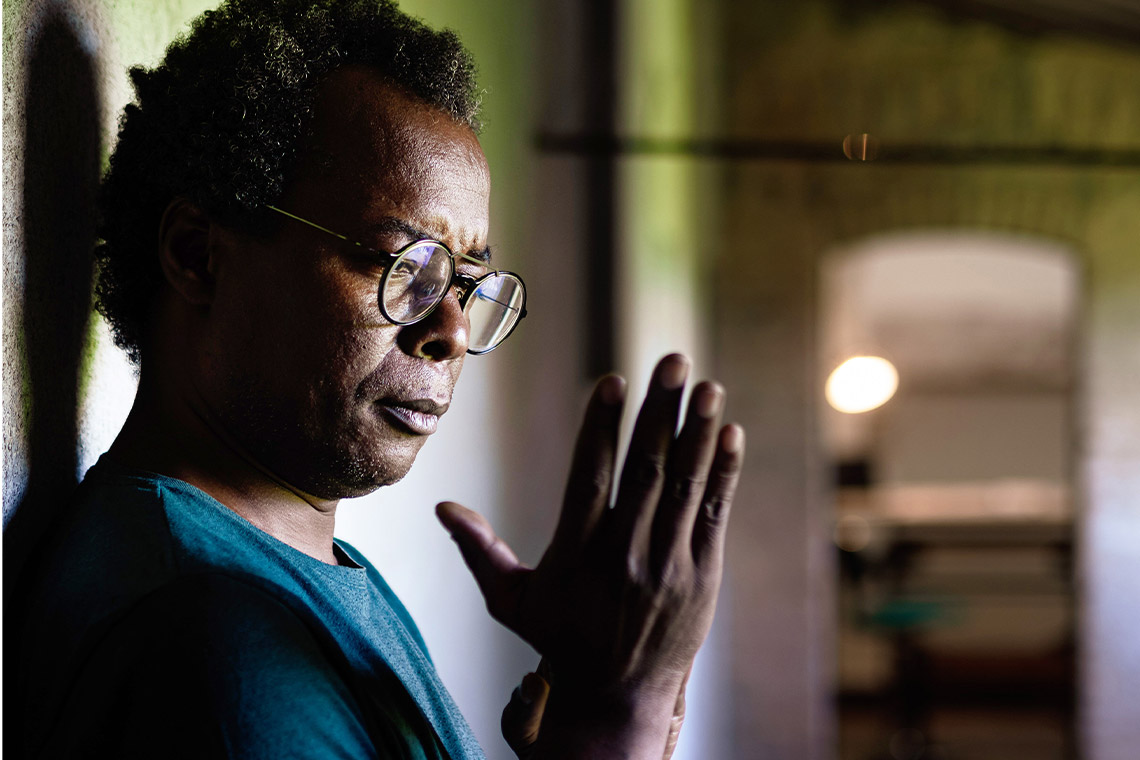
The Moroccan artist of Amazigh descent defies what borders and history books dictate, attributing his own alchemies to earthy materials.
A few years ago, M’barek Bouhchichi was in an artist residency at a former settlement of enslaved African people in Brazil. During his research on native materials, he had an epiphany of sorts, recalling to Canvas how “I suddenly no longer saw the difference between humans and flora”. The multimedia artist still attributes the moment to “how surprising the invisible is” and to the alchemy of knowledge and tactility that unveils another sensory revelation: “Materials speak like us; they are witnesses”.
Bouhchichi’s interest in unconventional forms of communication lends itself to a curiosity for vulnerable yet perseverant languages. In the current Sharjah Biennial, , he presents Our voices are wounded (2024), an earthy installation featuring 40 ceramic vessels of styles and forms reminiscent of the archaeological finds exhibited at most international museums. Disarmingly familiar yet charmingly singular, each vessel is engraved with lines of Palestinian poetry translated into what the Moroccan-born artist calls “so-called minority or forgotten languages”, as well as English, Arabic and French, which he explains as “charged with historical responsibility”.
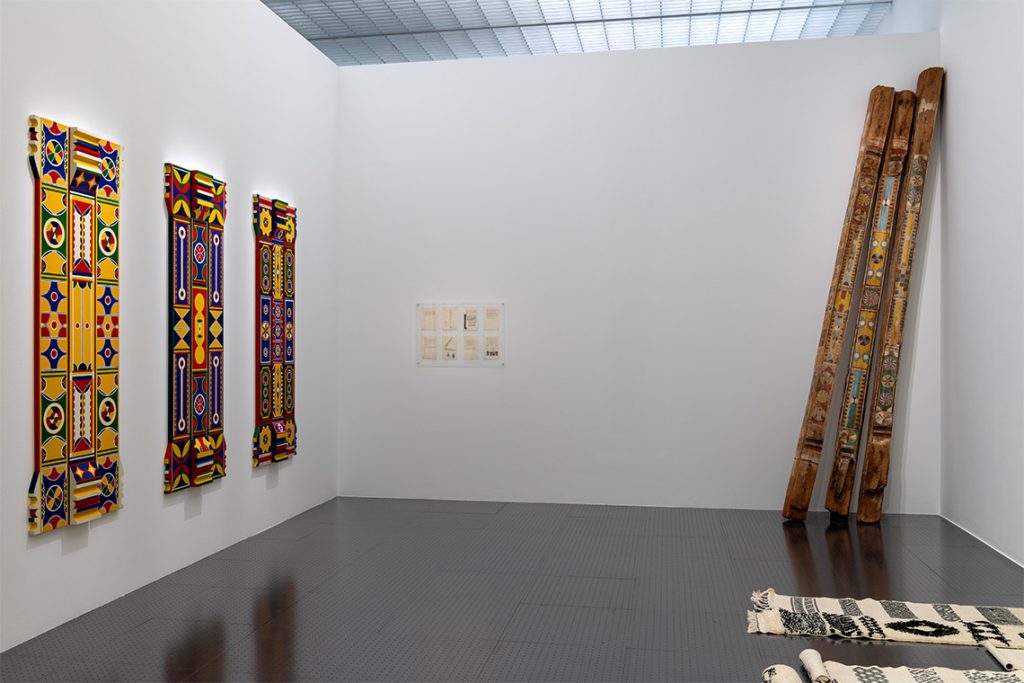
The individual pieces are arranged within wall niches and are accompanied by the artist’s 2023 project, Poetry must not perish. For then, where would the hope of the world be – Léopold Sédar Senghor. The leaning sculptures comprise ancient wooden threshing boards called tribula (sing. tribulum), used by the artist as tablets for excerpts of poetry by the titular Senegalese thinker and former president. Bouhchichi has translated these quotes into Braille in order to revitalise the meditations of the late Négritude theoretician on the potential of words and language to effect restoration and change, attributing power to the invisible. The subtle layout of the coded white letters sparks across the aged dark wood, resonating as abstraction for the sight-abled viewer. “The invisibility of struggles and the idea of a plural testimony transcend time,” the artist explains. The poetry’s yearning for touch over the textured surface embodies the artist’s invitation to listen with the eyes and touch through seeing.
Bouhchichi is deeply committed to the exploration of erased histories among his community of Black Amazigh people of southern Morocco. His process embraces unconventional subjective sources to conjure a pliable perception and sees him investigating far-off craft studios, perished languages and forgotten poems. “I invent to exist,” he says about the quasi-archaeological experience, explaining how it “allows me to interpret freely without pressure”. In this sense he sees a parallel between his appetite for the unearthed and the urge to use multiple pieces in his sculptural practice, such as with his presentation in Sharjah. “The act of multiplying the medium pushes me to activate observation and look, listen and read with an open approach,” he says. All along, he asks the question of what it means to be Black in Morocco.
Accounts of the “inter-racial social lives led by poets” intrigue Bouhchichi for their balancing of honest orality with sharp observation. Oral poems of the twentieth-century Black Moroccan peasant and poet M’barek Ben Zida, for example, guide him perhaps more than any form of historical text. The artist’s 2018 floor installation M’barek Ben Zida features multiple glazed ceramic busts of the titular poet. Clay best embodies the harmony of the individuality that the artist encountered during a discussion with a potter in southern Tunisia: “I still live with the memory of him telling me ‘We are all made of clay’,” he recalls. The encounter led to a series of works in which multiple busts unite in different earth tones, similar to skin colours. Throughout, the corporality of a vessel is an uncompromisable essence. Bouhchichi remembers a habit among Moroccan potters of describing ceramics by using human body traits, as well as aspects of everyday behaviour and organisation. “The use of clay symbolises racial relations around the appropriation of land and water,” the artist observes.
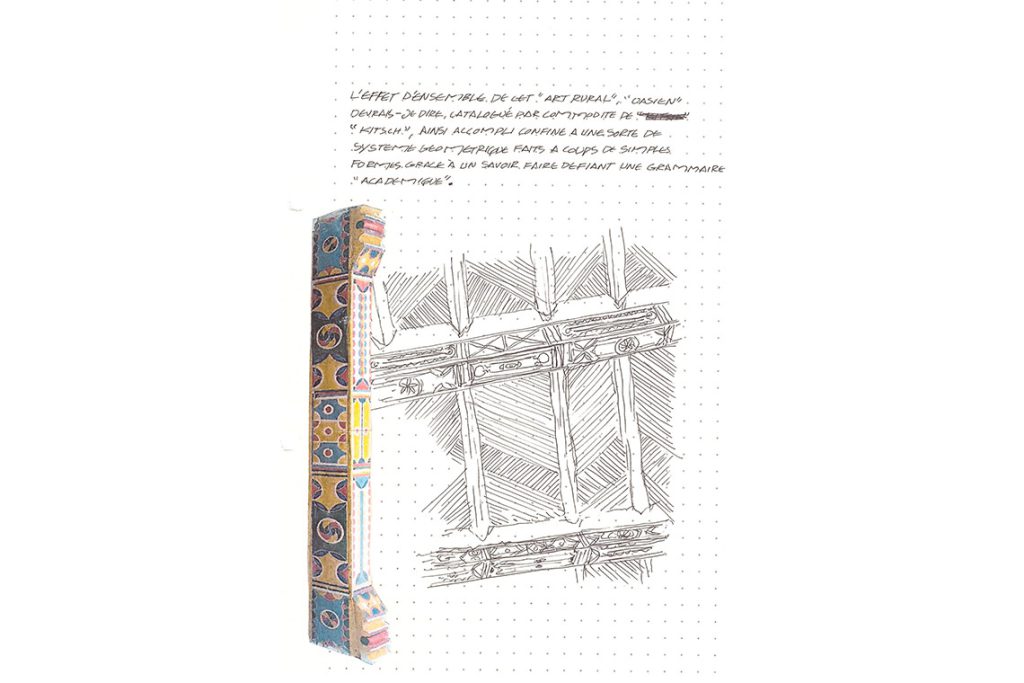
Besides microhistories of his community, Bouhchichi often returns to his own particular lineage. Southern Morocco’s large oasis of Akka, which he sees as an “unknown region that I carry with me”, grants tales innate to the artist’s own journey. Reprendre les gestes interrompus and Ma grand-mère (both 2024), which are currently a part of the group exhibition After the end. Cartographies for Another Time at Centre-Pompidou-Metz, pair the artist’s craftswoman grandmother Aicha Hammou’s painted palm beam panels, which were offered to her by a relative in the late 1950s, with steel beams decorated in similarly energetic geometries. As much as the emotional bond of the familial, the gesture links what he calls “the supposed distinction between school-taught art and craftsmanship tied to the Black body and non-knowledge”. The visible and the overlooked equally inhabit the generational conversation between a globally exhibited artist and his elder. Bouhchichi sees in his community an “inherited language that is made with hands and transmitted and personalised as a way of expressing and maintaining singularity”. He considers craft as a territory of exploration and excavation in which he seeks to unearth the loaded histories of the coloniser, an impact and legacy that “qualified our objects and created a distance from our imagination”. Individuality in craft is paramount, with the artist relishing the potential of error and repetition in the hands of different makers, a process that “defies industrial seriality”. Clay’s unpredictability in outcome and its susceptibility to variable formation helps Bouhchichi to “learn to unlearn a standard aesthetic in horizontality”.
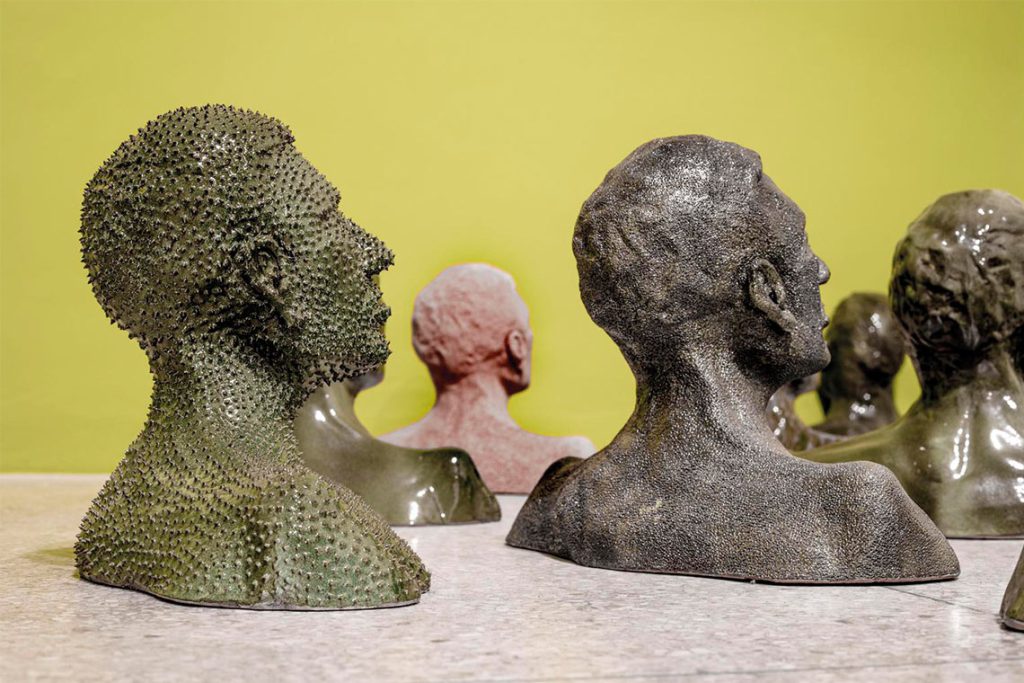
Image courtesy of the artist and Selma Feriani Gallery
Portraiture, on the other hand, grants a form of archive, an unrestrained manifestation of the decolonised imagination; Selma Feriani Gallery will debut a group of the artist’s portraits at its Art Basel Hong Kong booth in March. Painted on yellow rubber, his Black subjects persist and inhabit, either locking eyes with their audience or diving into contemplation through far-off gazes. “The Black body has long been considered a raw body, the object of representation in nameless characters and sometimes fantasised,” Bouhchichi explains. In his re-claiming of autonomy, his subjects seep into the firm rubber with daringly malleable emotionality.
The self, in Bouhchichi’s work, is positioned against a vertical continuum of time, history and reason, as imposed by the oppressor. The artist describes the being as a “form of assuming social responsibility”, which claims its potential through ancestral orality, craft and land. “I think with my feet, but not alone,” he says about the impact of the geography which he believes “has shown me the invisible walls”. Furthermore, within the invisible he notices interpretation and open-mindedness, with abstraction lending itself to a narrative fluidity that captures each viewer individually. The rhythmic geometry of the dominant oxidised metal and minuscule brasswork in La Société de Métayage (2021–22) refers to the unjust distribution of land to the Haratin people of the southwestern Maghreb. The beaming of sharp brass motifs across heat-treated metal materialises the struggle of communities for agricultural rights. “With abstraction,” the artist says, “I continue ancestral gestures to cultivate silence, a means where I do not engage with violence but with poetry linked to the land that we both share but which divides us.”
Place is a consciousness that Bouhchichi experiences daily at his studio in Tahanaout, at the foot of the Atlas Mountains. “I continue to look at Marrakech from afar and at the mountains that lead to the south,” he ruminates. At his small studio, he works with a variety of artisans from different regions, particularly the south of Morocco, affirming how “my workshop is the geography and the history of many individuals, as well as of their communities”. Beyond nationalities or borders, craft conjures imagined possibilities of a Berber existence at the crossroads of shared and personal experiences. “The Maghreb is a floating island to which the colonial imagination has installed the idea of a Sahara barrier,” concludes Bouhchichi.
This profile first appeared in Canvas 117: The Maghreb Issue
