

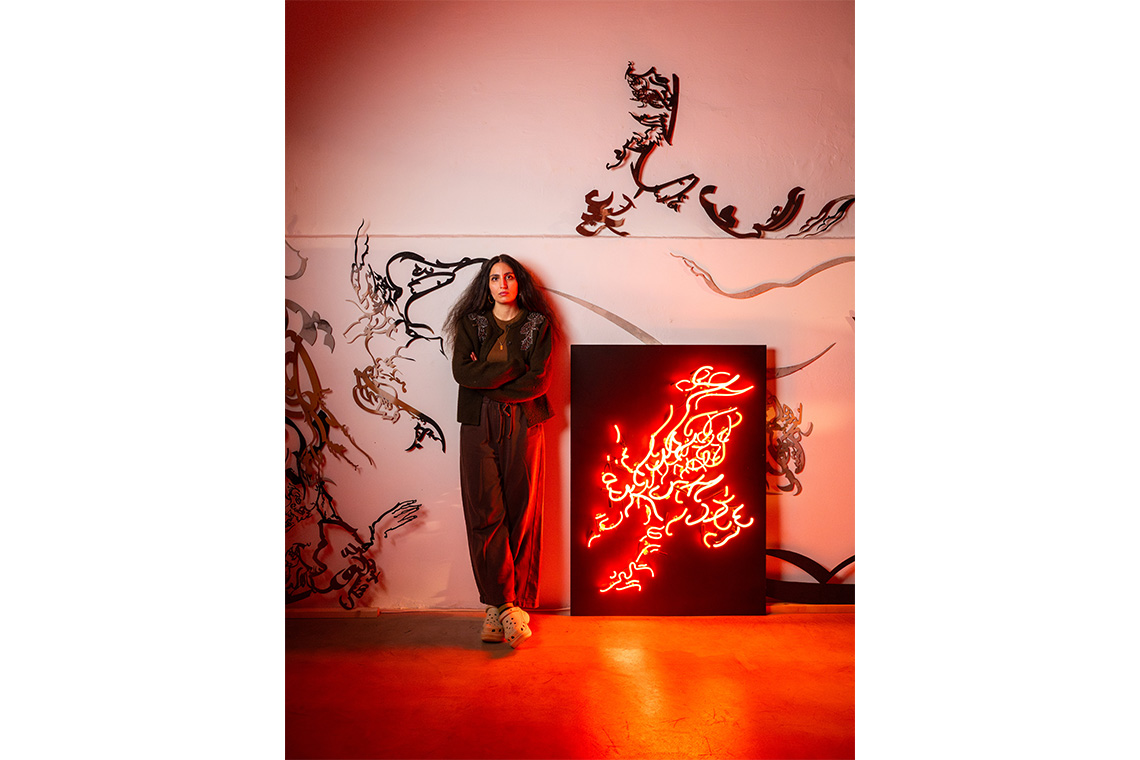
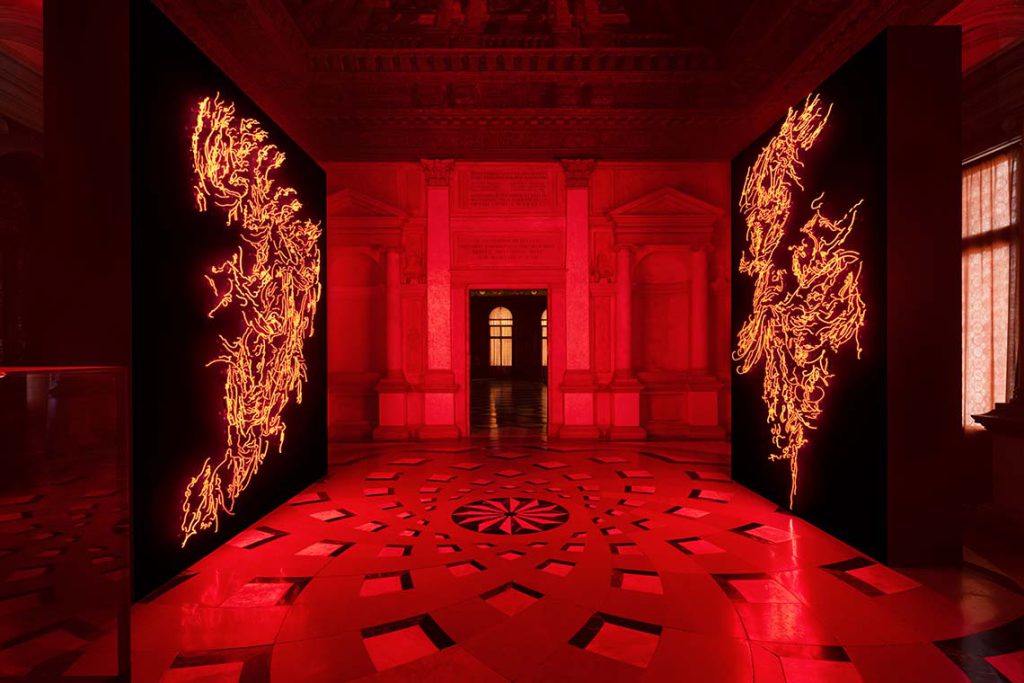
The artist discusses Fragments of Fire Worship, a site-specific installation at the Biblioteca Nazionale Marciana, hosted as part of the first collateral exhibition at the Biennale Arte by Fondazione Bvlgari.
Canvas: What was your starting point when developing the installation for the exhibition?
Monia Ben Hamouda: The context was the first important consideration. Entering the vestibule of the Biblioteca Nazionale Marciana meant confronting a form of knowledge that presents itself as solid, ordered and almost untouchable. Rather than establishing a direct dialogue, I felt the need to work through friction, avoiding any illustrative or mimetic gesture.
My intervention was guided by the idea of not occupying the space, but activating it laterally, introducing a presence that does not compete with the monumentality of the architecture, but subtly disturbs it. I conceived the work as a controlled contradiction within an institution built on the promise of permanence, emerging from a tension between what remains and what can no longer be reconstructed as a system. The building embodies a Renaissance logic of order and rationality, where classification, transmission and custody are inseparable from power: who can access knowledge, who can interpret it and who is allowed to preserve it. At the same time, preservation is never neutral. It is a constructed narrative, one that can be shaped, controlled and manipulated. In a moment like the one we are living through, it becomes even more urgent to acknowledge that no space is neutral, and that every system of knowledge, no matter how stable it appears, can be instrumentalised.
What are some of the considerations when presenting a site-specific installation?
Site-specificity is not only about scale or placement, but about reading the space as a system, trying not to impose something onto a site, but to allow the work to emerge through a negotiation. This is often a productive condition for me, because it allows me to engage with structures of power, with non-innocent architectures, and with spaces that already carry an embedded vision of the world. For this reason, in my practice, the space that hosts the installation is always treated as a malleable material, to be shaped as much as the artwork itself.
Where did the title Fragments of Fire Worship come from? What does fire represent in your work?
The title emerges from a tension between what remains and what can no longer be reconstructed as a system. The artwork’s conceptual layer begins with a reflection on fire as an origin of knowledge – fire as revelation, but also as destruction and erasure – and on the idea of worship as a repeated practice that does not necessarily require full understanding. The artwork aims to investigate the structural conditions that produce censorship and destruction, with fire serving as a conceptual device through which I can address how knowledge is filtered, how narratives are authorised and how texts and images become vulnerable.
Historically, fire is one of the most charged images. It has destroyed libraries and archives across centuries, but has also appeared as a force of political transformation. Memory inevitably informs how fire functions symbolically today. It is not only an image of destruction but also on of exposure of a system pushed to reveal its own violence. Fragmentation and opacity in my work attempt to hold space for these contradictions without collapsing them into a single narrative. The work does not represent events directly. Rather, it constructs a condition in which the viewer becomes aware of how knowledge, power and vulnerability intersect.
You were the winner of the MAXXI Bvlgari Prize in 2024. How has this impacted your practice? Do you see this moment in Venice as a continuation of your previous work or a shift in a new direction?
The prize allowed me to expand both the scale and the complexity of my work, particularly in relation to architecture. The installation at MAXXI was already engaging with conditions of collapse, suspension and instability. Winning the prize was important, but my focus was primarily on entering into a direct confrontation with the architecture of the museum. Working within a building designed by Zaha Hadid meant engaging with a very strong spatial language that does not easily allow itself to be interrupted. At the same time, they are extremely valuable situations because they allow the work to be tested against a context that is not designed to accommodate it, but rather to challenge it.
The Venice project continues this trajectory. The Biblioteca Nazionale Marciana is a space that can easily absorb any intervention, and the challenge is to maintain a presence that does not disappear within it. In this sense, it is a continuation under different conditions: less about resisting a spatial force, and more about introducing a subtle but persistent displacement within an already codified system.
This moment also marks the consolidation of an ongoing collaboration with Fondazione Bvlgari. This exhibition represents our third project together, and this continuity has allowed the development of a sustained dialogue over time, rather than a series of isolated interventions. Working within a long-term framework of trust and support creates the conditions to approach projects with greater depth and precision. It makes it possible to engage with more complex spatial and conceptual questions, and to take the necessary time to refine both the material and formal aspects of the work.
How do you think about the relationship between material and meaning? What draws you to certain materials or forms when expressing ideas tied to ritual and transformation?
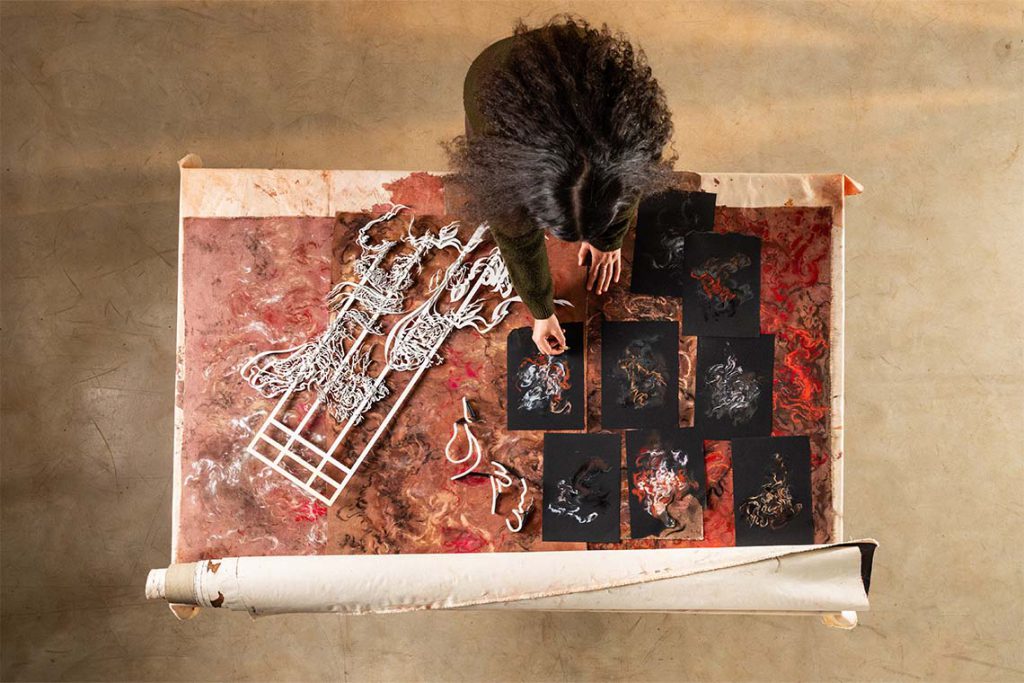
I am not interested in the relationship between material and meaning in the sense of illustrating something that exists outside the experience of the work. I do not begin with a predefined meaning. Instead, I choose materials for their capacity to store time and to carry symbols that can be reactivated, often holding strong internal contradictions. What interests me is how matter becomes charged, how it moves from substance to symbol, and how that transformation is never stable or resolved. Materials speak to me when they absorb this instability – surfaces hold residues, forms appear interrupted, elements are suspended or displaced. The object becomes less a representation of memory and more a site where memory is enacted, and absence, latency and persistence coexist materially.
In my practice, the artwork is conceived not only as a visual phenomenon, but a physical one. Through the use of smell, light, temperature or spatial pressure, it enters the body, alters perception and can generate reactions that are difficult to suppress. I wish the experience act to be very intense and prolonged, and therefore to have the power to affect whoever encounters it directly. It is interesting to me that the work can have the power to heal, to curse, to cast a spell or to evoke a desire, operating within a space that is close to ritual. In this sense, the work does not only represent, it also acts.
Growing up as the daughter of an Islamic calligrapher, how has calligraphy influenced your visual language, even beyond the written form?
Calligraphy is a central territory in my practice, particularly in relation to the idea of language as something written and transmitted. What interests me, however, is the possibility for writing to deliberately lose its communicative function in order to open itself to something else, something closer to a non-verbal, almost telepathic transmission of information. Religion, figuration, geometry and calligraphy are all part of my language and have always been a filter through which I approach art.
When you describe your works as “gestural exorcisms”, what is being confronted? Is this process intuitive or controlled, and how do you balance it?
It is a way of describing a process where gesture becomes a form of release, as well as one of confrontation. What is being confronted is not something singular, it is a set of inherited structures, tensions and internal contradictions. Following the idea that each individual is inextricably connected to their family history and to the psychological universe of those who came before them, “gestural exorcisms” can be understood as attempts to negotiate and, at times, resist these inherited influences – generational legacies, cultural expectations and the pressures imposed by both tradition and the present. The gesture becomes a way to channel this complexity, drawing its force from a sense of urgency. The process is both intuitive and controlled, shifting between what I desire and what the work itself desires to be. There is discipline, but also a moment where control is suspended. The balance between these two conditions is where the work emerges.
This interview first appeared in Canvas 123: Venice Special Issue
