

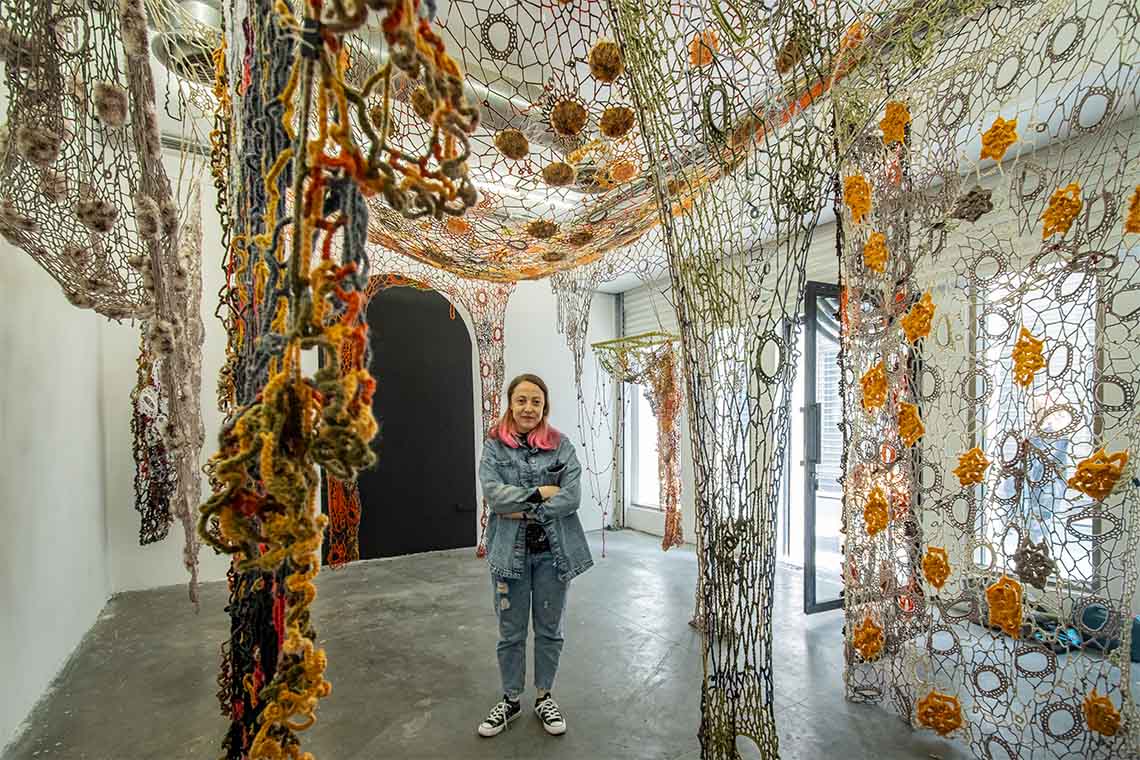
In a sped-up world that is losing connection, the artist aims to remember and record intimate moments of familial closeness.
There is something ironic about the Iranian artist Nargess Hashemi’s memories of her childhood, spent in Tehran and tainted by the Iran-Iraq war of 1980–88. She remembers the destruction, the horrifying air raids, the carpet bombings – sirens going off at her school, with classes peremptorily dismissed and students rushing home to shelter with their families.
Yet strangely enough, Hashemi also recalls instances of joy and relief amidst the atmosphere of danger and anxiety. “What I particularly remember is one specific point in the war, when the city of Khorramshahr, which had been captured by the Iraqis, was retaken by Iranian forces. I remember the celebrations after that,” the Tehran-based artist tells Canvas, with the help of her friend, curator Ashkan Zahraei, who is translating.
Until this day, there have been further instances of armed and political tension in Iran affecting Hashemi and her art, revealing an artist who has carefully observed human behaviour in intimate, domestic settings for more than two decades. She was born in Tehran in 1979, the year of the Iranian revolution, into a non-artistic household. At school, she enjoyed reading and writing, and one of Hashemi’s teachers encouraged her to take extracurricular humanities classes at Kānoon-e Parvaresh-e Fekri-e Koodakān va Nojavānān, a renowned arts institute. When it was time to enroll at university, she was accepted to study microbiology in Tehran, but realised that the subject was not for her, instead studying one year of industrial design and later changing to painting and a degree from Azad University. “I tried photography, playwriting, sculpture and installation art, but with painting I found a sense of immediacy,” she explains. “I particularly valued how it added a layer of expressiveness to portraying my realities and subject matters.”
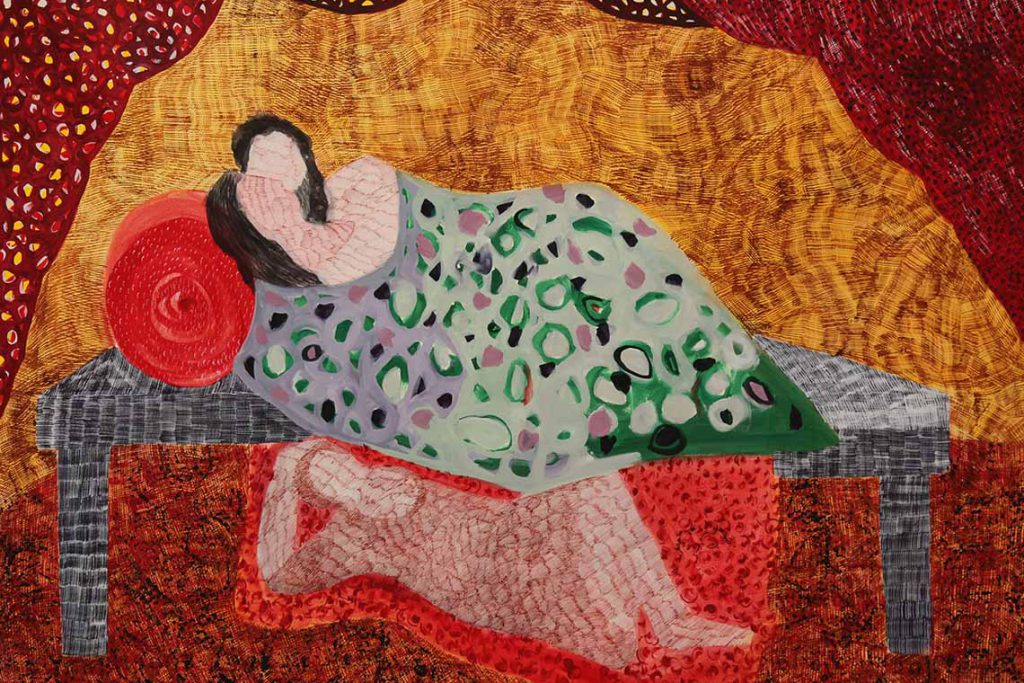
Based on her own memories and experiences, Hashemi’s personal and communal oeuvre dives into the concept of people – friends, family and other acquaintances – gathering together in wedding or party scenes. Sometimes, the setting is much more simple – a man sleeping on the living-room floor, two girls huddled together on the sofa, plucking their eyebrows. “I’m always trying to portray life,” she says, as evident in one of her earliest shows, Stories from the Boudoir (2008), based on her recollections of growing up in the 1980s.
Hashemi’s pieces are drawing-based images of nostalgia and imagination, depicting a society and a world that has altogether faded away – becoming faster, globalised and digitised. You hardly see a single person, for instance, holding a mobile phone or in some sort of online engagement. “There is this pleasant feeling, mood or aura when you gather with people whom you like. What I’m trying to portray is the atmosphere of that feeling,” she says. “But this is something that’s becoming ever rarer as we go ahead. In our lives, we’ve become more secluded, isolated or more lonely, let’s say. A lot of the time, you miss these simple moments of pleasure.”
Ultimately, one of Hashemi’s key messages is to show how people become closer during periods of distress. “In times of war, what you see from family members is a sense of selflessness. People get rid of their selfish behaviour or interests and try to cope with each other. Everyone will eat from the same pot, all cooking together,” she explains. On that point, Zahraei interjects. “In my opinion, during that period [1980s], because of the war and destruction in the country, families were more closely knit,” she says. “It was exactly like what happened this past summer, when Israel struck Iran. Families are close to and supportive of each other during such times.”
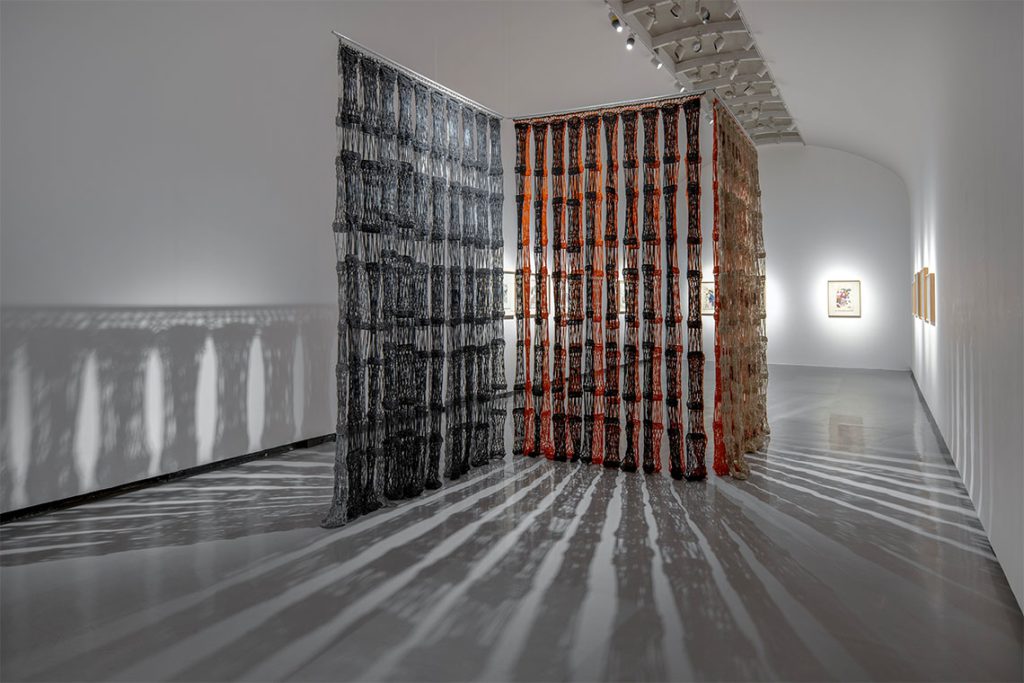
When people are too close to each other, tensions – caused by lack of privacy, confrontations and arguments – can arise, of course. However, Hashemi aims to focus on the positive aspect of togetherness. She holds family dear to her own heart; she lost a younger brother nearly 20 years ago, and remains close to her two sisters, with whom she collaborates on fabric art projects. In her work, she has created a safe space where her figures can rest, be themselves and live moments of closeness and conviviality, perhaps forgetting the outside world and its unpleasant reality. In Wrap Me Up In You (2009–11), she draws a world of contradiction. The series was created at a time when widespread riots broke out in the streets of Iran following the re-election of President Mahmoud Ahmadinejad.
“I used to live in an area where most of the protests were happening,” remembers Hashemi. “While people were protesting outside, some of my family members were having ceremonies, celebrating someone giving birth, going to a wedding or something like that. There is this idea that life will not stop. In appearance it is a paradox, but in reality, it’s just what life is about.” The series was showcased in 2011 at Gallery Isabelle in Dubai, where most of the works were actually finished.
A majority of Hashemi’s drawings feature vibrant patterned fabrics, commonly used across the region and some of which were sourced from traditional souks in Sharjah and Dubai. “All over the Middle East, you see the patterned fabrics – liners, clothing, table cloths – that are prominent elements of domestic culture. They always have this sense of domesticity,” she adds. Most of the time, Hashemi’s creative process begins with a simple sketch, drawn while seated in gatherings. At other times, she takes pictures or works from memory.
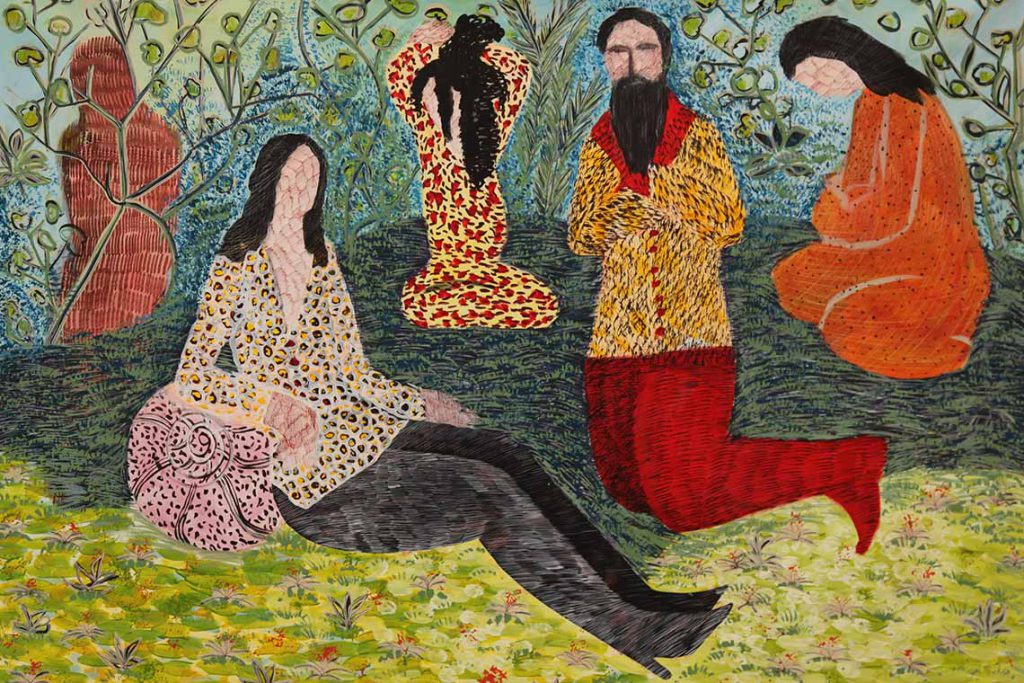
Each work tends to be made up of a few layers of plastic sheets stitched together, one of which is marked by her elaborate drawing, carried out with the use of permanent black markers. “In today’s world, we often experience and feel different things at the same time. There are several things happening to you and going through you, all at once. This is the layering of a human being, so in order to express this idea best, you should go with layers,” she says of her process.
Several of her snapshot-like pieces are largely populated by women, who are dressed comfortably and with many free of Iran’s mandatory hijab. Such details are intentional. “There’s a hint of criticism of the patriarchy in this society,” she says. In a way, her work uplifts the women in her own life, from teachers to family members. “The most support I have received in my life came from women close to me. They have always inspired me,” she affirms.
In her most recent project, A Waking Dream, shown last year at Dastan Gallery in Tehran, Hashemi approached the intimate act of sleeping, with some of her serene drawings of children, men and women asleep stitched with pieces of fabric. The images came from her own experience of waking up early in the morning and observing her resting family members, as well their sleeping habits. Also present is the notion of how sleep can be an equalising factor amongst people of different backgrounds and circumstances. “When they’re sleeping, they’re in this weird or particular position and you can imagine what they are dreaming about and ask why is that specific person in that posture,” she says. “What interested me was that it doesn’t matter where you are sleeping, whether in a comfortable bed or even in prison, if you fall asleep, you have this ability to dream and imagine things.”
This profile first appeared in Canvas 121: If Walls Could Talk
