


A new exhibition by Mounira Al Solh at Bristol’s Arnolfini offers new insights into a practice that continues to explore resilience and the power of colour.
Rarely does Mounira Al Solh give the viewer a resolved position. Her exhibition A land as big as her skin, at Arnolfini in Bristol, curates itself the way she paints: through controlled instability, always pulling toward the next threshold. The show brings together painting, embroidery, sculpture and film across several rooms, moving from the mythological boat installation A Dance with her Myth – which represented Lebanon at the 2024 Venice Biennale – through large-scale paintings, a total environment dedicated to the Phoenician founder-myth of Elissa, and closing on two polypropylene sacks pegged to a washing line. The show spans ancient Mediterranean myth and the bombardment of Beirut in 2024, holding both without resolving either.
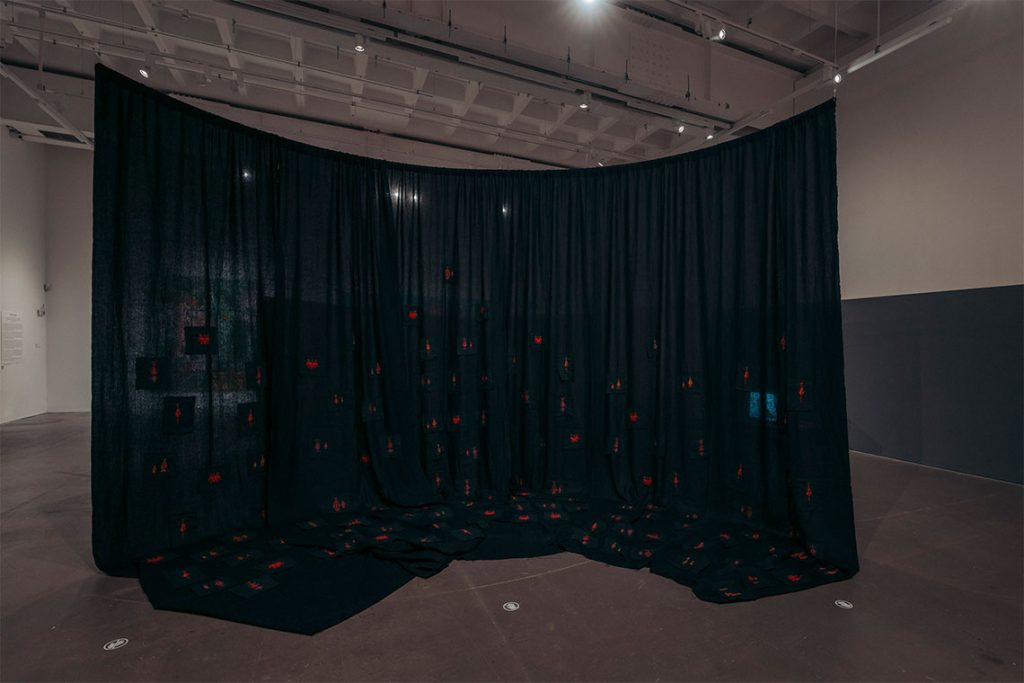
Red Cypress Tree (2025) hangs from the ceiling like a heavy theatre curtain, its black textile draping onto the floor in gathered folds. The fabric’s weight produces a stark sculptural presence, its surface interrupted by small stitched panels in red, orange, fuchsia, violet and pink tones, each drawing on patterns specific to Palestinian villages preserved by the Inaash collective among displaced Palestinian communities in Lebanon since the 1970s. Against the exhibition’s colour-saturated paintings, the work operates as a sombre counterpoint, an emotional centre that absorbs rather than radiates colour. Al Solh had planned to meet the Inaash embroiderers in Beirut in the summer of 2024. The bombing made it impossible; she left Lebanon under bombardment. It was only after the ceasefire in November that the collaboration could resume. The work did not merely anticipate the violence – it was made inside it, completed on the other side of a pause. As a child in Beirut during the Lebanese Civil War, Al Solh recalls her grandmother coming to collect her during a bombardment. “She did not run,” the artist says. “She just walked slowly to take me home.”
From Beirut to Saida, Ya My Eyes (2023) is the most colour-saturated work in the exhibition and the most openly joyful, which in Al Solh’s hands amounts to the same political act. The title references an iconic Lebanese love song played on the radio between conflict bulletins. The painting makes that song visible. Its structure is altarpiece-like: a predella of small testimony fragments at the base, a frieze of arm-linked figures across the middle, some winged. Their wings are rendered through colour shading rather than outline, and above them two women are facing each other inside a heart, flanked by cars releasing celebratory sparks. A mosque sits at the upper margin, witnessing rather than presiding. The black contour line holds the entire surface together: colours, symbols, the living and the departed bound by a single continuous mark.
At 235 x 206 centimetres, Silicone, Poppies, and a Couple of Invisible Deffs (2022) is nearly life-size and nearly everything Al Solh does is visible in it. Two green-skinned figures dominate, green carrying West Asian associations with the sacred and the otherworldly, as well as something more immediate: a colour of things pushing into life. The dominant figure balances on two ceramic deffs, the frame drums named in the title, arms outstretched, her exaggerated silhouette the cosmetically aspirational body that Al Solh calls simply “the look”. On her companion’s arm, the word سيليكون – silicon – is written in Arabic, casual as a tattoo. Three skulls occupy the room like furniture. Al Solh made the painting in a studio she was about to vacate, the canvas hanging free. “I was not only painting,” she has said. “I was deleting.” The black line that moves through the surface (rooting figures, tracing contours, holding an impossible balance of elements) has a generative quality: things appear to grow from it rather than be contained by it. In a painting about artificially induced bodies, the line itself blooms.
Flying, clapping, grooving, tasting love (2025) does not hang on a wall. Its three panels stand freestanding in the centre of the room, an open screen that you move around rather than face. In the left panel a figure arches backward in the Fosbury Flop position, clearing an unseen bar while a yellow beam fires diagonally upward, transitioning to purple at the governing arc above. The centre panel shifts to near silence: a solitary figure, one eye patched, built from white canvas space compressed by surrounding purples, a body constituted by what has not been painted over. In the right panel, drawn rather than painted, a hand fills the canvas. Twelve fingers, exceeding anatomy, are shaped like rose petals gathering toward the eight-petalled flower tattooed on the palm. Each finger bears a face. Testimonies migrate onto a single bloom, it would seem.

Photography by Remco Merbis. Image courtesy of Arnolfini, Bristol
Conventional reading organises Elissa’s Room (2025) in three horizontal registers – top, middle, bottom. The more generative reading is structural, with the painting operating through mixed geometric concentric spatial systems, five nested layers that produce depth without perspective. The outermost layer is the rectangular canvas itself, establishing the panoramic format. The second layer is a framed pictorial zone: a dark upper band carries Arabic inscriptions, an eye and infinity symbols, functioning as stage backdrop and temporal frieze. The third layer is the procession band. Figures stand on striped cylindrical pedestals, a horizontal axis stabilised by repeating verticals, operating like an ancient relief or a ritual procession frozen mid-movement. The fourth layer is the orange oval inner chamber – the painting’s visual engine –tintensifying colour while compressing space. The fifth layer is the micro-figures inside it, shrinking in scale while shouting in chromatic intensity: a miniature painting compression, icon panel structure, sequential actors in a narrative that the painting never clarifies. Combined with the geometric tension between rectangular frame, vertical cylinders and off-centre oval, the result is controlled instability. The eye moves between procession, columns and centre, finding no axis on which to rest. It is one of the rare occasions when the word mesmerising, applied to a painting, is not out of place.
The exhibition concludes with Words of grief and mourning (2025). Two polypropylene sacks – materials used to clear rubble or carry the meagre belongings of those fleeing – hang from a washing line on wooden pegs. On the left: بكاء, weeping. On the right: رحيل, departure, death. The words are hand-painted directly onto the sack material. Two words. Two sacks. Wooden pegs. The exhibition knows how to end.
A land as big as her skin runs until 24 May
