

The Uzbekistan National Pavilion, commissioned by Gayane Umerova, chairperson of the Uzbekistan Art and Culture Development Foundation (ACDF), focuses on the Aral Sea. Located in north-western Uzbekistan, until the 1960s this sea was one of the world’s largest natural inland water masses. A multitude of man-made diversions and interventions have caused the water to disappear and the basin that it once occupied has become a desert.
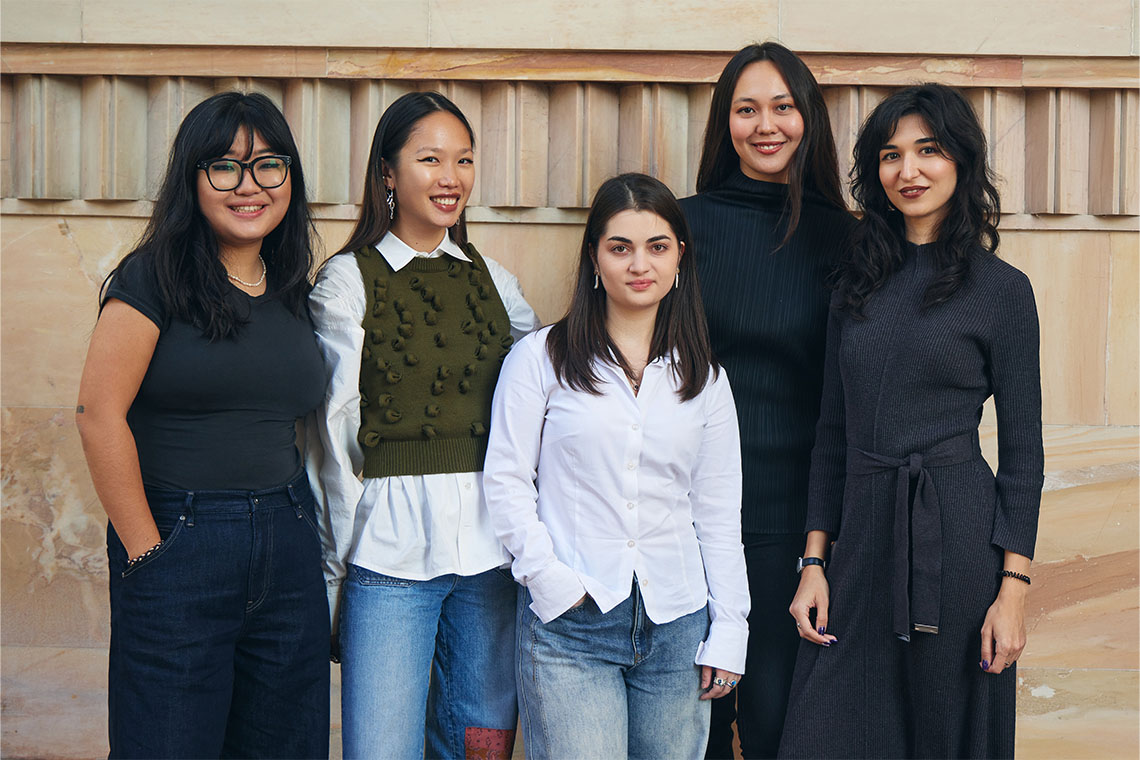
Sophie Kazan Makhlouf for Canvas spoke to the pavilion’s five curators, Sophie Mayuko Arni, Kamila Mukhitdinova, Nico Sun, Thái Hà and Aziza Izamova, about their work on the project, common themes and how they selected the pavilion artists: Jahongir Bobokulov, Zi Kakhramonova, Aygul Sarsen, Zulfiya Spowart, Xin Liu, A A Murakami and Nguyen Phuong Linh. A multi-national group comprising two Uzbek nationals with others from China, Vietnam and Japan, the curators are a group of inspiring people who came together through the Bukhara Biennial Curatorial School. The conversation reveals a striking sense of common agreement and camaraderie among the curators. These five accomplished women have become a strong team through this curatorial journey and the Uzbekistan Pavilion that they have created in Venice tells an important artistic and environmental story to the world.
Sophie Kazan Makhlouf: How did you first become involved in the Bukhara Biennial Curatorial School? Can you say a little about yourselves and how you came to be curators of the Pavilion of Uzbekistan?
Thái Hà: Being based in Vietnam, I’ve been trying to draw these Asia to Asia, Asia to Africa links, and so learning more about Central Asia was exciting. It has been really great to work on the pavilion together.
Sophie Mayuko Arni: I’m based in Japan and I also work a lot in the UAE, so I’ve been back and forth between Tokyo and Abu Dhabi. I’m also interested in inter Asian dialogues between the Arab world and Japan. I had followed the initiatives of Gayane Umerova, the chairperson of the ACDF and the Bukhara Biennial, so when I came to this Venice project, through an open call via the Delfina Foundation, I realised it was a great fit. We were in Bukhara four times, over the course of the biennial, which cemented in me a deep interest in Central Asia as a crossroads. There are so many dynamics at play there.
Aziza Izamova: I am from Tashkent originally, so the most straightforward answer is that I was there anyway! I’m doing my PhD in the USA in art history, specifically on how craft industries became institutionalised in Uzbekistan under the Soviet Union. I came home for archival research and also ended up organising a symposium as part of the public programming at the Bukhara Biennial. That was my initial involvement with ACDF, and I then joined the curatorial school to learn about the ‘behind the scenes’ aspect. It was a great opportunity to shift my gears a little bit, understand the contemporary setting better and see how things work.
Kamila Mukhitdinova: I’m from Tashkent and graduated as an architect last year. I have been working as an interior designer, but wanted to try something new, something different yet also familiar.
Nico Sun: I grew up in Xinjiang. Although it is in China, this region is very close to Uzbekistan, Kazakhstan and Tajikistan. Our cultural backgrounds have a lot of similarities. My interest has always been on the under-represented regions of Xinjiang and Central Asia and how contemporary art could engage with identities, tradition and modernity. For the past six years I’ve been working in Xinjiang and following contemporary art practices from Uzbekistan, and Central Asia more generally, including the Bukhara Biennial from the very beginning. When I saw the open call, I applied immediately and I have been looking forward to creating this platform for local communities, crafts, cultures and contemporary art.
SKM: The Aural Sea is the title of the pavilion’s exhibition. Can you explain your approach and how you came up with a curatorial concept?
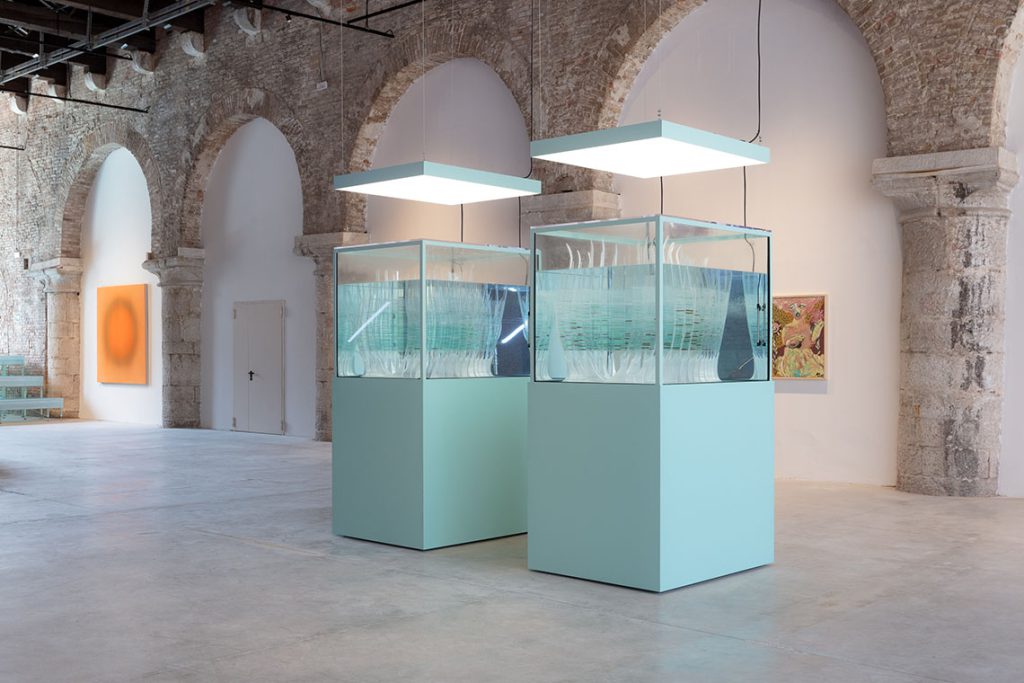
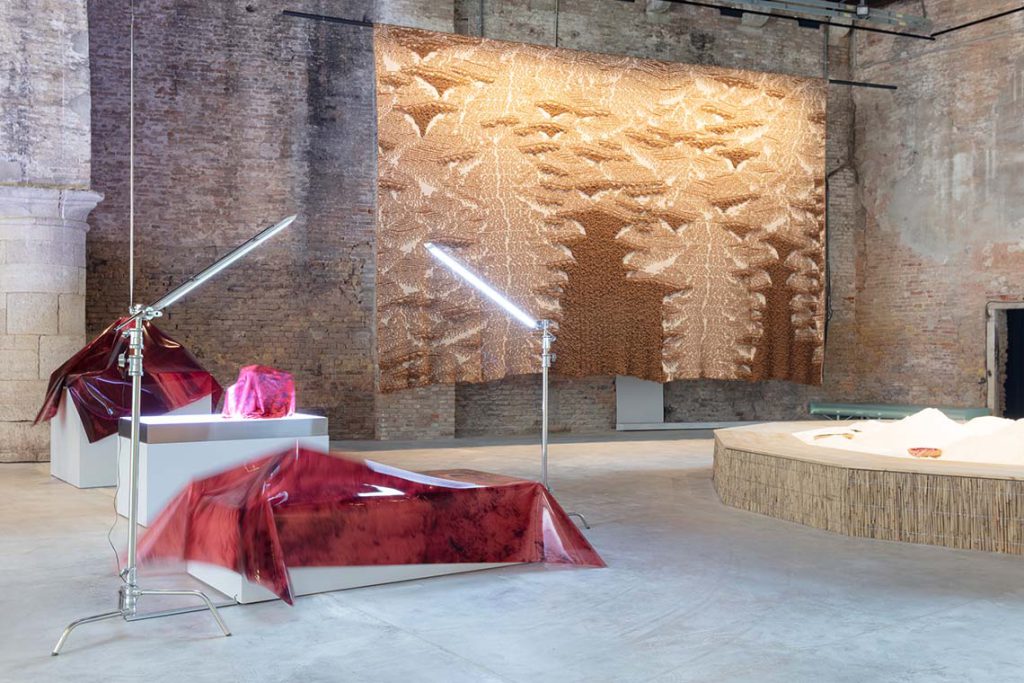
TH: Our exhibition was inspired by Karakalpak writer Allayar Darmenov’s fairy tales depicting the Aral Sea in the year 2050, which he wrote in 2015 when he was just 18 years old. In his stories, he writes of fish living in the waters of a replenished Aral Sea and reminiscing on the desert years. He is not retreating into simple escapism, however. As he states in the footnotes to his stories, for Karakalpaks the restoration of the Aral is an eventuality, and it would be incorrect to classify his stories just as imaginary fairy tales. His cast of catfish, sabrefish and carp inhabit an Aral that will exist. Continuing from his approach, we find agency in reimagining the possibilities of living and adapting with the landscape. Alongside the destruction there is also life still persisting in the Aral. The Aural Sea highlights this presence, which is often overlooked in disaster-driven narratives of the region, to invite alternative imaginaries of the past, present and future of the Aral.
SKM: How did you develop the vision and concept for the pavilion itself in Venice? It seems that you began to work on this once the ACDF had decided to focus on the Aral region.
TH: Yes, the ACDF and Gayane Umerova have been working to create opportunities in the region and greater engagement with the Aral Sea through projects such as the Aral School and Aral Culture Summit, so we were prompted to think about the ecological issues that Uzbekistan and the Aral region are facing today. We worked together, brainstormed a lot and arrived at mythmaking and storytelling as the crux of our exhibition. Things developed further through a long conversation process with the artists, which started when we were meeting each other for the first time in Bukhara, in October last year, and has continued ever since.
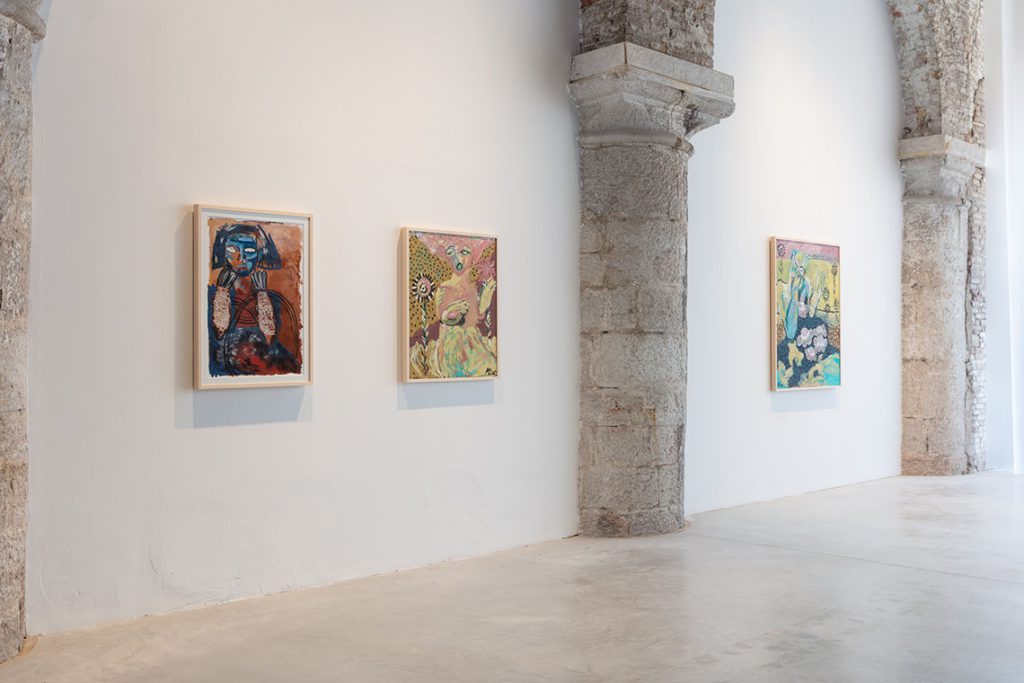
KM: In Bukhara, we got to know the work of some of the artists by being there so much and meeting them in person. Other artists we got in touch with through digital research and there were also several with whom we had worked before or just really liked their work. Each artist spoke on different thematic levels.
TH: This method of distillation seemed to work best. The selected artists’ works have common themes that can respond to each other within the space of the pavilion. The connecting thread is the process of material change and transformation, which is an important and quite complex subject to explore.
SKM: What was your working method? Did you each champion particular artists?
TH: A lot of it was a collective decision, but you’ll notice of course that we have a mix of Uzbek and international curators and artists, mirroring the artistic context of where we come from. So, we have Xin Liu, who is from Xinjiang, the same region as Nico. We have a Japanese British artist duo who Sophie was familiar with, and Nguyen Phuong Linh is someone who I’ve worked with before.
SKM: Your team was formed through the Bukhara Biennial Curatorial School to work collectively. How did this ‘peer-driven’ collaborative process shape the exhibition?
SMA: Our curatorial team’s approach, emerging from pedagogy and the idea of a school, fits with the greater theme of this year’s Biennale, In Minor Keys. The art of listening has always been at the heart of curatorial practice, as in listening to artists’ stories and amplifying their voices through the exhibition format. Our curatorial process took a step further, asking each one of us, as co-curators, to listen to each other to find consensus and imagine further. We also listened to and incorporated other voices from the literary world, providing a polyphony that mirrors the multiple perspectives on the Aral Sea and its imagined futures. In many ways, the exhibition emerges from that learning process, which is co-authored and leaves behind a legacy of relations, materialised through objects.
The Uzbekistan National Pavilion is located in the Arsenale
This interview first appeared in Canvas 123: Venice Special Issue
