

The Saudi artist explores identity and belonging through the use of AI and open-source technologies, bringing non-Western histories to light.
Canvas: You studied architecture and human-computer interaction in your undergraduate degree, and then you did a master’s in interactive telecommunications. How did you end up in the art world?
Nouf Aljowaysir: While I was in a marketing job where I explored branding through AI, I also worked with an artist collective called Creep Collective in New York City on a project entitled Alexa Call Mom!. It’s an interactive darkly comedic experience where Alexa, Amazon’s virtual assistant, tells you what to do. This first introduced me to conversational AI. I was accepted onto an artist residency on the topic of synthetic media at Thoughtworks Arts after leaving my job, where I wanted to keep exploring these open-source technologies.
How did the topic of identity arise as you were exploring the uses of AI?
I’ve been in the USA since I moved here for boarding school around the age of 13. I find it difficult to explain to people where I’m from, and often end up feeling lost between cultures. During my residency, I didn’t think I would get so personal. I wanted to explore identity and AI, without knowing exactly what that meant. There’s a lot of confusion in the general public surrounding AI, which I hope to help untangle. I would never call myself an AI artist though, because I look expansively at how technology and algorithms are affecting the self and collective identity.
Why did you start using archives to explore these topics?
It began when I interviewed my mother to learn more about my identity. She traced our whole family history back to the 1800s. The history of my family is one of migration. We are originally from Saudi Arabia, but some ancestors migrated to Iraq and back on my mother’s side, and from Saudi Arabia to Syria and back on my father’s side. After speaking with my mother, I searched online for something through which I could visualise this history, and could only find colonial archives. Our generation relies on technology to tell us about who we are, but the internet is predominantly in English, from Western countries.
How did you take these archives and use them to reframe that history?
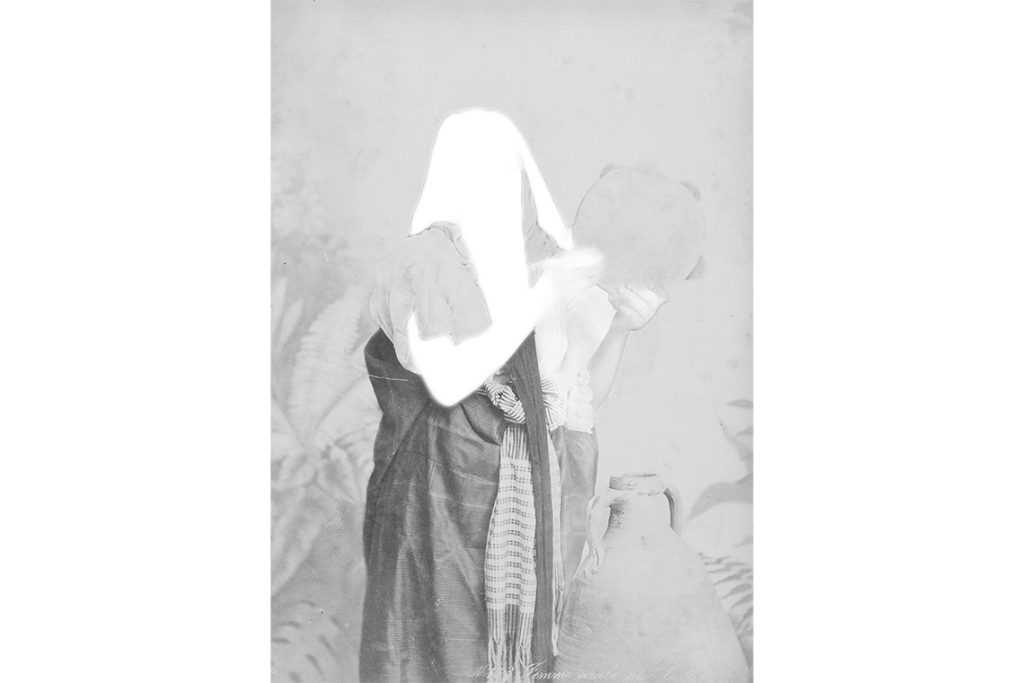
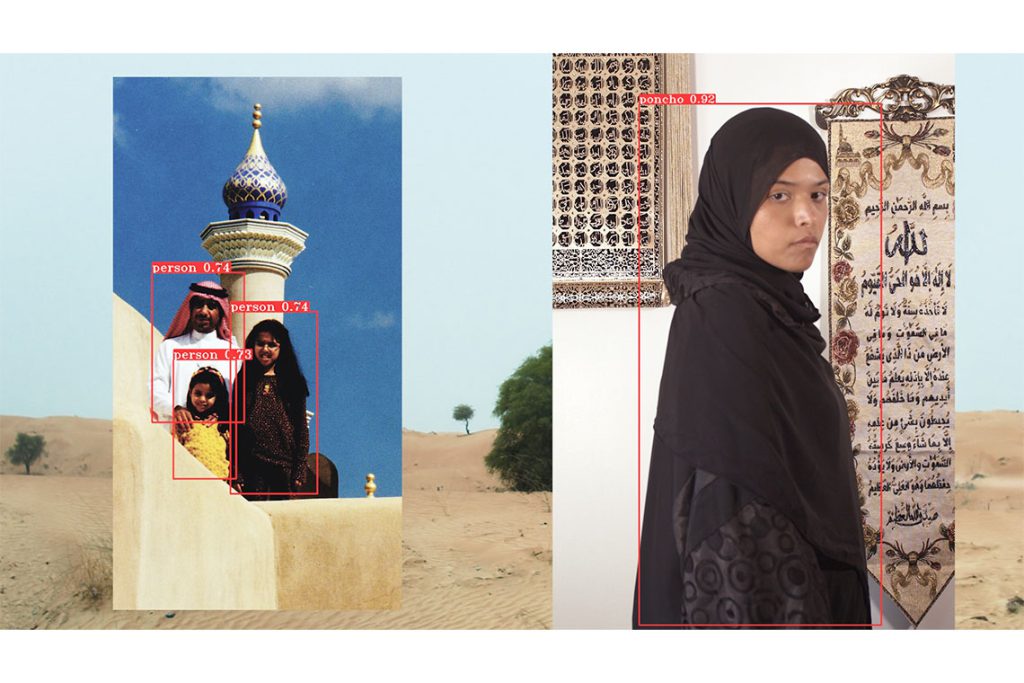
After realising that nothing online could teach me more than my mother’s story had, I scraped images from The Ken and Jenny Jacobson Orientalist Photography Collection at the Getty Museum and tested them across different computer vision models. In Salaf (2020), I erased the figures in these images through an AI computer vision technique that is usually used to detect and perceive subjects in images. I inverted how it works and created an absent data set to talk about the absence of data, and then trained an AI model on it. That’s how I generated Ancestral Seeds (2025). It has a more fluid, morphing structure in which you see the figures take on the stereotypical poses that were fashionable in colonial photography. I want to show how colonial patterns can be relearned by AI, and that, as much as it is overhyped nowadays, it is delicate and still makes mistakes.
How do you intertwine this personal history with the collective?
The politics of representation have really impacted me as an Arab living in the USA. I came here soon after 9/11, when there was a lot of fear around saying you are Muslim or Arab. Working on this archive for Salaf and Ancestral Seeds felt as if I were exposing myself, although ultimately it was really healing for me to push through. So many people have come up to me saying how they relate to the work. I reference Edward Said’s concept of the ‘white’ and the ‘other’ all the time. We always fall within this ‘other’ and algorithms perpetuate that notion. So it’s not just about me, it’s about the marginalisation of many identities, memories and histories. My film Ana Min Wein? (Where Am I From?) (2022) speaks about this. I wanted to document the process of conversing with the machine and saying, “Where am I from?” And it’s messing up. It doesn’t know. It says, “Are you from here? Are you from here?”. Sometimes I hear people laugh in the audience, and that brings me joy to know that they understand, as so many of us can relate to that experience.
Was the reception to it different in the West compared to the Arab world?
I was adamant about not simplifying things for a white audience in the film, which is why I was so surprised at the positive reception. Some Arab and Saudi artists I have spoken to really enjoy the film as well, because often these oral stories are private. But through art, we are becoming more open to analysing our culture, talking about migration and these family stories. I hope to be part of that conversation for my country as well.
What does the future hold for your practice?
Right now, I’m fascinated by the aesthetics of beauty and how they are determined by the media and by technology. This has really impacted me as a young woman in the USA. I hope to expand it into a body of work, with similar themes to previously, with the thread being this constant conversation between us and technology and how we’re changing, but also how it changes us. I’m showing my video workAncestral Seeds with the CHANEL Culture Fund at Alserkal Avenue, alongside other artists. We’re also going to show the Salaf data set in a digital presentation. It’s very exciting for me to show in the Arab world and to continue having a conversation there.
