

What does the future look like? A horizon that remains constantly a few worlds away, but what awaits next is also always as far as a blink of an eye. A chronically history-dependent phenomenon like art never ceases to dabble with what the future may bring, partly because that very next moment is contingent on the ensuing second or, if not, it would evanescence into the ether as the past. Only with this linearity does art define and categorise its procession. Books write it, museums show it and dealers speculate on it. What came before us lives in storied paintings and gloried sculptures, from which we can gauge what the future has to bring. Long considered oracles, artists have something of a third eye for what societies are headed towards. They are a Cassandra who yearns to convince us – the indifferent – about imminent falls and calamities.
The New Museum’s inaugural group exhibition, New Humans: Memories of the Future, is a sprawling enquiry into the future by some 200 artists of 50 or so nationalities. Besides more than 15 commissioned works by participants including Wangechi Mutu, Camille Henrot and Hito Steyerl, the show congregates the output of its artists over the last decade or so. Curators Massimiliano Gioni, Gary Carrion-Murayari, Vivian Crockett and Madeline Weisburg have hung works in the museum’s brand-new OMA-designed galleries, as well as in the existing building, canonised emblems of modern art by the likes of Francis Picabia, Alberto Giacometti, Eva Hesse and Francis Bacon.
The inseparably knotted ropes of social politics and technology hold intact most of the show, while geopolitics, identity, memory and the body meander across the 5,570 square meters of space on multiple floors. The reality of experiencing a show about the very current state of contemporary art at an über-fresh building designed by a globally sought-after architecture firm both affirms and shakes the statement on view. The future is chicly sharp with chrome finishes, but the content is alarming and to be wary of. Chaos and sleekness counteract against one another, wrapping fear with beauty at times and gutting out vivacity with fiery tension at others.
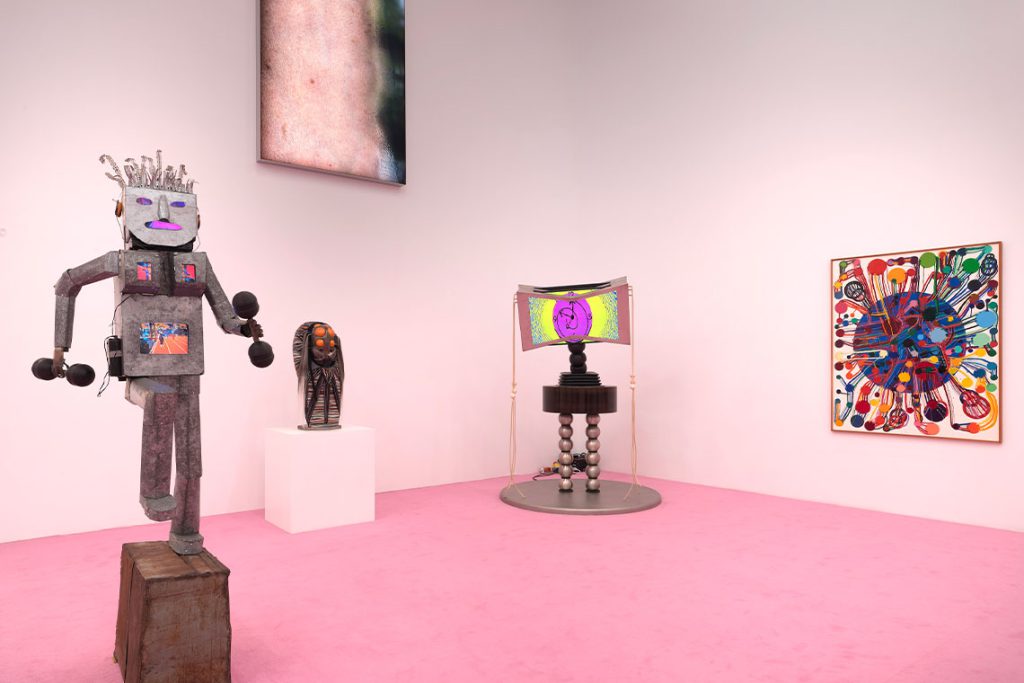
Of the show’s artists, three from the MENA region contribute to the visual symphony of wariness and joy with a diverse material palette and narrative potentials. Meriem Bennani’s TV JANGLE (2022/25) claims a larger atmospherical real estate than its lifesize appearance at the corner of the show’s Hall of Robots section which is joined by other groupings with poetically clashing titles, such as Reproductive Futures, Mechanical Ballets and Prosthetic Gods. Loud and spatial, the moving sculpture is among the works scattered over a pastel pink carpeting. This segment of the exhibition brings together corporeal forms with moving and audial parts that orchestrate an overall cacophony of kinetic unknown. Bennani’s sculpture of a human-like form with a television in lieu of its head suddenly swings back and forth, causing its rubber plastic strings on both sides to wave like few pieces of hair left on an ageing head. The rubber bellow operates like a neck and holds the screen, which streams different illustrations of clocks within the aesthetic realm of nostalgic morning-time cartoons on television. The drawings’ simple and familiar allure contradicts with the frantically swaying robot’s last breaths. The almost three-minute-long footage becomes the eye and the mind of its agent, which is desperately stuck between life and collapse.
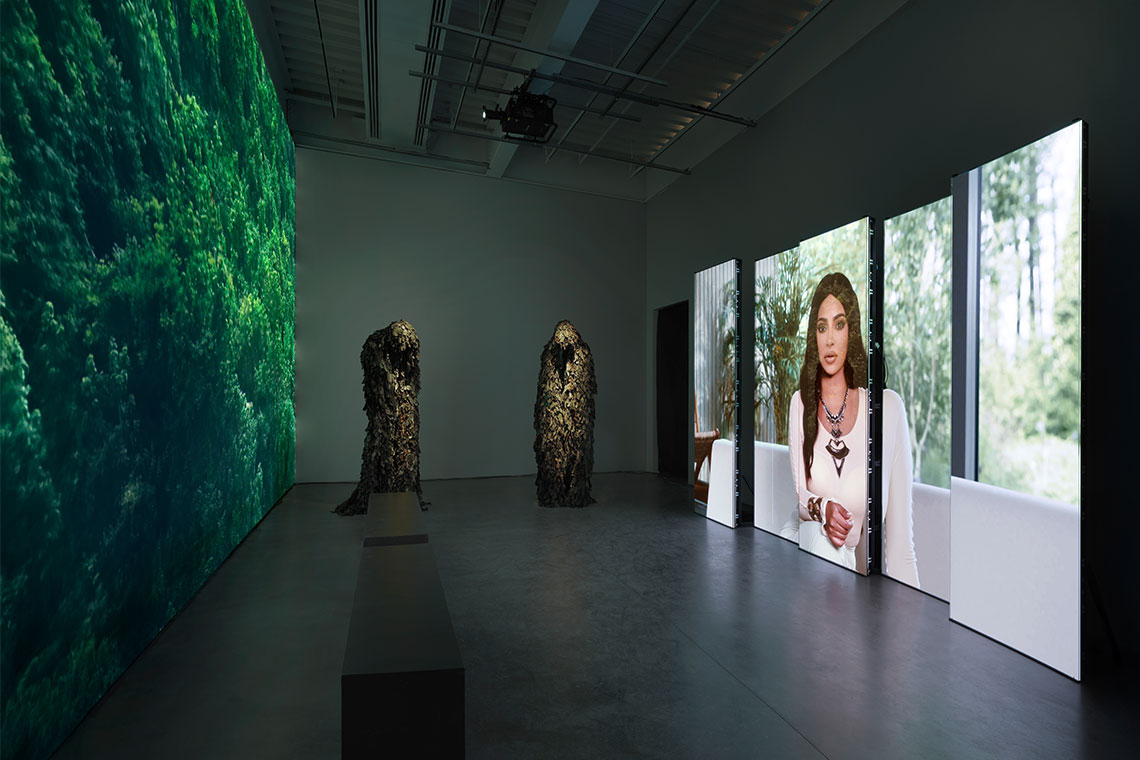
A few steps away from Bennani, Sophia Al-Maria and Monira Al Qadiri exhibit two distinct types of work in close proximity. In Al-Maria’s The Future was Desert Part I and The Future was Desert Part II (2016), snippets of an anonymous dreamscape travel between nightmare and calmness. In a matter of seconds, bird’s-eye views of endless deserts in a neon greenish colour scheme morph into a photograph of Kim Kardashian – the fact that the works belong to a decade ago, when the world was being shaken to wake up from its lulling daydream, sounds like a silent echo within the sonic reverberations audible in the room. In the videos, cacti are over-imposed onto arid landscapes, followed by lush pink flower fields with a camel in the centre, or planets revolve at the speed of light. A 1990s-style aspiring commercial aesthetic comes to mind in some of the sequences, as well as the artist’s signature exploration of millennial Gulf wealth. A squeaky robotic voice utters words of stone-cold disbelief in the future, while a wobbling sound effect tests our visual and sonic patience. Al-Maria’s meditative take on Gulf opulence meanders between abstracted portrayals of nature and animated snippets of human performance, which all lends itself to a delirious landscape of a multi-sensorial question mark.
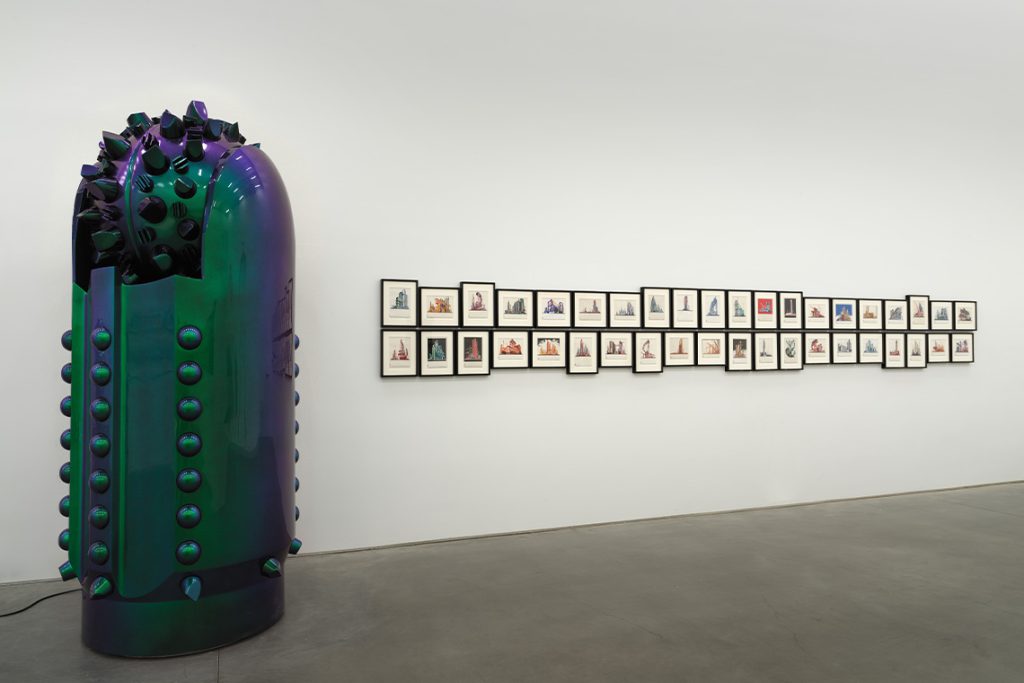
Dimension is central in Al Qadiri’s Alien Technology (Tower) (2023), a rotating aluminum device painted in automotive dye. Here, the petrol-fuelled wealth of the Gulf is monumentalised in a glorified sculpture of no immediately recognisable pull for a general viewer. A speculative suggestion and a science fictional proposal, the sculpture’s visual tie to an oil-drilling device problematises repetition and obsession, which are inherent in the act of extraction. Beautified by dazzling neon purplish colours and impeccable surfaces, Al Qadiri’s sculpture ridicules the notion of an object of desire in a world of fleeting tactility. Immediately textural and painfully present, the towering sculpture materialises its own innate questions of three dimensionality under the light of a sculpture made to look like a loudly utilitarian device, dressed in various bits that amplify its sculptural aspect. Here, the artist underlines the future’s charming offering of danger, dressed in splashy colours and smooth surfaces that may veil what the future hides from us.
