

A group show at Taymour Grahne Projects showcases how young Gulf artists are striving to articulate their own language and perspectives in a fast-changing environment.
Soon approaching its first anniversary in Dubai, Taymour Grahne Projects is focusing on the current generation of young female artists from the Gulf region through its latest group show, Five Painters. Presented across the gallery’s ground and mezzanine floors, the exhibition delves into figuration, geometry and landscape through more than 20 paintings by artists Roudhah Al Mazrouei, Dalal Al-Obaidi, Hayfa Algwaiz, Latifa Alajlan and Hawazin Alotaibi. Offering a fresh and more analytical take on painting from the region, it comes at a time when the Gulf’s dynamic emerging and established voices are echoing on various platforms in the international art community.
Across the exhibition, the artists, all of whom are aged 35 and under, hail from the UAE, Kuwait and Saudi Arabia. Their visual commentary explores ideas of space, memory, relationships and gender at a time when the Gulf states continue to change socially, economically and environmentally, a dynamic yet often misconstrued hub in the wider SWANA region. As Abu Dhabi-based Sara bin Safwan, curator at Guggenheim Abu Dhabi and founder and curator at Salasil, writes in one of several accompanying texts published by the gallery, “The Gulf is in constant, perpetual shift – and the five painters selected in this exhibition are inheritors of its dynamism and continuity. They mark moments of a not so linear, at times disjointed change, whether in the urban landscape or social fabric, in an attempt to reconcile with their surroundings and the movement through it…The Gulf is a place where the fictional and the real have always been in close proximity. Where cities have risen from the desert within a single generation.”
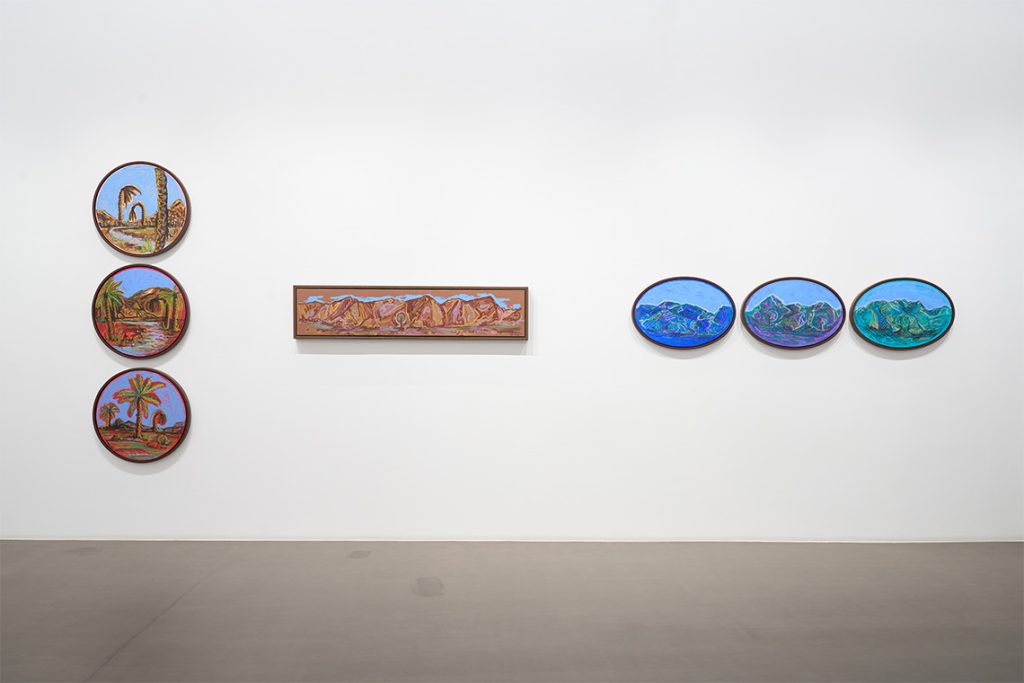
Upon entering the gallery, visitors are faced with works grounded in natural landscape with a touch of storytelling, explored by Emirati painter Roudhah Al Mazrouei and Kuwaiti painter Dalal Al-Obaidi. Inspired by the natural scenery of the UAE, specifically the landscapes of Al Ain and Fujairah, in Sphere II, III, IV (2025) Al Mazrouei depicts views of palm trees, streams and distant mountains through a loose usage of pastels that features her signature sharp bright blue lines. Most of her images come in a circular format, as if to contain and protect this little idyllic world of greenery. In her artist statement, Al Mazrouei shares that her work revolves around cultural memory, underlining how perhaps these works are a form of memory preservation in an increasingly modernised world where nature is often under threat.
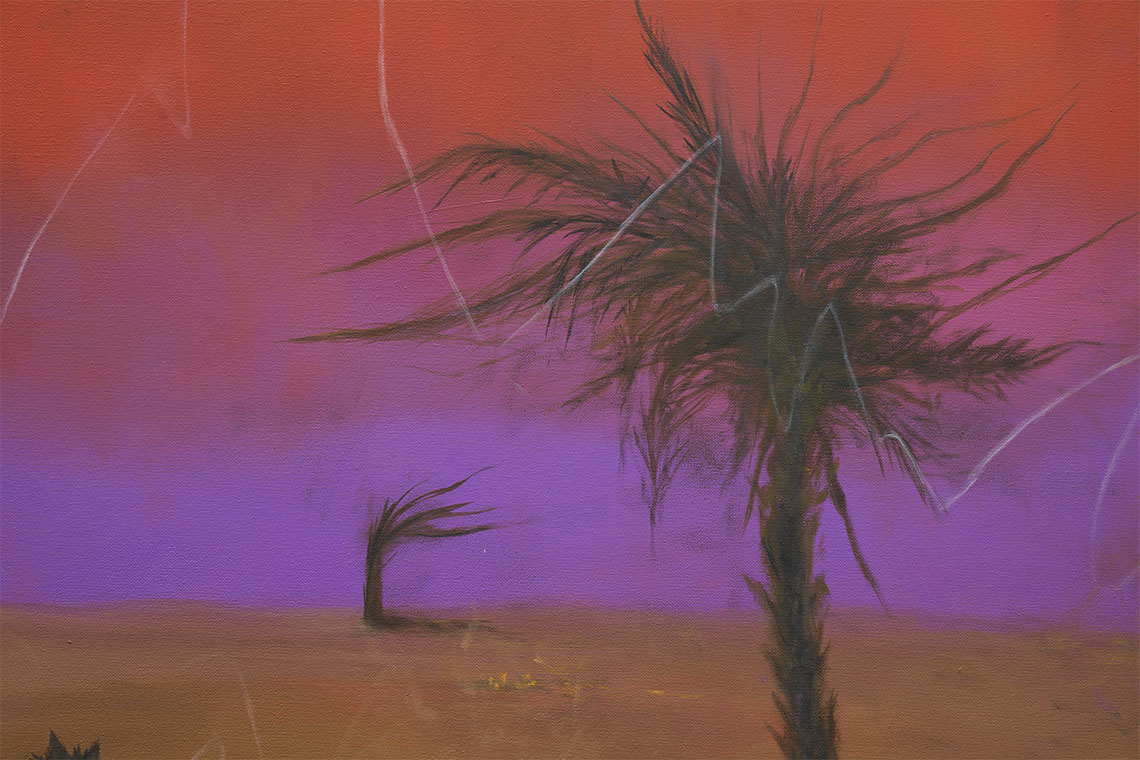
Next to Al Mazrouei’s works, the mood shifts with the dark and surreal-like paintings of Dalal Al-Obaidi. Akin to Al Mazrouei’s own personal experiences, Al-Obaidi is influenced by her childhood in Kuwait and by its particular spaces and scenes, ranging from a living room to street lamps. There is a sense of tension, otherworldliness and abandonment in her paintings. In Barren Conversation (2025), a red and purple sky stands against a few scattered palm trees, some of them looking defeated, in an ominous setting. Al-Obaidi is also experimenting with figuration, as in U-turn, I turn (2024), where the viewer is confronted with a red-faced man in the foreground and a woman in the background, positioned against the same red sky at a moment when there is seemingly nothing left to be said by the figures.
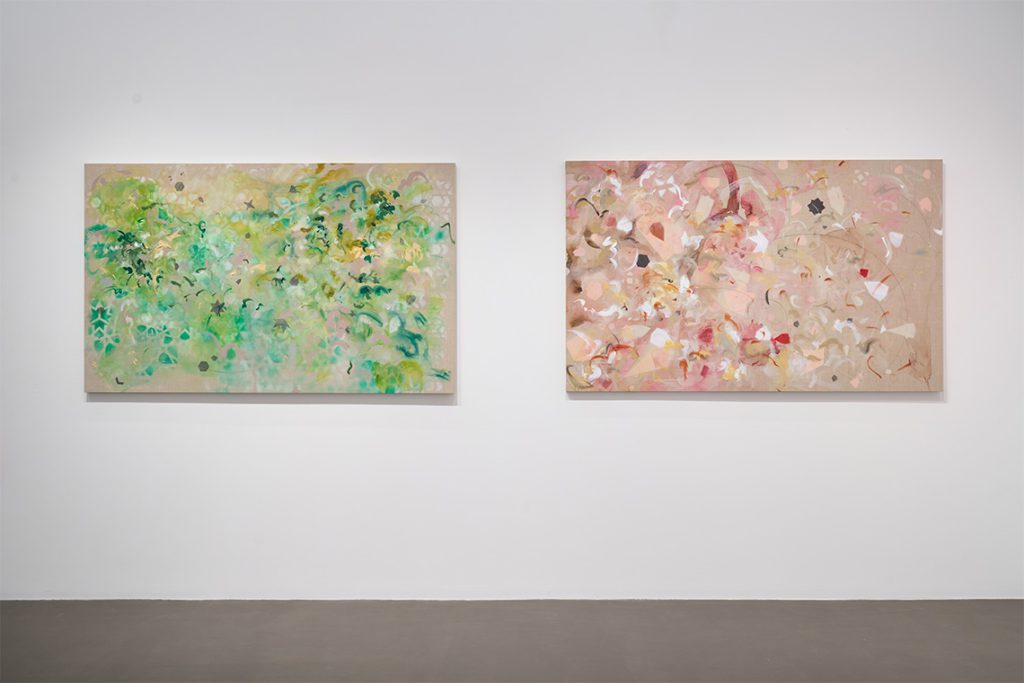
Joining Al Mazrouei and Al-Obaidi are lightly coloured, geometric artworks by the Kuwaiti, New York-based painter Latifa Alajlan. In her compositions, she hazily merges elements of Islamic geometry and abstract gestural markings, giving off at times a floral effect. It is the kind of work that visually pulls in the viewer, enticed to look for hidden clues. Some of her untitled patterned works from 2026 continue upstairs, where they are accompanied by paintings from Saudi painters Hawazin Alotaibi and Hayfa Algwaiz.
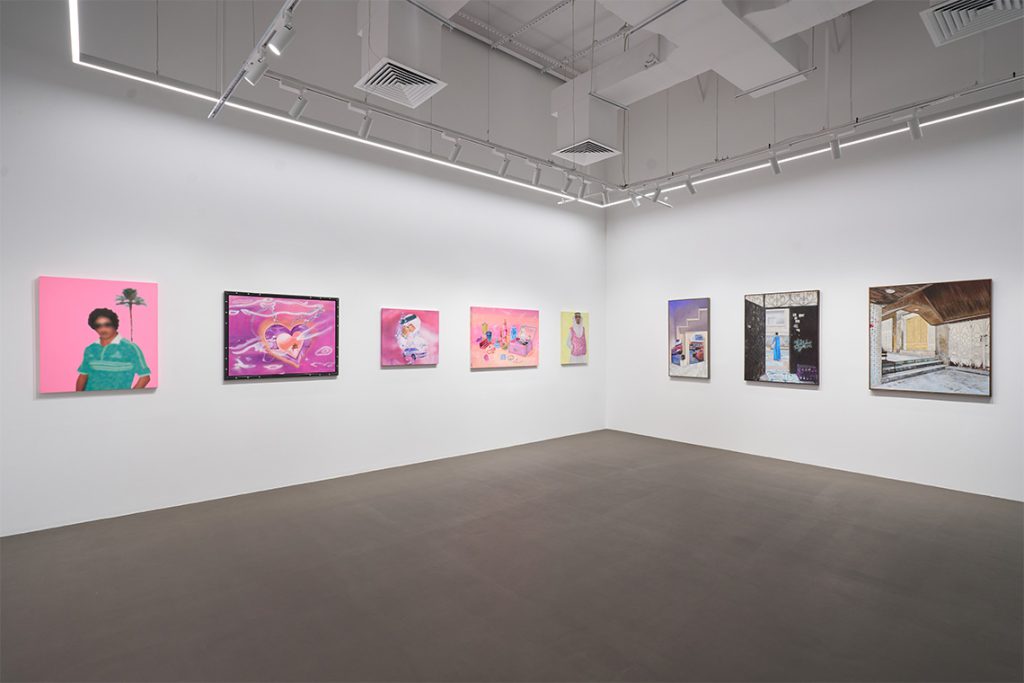
Through her thoughtful and sensitive approach, Algwaiz also explores private and public spaces and how people are shaped by them. One of the exhibition’s quietly compelling pieces is Love & Marriage (2026), where she takes us into her family home, embellished with marble flooring, pink sofas and a patterned carpet. Her parents are having a laidback breakfast and sharing a moment of intimate silence.
Meanwhile, Alotaibi heads in the opposite direction stylistically with her pink-hued images, executed with a touch of playfulness and humour. They address notions of display, vanity and kitsch culture in the Gulf. Challenging the perception of gender, she also presents male figures in a more feminised way, as seen in her slightly blurry painting Closer (2023), where one young Khaleeji man is dressed in a traditional white kandora and a glittering pink top.
One of the interesting aspects of Five Painters is the contrast between the shapes, shades and moods in the paintings. Yet they all stem from the same starting point, one inspired by the artists’ personal experiences and observations of societies and surroundings that have grown and evolved over time. The question remains, however: where are they headed towards? With the Gulf in a continuing state of change and flux, the challenge for these young artists will be to develop and sustain voices that remain both relevant and resonant as the socio-economic landscapes around continue to shift and evolve.
