

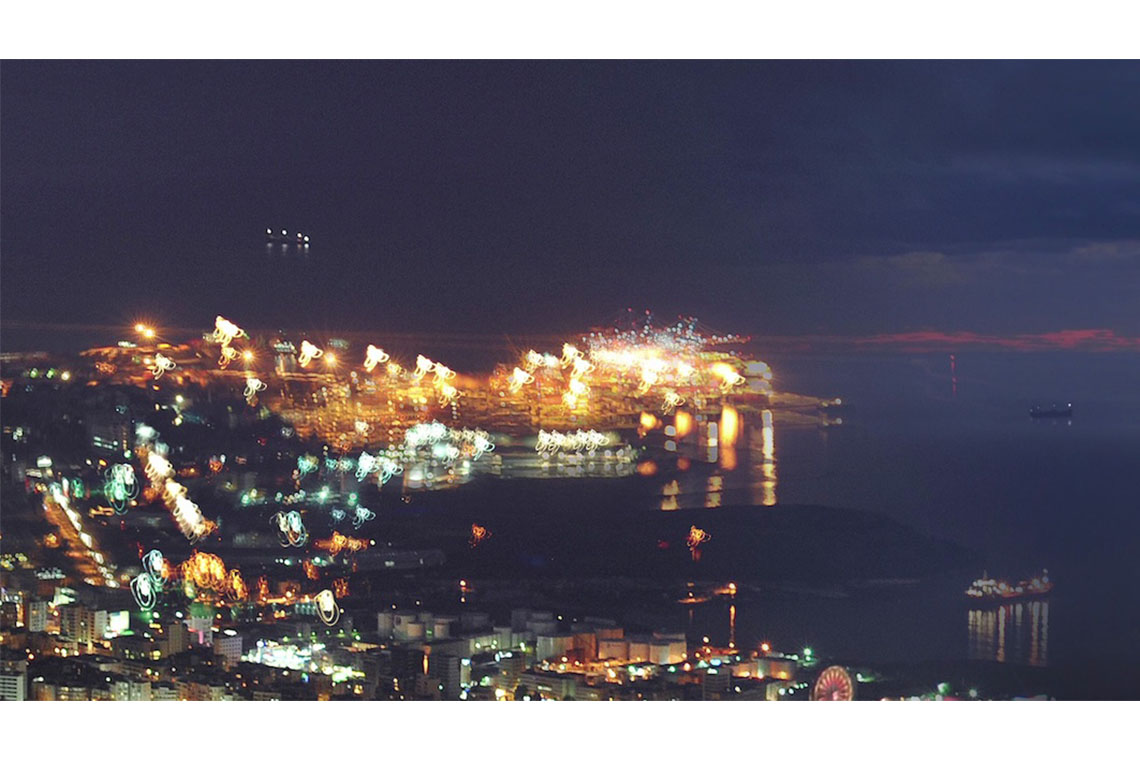
At Circolo in Milan, a show by Saikalis Bay Foundation presents works by artists reflecting on the cyclical nature of Lebanon’s challenging history.
Dated coloured photographs from the 1960s and 70s, capturing views of the charming coast of Beirut lined with luxury hotels, project the eastern outpost of la dolce vita. Aligning the wall of the non-profit art space Circolo in the heart of Milan, the series of images first portrays dreamy scenes of Beirut during its Golden Age, a much sought after eastern Mediterranean refuge for indulgent, carefree living with an Arab flair; then, as the images progress, the scene becomes torn and burnt in places as the once mesmerising vista transforms and becomes shrouded with the signs of war.
The work is The Battle of the Hotels: Historical Process N°1 by Lebanese artists Joana Hadjithomas and Khalil Joreige from their series Wonder Beirut: The story of a pyromaniac photographer (1998–2006). How does one report traces of conflict while also capturing what war and destruction do to the image itself and preserving an element of the vibrancy that once was? This image is part of Shifting Crossroads. Beirut Contemporary, a group show curated by Beirut-based curator Ibrahim Nehme at Circolo and reflecting ideas of memory and history.
Originally conceived to celebrate Beirut’s cultural and artistic renaissance after years of hardship and to challenge the idea of the eastern Mediterranean as a place of perpetual crises and violence, the show instead opened during a time of renewed war and devastation in Lebanon. The grim backdrop notwithstanding, Nehme seeks to show Beirut’s connection to its wider maritime context. “The Mediterranean has always been a sea of crossings: of trade and empire, but also of whispers, recipes, jokes and mourning songs carried from one port to another,” he writes in the curatorial essay. “The artists gathered here belong to that stubborn current. They remind us that the sea does not separate; it connects. Through story, through wound, through struggle, through art.”
The city of Beirut is the protagonist of this exhibition – one who is gracious, strong and willing to perpetually fight for beauty, as much as for its own existence. The display of Hadjithomas and Joreige’s work offers a particularly apt reflection of the perpetual cycle of violence. The viewer becomes mesmerised by idyllic scenes, as one often does when visiting the Lebanese capital, until they become obscured with wreckage. Wonder Beirut is based on a series of postcards from the 1960s and 70s that are still on sale in Lebanese bookshops, even though the places they depict have since been bombed, shelled or changed out of all recognition due to reconstruction programmes. The artists created a fictional character: the photographer Abdallah Farah, who allegedly took the photographs used to produce the postcards and then burned them himself to record the impact of the bombardments and street battles during the Lebanese Civil War.
The photographs continue their resonance today as war has erupted again, forcefully disrupting the fragile period of 10 months since Lebanon last witnessed conflict. As Beirut-born Nicole Saikalis Bay, founder of Circolo and the Saikalis Bay Foundation (which she founded with her husband, Matteo Bay), asks: “How can a country rebuild its future without forms of expression that seek to understand, navigate and articulate its lived experience and present realities? How can new imaginaries emerge without passing through this necessary terrain, a terrain whose urgency is only intensified by the ongoing conflict in Lebanon?” The works on view strive, with determination and passion, to provide answers.
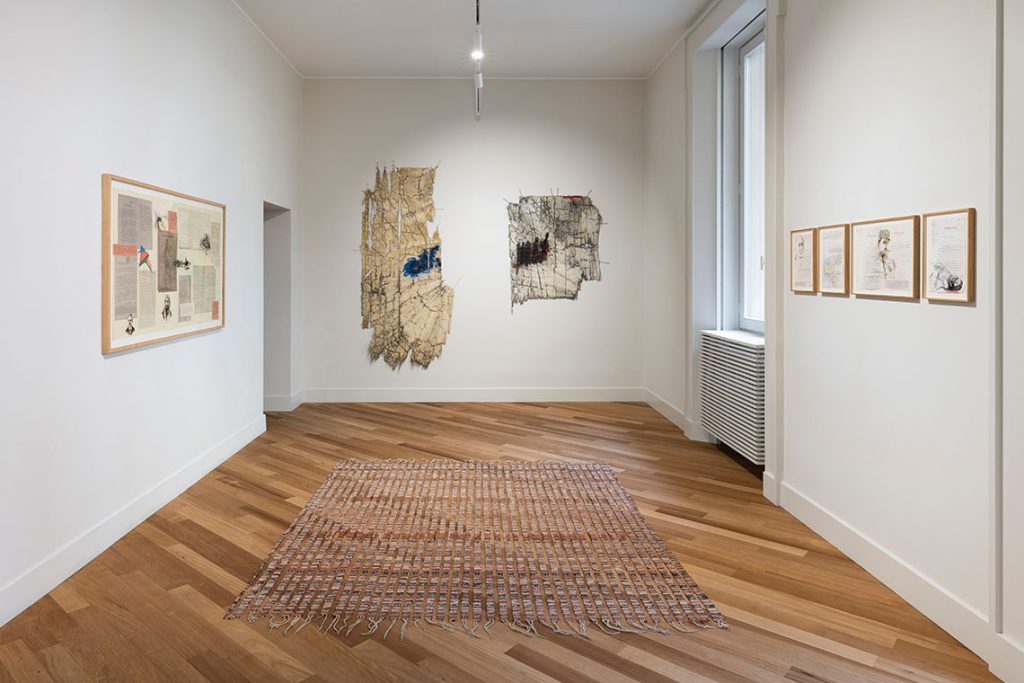
As one enters Circolo, a powerful yet subtle array of works offer documentary and emotional resonance and open up broader questions, such as how to maintain a sense of beauty and joy during times of perpetual hardship. Stéphanie Saadé’s delicate, multi-hued carpet entitled Stage of Life (2021) appears in the centre of the first room, over which hang two works by Omar Mismar, Root and Branch #1 and Root and Branch #2 (both 2025), made from watercolour and spray paint on a salvaged flex banner – the ragged nature of the works reflects the war-torn walls of Beirut, with its cracks and, every so often, vibrant graffiti that appears as if to illuminate their decrepit state. Mona Hatoum’s porcelain sculpture Witness (2009) is positioned on the right side of the room, presenting a small-scale reproduction of the Martyrs’ Monument located in Beirut’s Martyrs’ Square – a site deeply connected to Lebanon’s turbulent history. The two figures stand proudly, defiantly even, while their white bodies are filled with dark bullet holes in yet another visual representation of how Hatoum explores the fragility of history, the lasting effects of trauma and how societies remember conflict.
A more documentary thread continues in the first room on the left side with Lamia Joreige’s Uncertain Times – Locusts (2021) and Uncertain Times – Fayçal (2021), made from a series of mixed-media artworks that assemble various elements, including drawings, archival photographs and documents alongside her own commentary. The latter takes the form of personal texts by the artist, creating visual and textual correspondences that explore the turmoil around the time of the Ottoman Empire’s collapse, tracing events including the Arab uprisings, the fluctuation of diplomatic powers and the great famine of Mount Lebanon – all momentous events that transformed the region socially and politically and are still being felt today. Appearing on a wall nearby is a burst of colour from Akram Zaatari’s YM Series (2024), depicting a diagrammatic map of the Mediterranean Sea, which in Phoenician is ‘YM’. The work reflects the rich ancient region as a site for cultural exchange, immigration and violence.
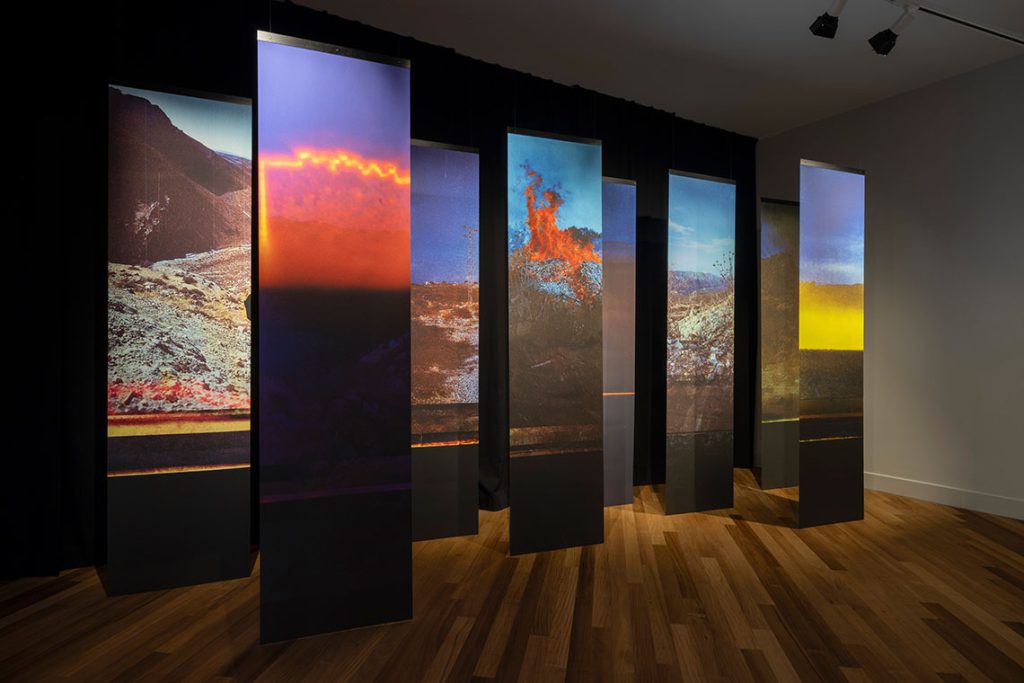
While a sense of urgency rings strongly in the first room, intertwined with documentary and historical references, it is in the second and third spaces that it becomes most palpable and passionate. Catherine Cattaruzza’s installation I am Folding the Land (2022), presenting eight 260-centimetre-high vertical panels, explores the impact of geopolitical instability on the shifting landscape of Lebanon. On the facing wall are The Battle of the Hotels: Historical Process N°1 by Hadjithomas and Joreige and their multimedia work Waiting for the Barbarians (2013), exploring panoramic images of Beirut that continuously shift from mobile to immobile, while a poem on the wall entitled Waiting for the Barbarians by Constantine P Cavafy in 1898 represents the ongoing desire for radical change – as if the arrival of the barbarians could find solutions to Lebanon’s ongoing problems.
In the last room, the sense of urgency propelled by the exhibition transforms into more abstract representations. Rabih Mroué’s Too close but yet inaccessible (2022) plays on a video loop and depicts the artist’s ongoing resistance to how images of war are circulated and absorbed by the public. His sketches reveal obscured figures seemingly fleeing or lost in a space – a means to reckon with repeated cycles of violence – while on one slide the writing states: “There is no going back in time; With time my pain will increase; My life will end; Wars will never end”. Small abstract sculptures of human torsos by Simone Fattal – Standing Man (2012) and Woman (2011) – appear to profess the fragility, humility and equality of the human state.
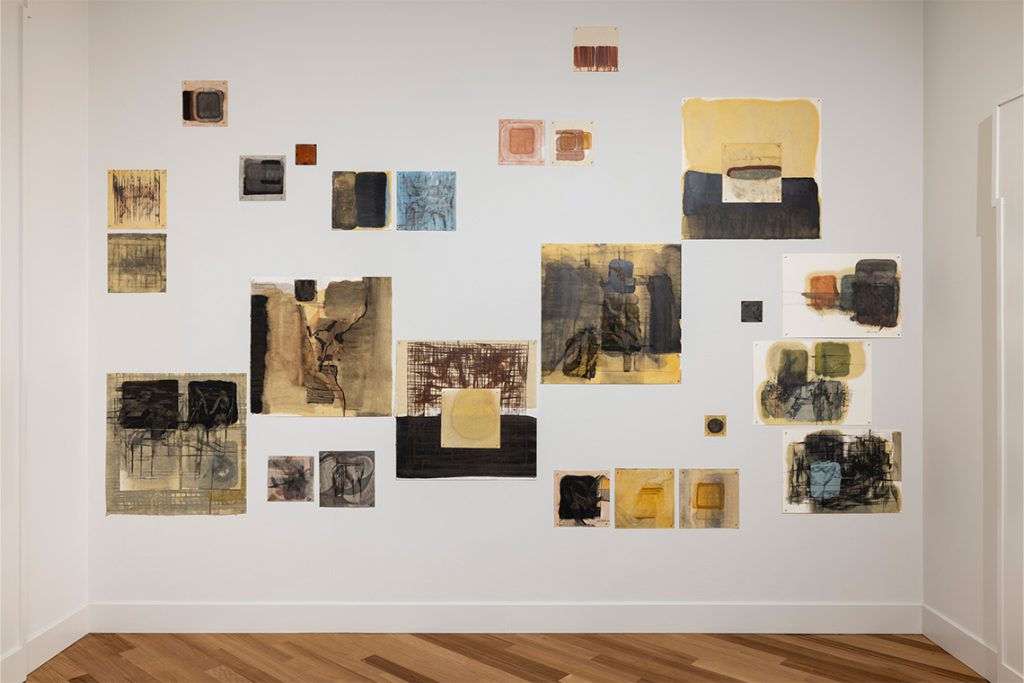
Young Beirut-based artist Soraya Salwan Hammoud’s multitude of paper drawings, Progenies of Oil (2025), offer the viewer a soothing sensibility – a way to mend from the turbulence of the past and the present. Combining bone, hematite and linseed oil on paper, the panoply of works in different sizes aligns the back wall in dark and light hues of green. Arguably the greatest discovery of the show, these drawings do not speak openly of war. Hammoud, who was present for the show’s opening, affirmed how the form of a square offers “neutral ground”. She further explained how through “gestures of repetition, erasure and layering, the surface becomes a site of pressure, a record of time, resistance and a field that attempts a resolution.”
Shifting Crossroads. Beirut Contemporary reflects the various remnants of history that tell the story of Beirut, its beauty, glory and pain. The works, like Nehme’s curation, seek to transcend the cyclical violence that has continuously impacted the city throughout its history. Saikalis Bay likens the show to Italian writer Italo Calvino’s postmodern novel, Invisible Cities. Calvino’s cities are not fixed realities, she notes, “but constellations of memory, desire, fragments and projections, very close to the idea of narratives continuously emerging from layered histories. The city does not tell its past but contains it like the lines of a hand.” As the artists demonstrate Beirut’s layered history, its various wounds are worn proudly here – the very fragments of both its pain and its beauty.
