

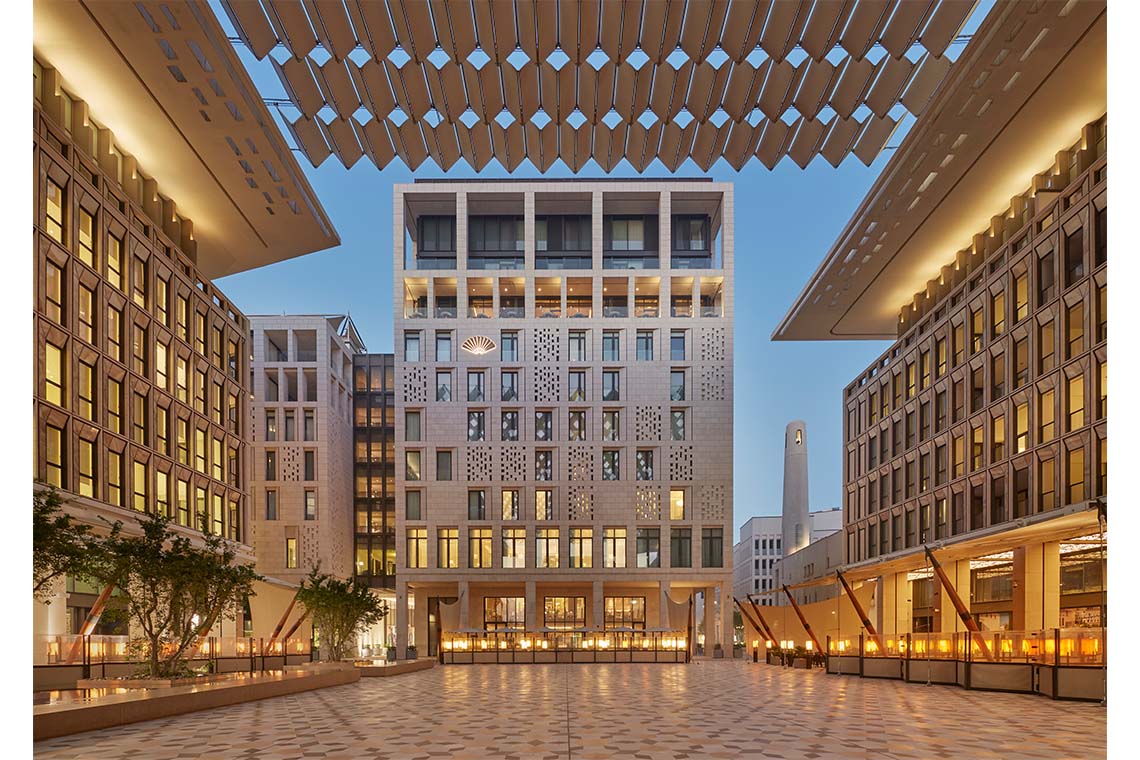
Mandarin Oriental, Doha is a striking example of how innovative architecture and design can integrate local heritage to provide truly immersive experiences.
Promoted as the world’s first sustainable downtown regeneration project, Msheireb Downtown Doha is a dynamic social hub in the Qatari capital. Take a stroll around on any day, and at any time, and you will find groups of friends catching up, families gathering and children playing in the shaded expanse of Barahat Msheireb, a dramatic new urban space designed by London-based architect Michel Mossessian and comprising a central courtyard with a retractable roof cover, encircled by a variety of boutiques, restaurants, Msheireb Museums and the M7 cultural hub.
It is in this vibrant urban context that Mandarin Oriental, Doha resides, its eye-catching design seamlessly blending in with its surroundings. The hotel’s warm-toned limestone, deep-set windows and mashrabiya-inspired screens echo the facades of the Mossessian-designed environs, which are also inspired by traditional Qatari architecture. From the outset, it is clear that this is not a hotel which seeks to impose its presence but one that melds seamlessly into its environment, occupying a unique place where the public and private converge.
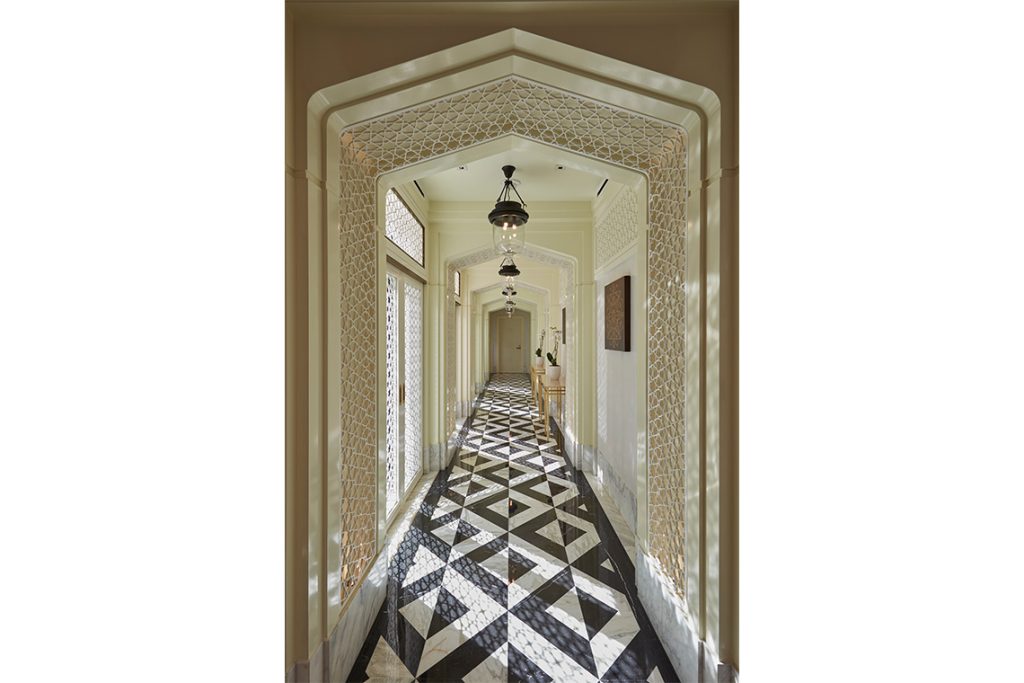
The hotel’s lower terraces overlook Barahat Msheireb and provide a welcome perch for those wanting to observe the action happening beyond Mandarin Oriental’s walls. Opportunities to engage with the wider neighbourhood are plentiful, as are welcome moments of respite within the hotel. Guests begin their journey in a reception area, which provides a sanctuary from the hustle and bustle of the square. A muted colour palette and soft lighting soothe the senses, while the elevated atrium allows the natural light to seep through in a gentle reminder of the outside world. Contemporary symmetry balances the architectural lines of the space, with a variety of traditional patterns adorning the walls and floors. The effect is a calming one, as though one has entered a private living room, very much in keeping with the atmosphere of tranquility and quiet elegance found throughout Mandarin Oriental, Doha.
Central to the interior design by David Collins Studio and Jouin Manku is the commitment to situating the hotel’s aesthetics firmly in their local context. “It was very important that the design was rooted in the culture of Qatar,” says Simon Rawlings, creative director at David Collins Studio. “It could not just be generically Middle Eastern.” This understanding of the specificity of context while avoiding regional clichés is evident at every turn in Mandarin Oriental, Doha. Whether in the mother-of-pearl inlays which recur throughout the hotel’s private and public spaces, the rope motifs alluding to the country’s pearl-diving history, the fretwork screens and series of patterns drawn from traditional pottery and basket weaving, the design is a true homage to the surrounding desert environment and ancient Qatari craft traditions.
Attention to context is embedded in the very architectural fabric of the hotel, which melds together Qatari urban forms with sleek contemporary elements and was conceived by John McAslan + Partners. Again, the interplay between interior and exterior space, public and private, is very much key, in keeping with traditional Qatari architectural principles, such as the central courtyard around which the hotel’s 117 rooms, 41 suites and 91 serviced apartments are arranged. The shaded passageways and open colonnades, which allow for protection from the beating sun, are inspired by traditional sikat alleyways and Qatari homes, working with the natural environment rather than against it to balance the interplay between light and shadow.
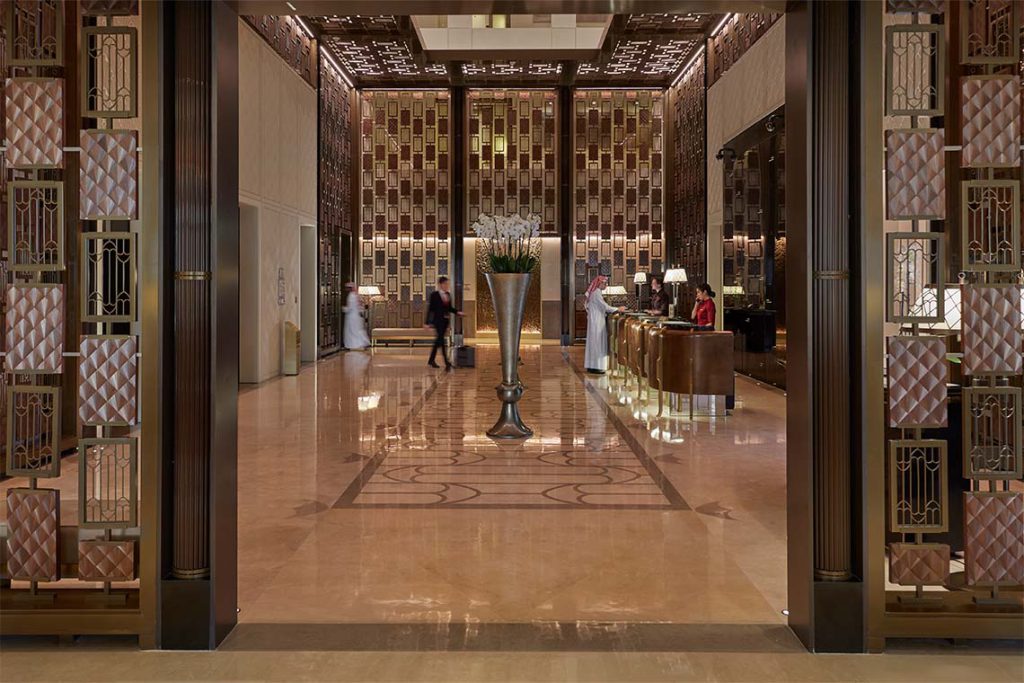
Mandarin Oriental, Doha is imbued with a spirit of innovation and craftsmanship, reimagining how heritage can be conceived for the contemporary world. Over 350 bespoke items were created for the hotel, among them lacquered woodwork, hand-finished wall panels and alabaster lighting. In addition to these one-of-a-kind elements, much of the artwork hung across the hotel’s walls and ceilings honours the guiding mission to present heritage in a dynamic and contemporary way, often making subtle acts of homage to Qatar’s natural environment. A sculpture by pioneering Qatari artist Yousef Ahmad, made from dried palm leaves fashioned into abstract Arabic letters and shaped like a fan, is a nod to Mandarin Oriental’s fan emblem. It is complemented by an imposing piece adorning the main entrance, rendered by two Chinese artists using traditional wood painting techniques and inspired by the local Al Thakhira Mangrove Forest.
A welcome surprise sits above the main staircase leading up from the lobby, in the form of Peter Gentenaar’s floating paper sculptures with undulating organic forms that recall the shape of sand whirling in a storm. The history and traditions of Qatar are subtly present in every detail of Mandarin Oriental, Doha, whether in the sand dune pattern in the ceiling reliefs, marble flooring, wall panels and carpets, the arrowhead pattern embedded into surfaces across the hotel, or the corridor lights and metal studs which allude to the wooden beams (danshal) that supported the clay roofs of traditional local homes.
Equally integral to the guest experience are the hotel’s nine dining spaces, each carefully designed to tell a distinct narrative. Whether one prefers the open-kitchen and convivial atmosphere of Mosaic, the indoor or outdoor areas of Mediterranean-inspired cuisine at IZU, or the moodier, sophisticated elegance of the sunset-inspired design at Ambar, there is no shortage of options for a variety of refined tastes and occasions.
Mandarin Oriental, Doha sets itself apart for many reasons, but perhaps most striking is the elegant tone set throughout, a perfect balance between the interior and exterior spaces in a harmonious blend of heritage, craft and tradition meeting contemporary design to provide a truly above-par hotel experience.
