

Aranya Art Center Guangzhou presented works from the Sharjah Art Foundation Collection in an exploration on the poetics of memory, the construction of history and the enduring idea of homeland.
In Absence and in Presence at Aranya Art Center Guangzhou (ended 6 August) marked the largest international presentation to date in Asia of Sharjah Art Foundation’s collection. More than 70 artworks by 28 artists were divided into three galleries, forming a constellation of Arab modern and contemporary art that offered both breadth and depth across the region’s art history.
One might find it hard to immediately connect with Iman Issa’s Heritage Studies (2015). The architectural structures of a minaret, a pyramid and a crescent crown were reproduced in scale and materiality distinct from their originals, resulting in the odd-looking objects that lined up on the floor. The accompanying museological labels lent them an air of legitimacy; part of the artwork, they staged an ironic tension between what was displayed and what was announced. Together, these objects showed how history could be recorded, manipulated and even fabricated. As the first works to confront the viewer in Gallery One, they challenged the concept of an ‘official history’ and opened up an expansive dialogue on the innumerable forms that memory and history can take – a dialogue that unfolded across all three galleries.
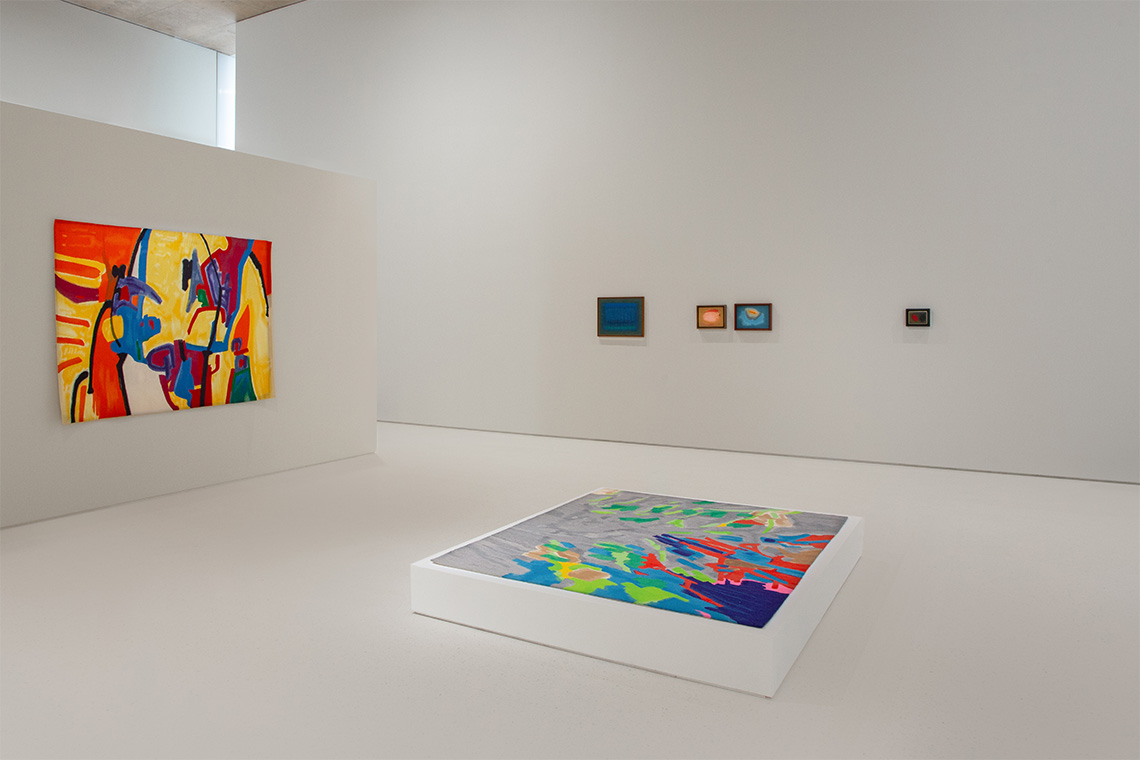
Other works in this gallery featured abstracted landscapes and everyday rituals. Among the works of Rasheed Araeen, Helen Khal, Samia Halaby and many others, the focal point was Etel Adnan’s wool tapestries Arbres [Trees] (2015) and Mount Tamalpaïs (2015). The fragmented vignettes of trees and mountains record the artist’s impressions of the Northern Californian landscape, a home that she eventually settled in after years of drifting. The vigorous branches and steady mountain ridges beneath her brushstrokes seem to capture the exact moment of her encounter with these subjects; yet their broken composition and cropped framing hint at stories hidden under the surface. On the same floor, Joana Hadjithomas & Khalil Joreige’s film ISMYRNE (2016) responded to these mysteries by gradually uncovering Adnan’s stories. The film follows Adnan’s struggles to construct an image of Smyrna (now Izmir in Türkiye), a maternal homeland the artist was never able to physically reach. Lacking visual references, Adnan could only piece together an image of this city through a few heirlooms, objects and memories passed down from her parents; these fragments became the thread through which she reconstructed a visual connection with a city she had never seen but nonetheless firmly believed in. Adnan’s tapestries are, therefore, her attempts to trace the contours of these memories, as she practiced her routine of faithful reimagining.
For Adnan, homeland was something imagined from afar, a landscape absent from direct experience but present across generations of memory-making and storytelling. In fact, many works in the galleries inhabited this dialectic of absence and presence. Our memories of the land might be as close and tangible as the canvas right before us, or might have dissolved into a faint echo in the depths of the mind.
In Gallery Two, Akram Zaatari’s film The Landing (2019) evoked that deep memory through various sounds emanating from concrete public housing ruins in Sharjah. Originally built to host the nomadic Kutbi Bedouin Tribe, these abandoned structures, half-submerged in sand, have found new life as sonic instruments. The three invited sound artists had either scratched or struck the surfaces of the structures or filled the gaps between them with strings, ropes and their own bodies to trigger variations in tune. In these experimental moves, sand starts to function as an instrument – it is slashed by a knife, struck by rocks, shaken within a bowl, blown through a pipe, or swirled across a fan… As the only remaining resident of these modernist ruins, the shifting sonic quality of sand evokes the history of how these houses were occupied, abandoned and incrementally naturalised by plants and camels. Ephemeral as they are, these echoes of the land encouraged us to listen deep into time and excavate the histories embedded within it.
In the same space was Mona Hatoum’s sculpture Projection (Velvet) (2013), illustrating a world map by removing the surface layer from a piece of velvet. The sandy hue of its lining renders the landmasses in their simplest form, suggesting a more truthful scale of the continents and a more rightful representation of history. Across from it, Hassan Sharif’s Desert series (1985) extends his early performance work by smearing sand on canvas. The notational strokes magnify the textures of the dunes and celebrate the life and beauty of the ever-changing terrain. At the corner, Zineb Sedira’s Sunken Stories (2018) presented six wooden shipwreck models sealed within boxes of clear resin, suspended in the moment of their sinking. They allude to the interrupted journeys of attempted migration across the Arabian Sea, whose stories are on the verge of fading from memory.
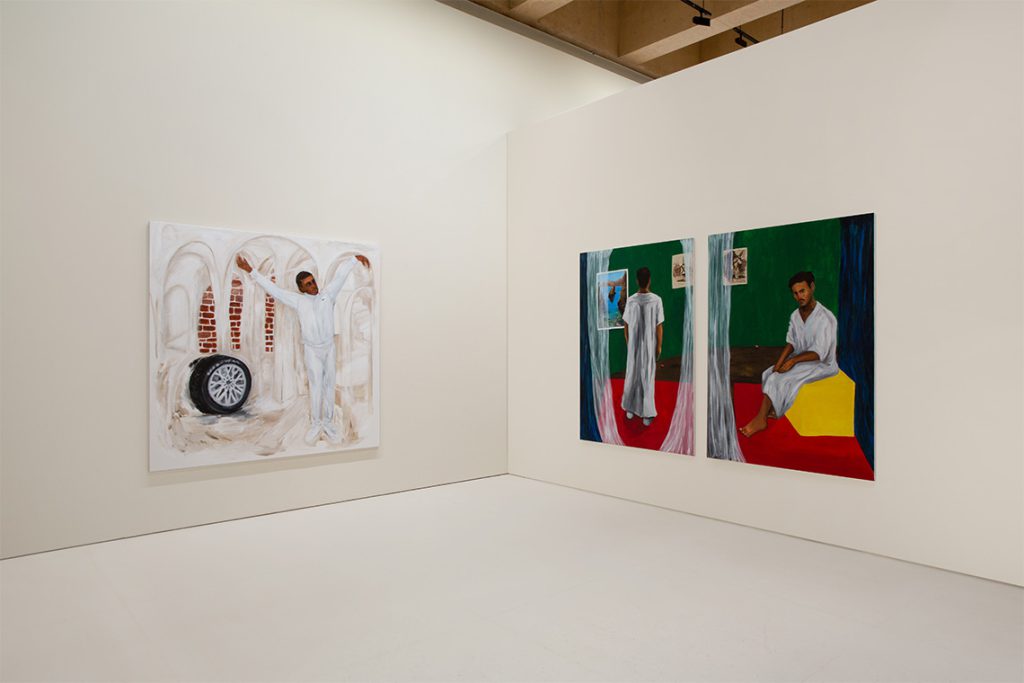
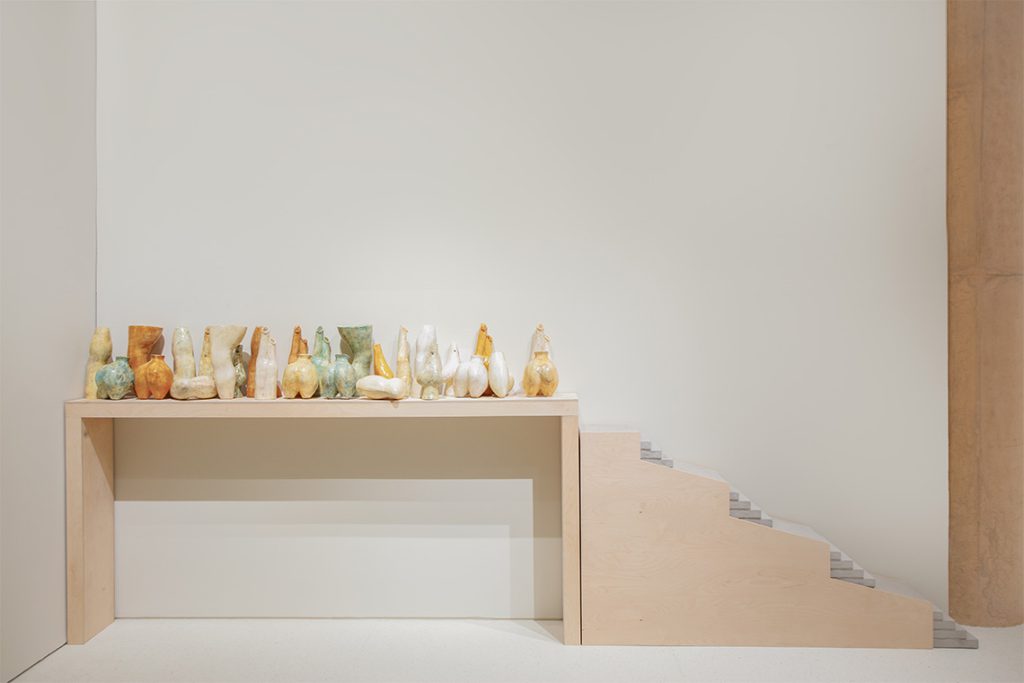
Gallery Three included a collection of figural paintings, sculptures and photography. The choreography of texture, colours and tones that enveloped those figures blurred the boundary between the factual and the imaginary, the corporeal and the illusory. The glossy ceramic forms in Jumana Manna’s A Stage for Any Sort of Revolutionary Play (2016) evoke an ambiguous gathering, poised between a casual assembly and revolution in the making. They contrasted with the coarse, earthy surface of clay in Simone Fattal’s Warrior (2006), an archetypal figure that speaks to the imperfections that underlie all humanity. Among the paintings, Anuar Khalifi’s self-portraits The Opening (2020) and Talwin Tamkin (2022) constructed the psychic depth of their figures through layered architectural forms, while Ahmad Morsi’s surrealist paintings flattened the figures into adjacent fields of colour. The photography section brought the gallery to a lively close, with the Iraqi and Sudanese photographers capturing the richness of everyday life among ordinary people, leaving poignant marginalia alongside the official accounts of history.
According to Joana Hadjithomas, homeland can exist anywhere. It can be found in the vignettes of mountains and trees, in echoes between rocks and sands, and alongside the stories and faces we recount and retrace. In the absence of homeland, it is our active depictions, storytelling and recollections that keep it alive and present; the shapes of memories and the echoes of landscapes become signposts by which we find our way back to it. Besides offering a compact yet well-tailored survey of modern and contemporary art from the region, In Presence and In Absence also reminded us of the poetics of remembering and of the multitudes of forms through which history continues to live and persist around us.
