There is a certain comfort in recognising an artist’s body of work and language. Over time, audiences learn to locate familiarity, within a medium, a gesture, a conceptual framework. This recognition becomes a quiet agreement between the artist and the viewer. When that agreement is disrupted, the shift is often framed as ‘experimentation’, as though deviation itself requires explanation. Sara Naim’s From the Perspective of Language at The Third Line enters precisely at this point of tension, not to reject her earlier practice but to stretch its terms of legibility.
Marking her first public presentation of paintings, the exhibition unfolds as both continuation and recalibration. While Naim’s earlier works have frequently engaged photography and video to interrogate perception and representation, here the canvas becomes an expanded site of enquiry, one that is no less mediated, no less constructed. The paintings, created sporadically between 2023 and 2026, resist the immediacy often associated with a ‘new direction’. Rather, they emerge as a parallel investigation, one that has been quietly unfolding alongside her more visible practice.
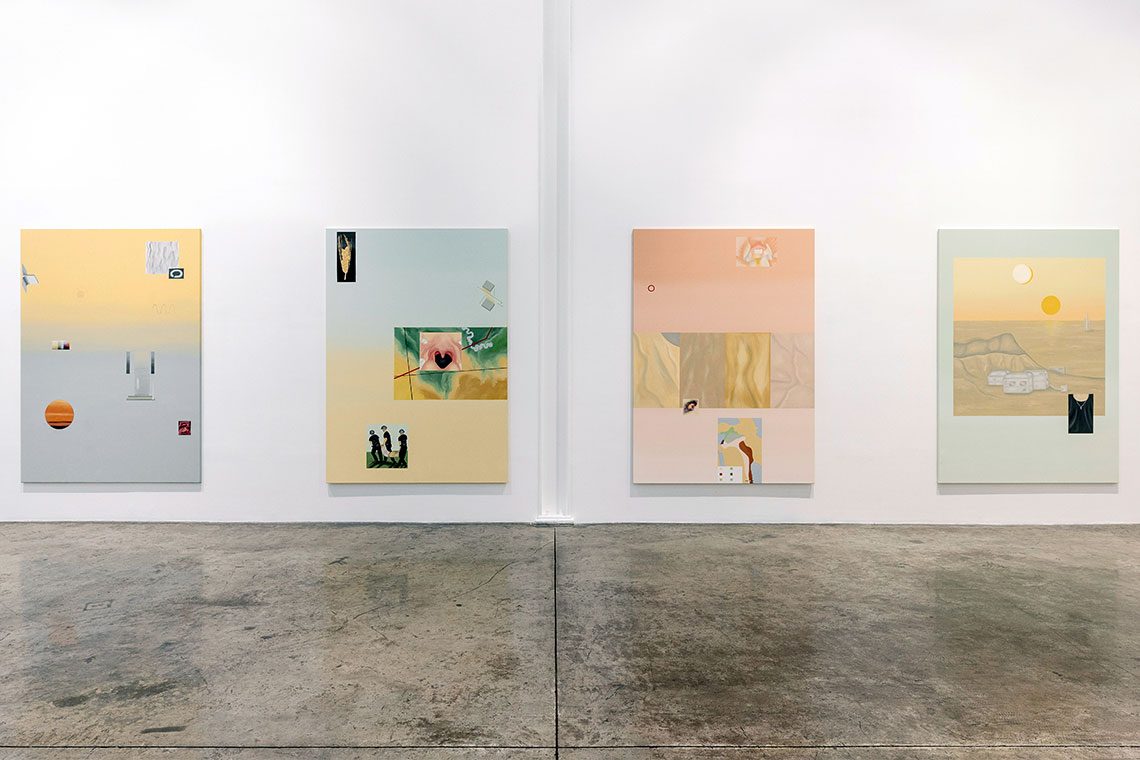
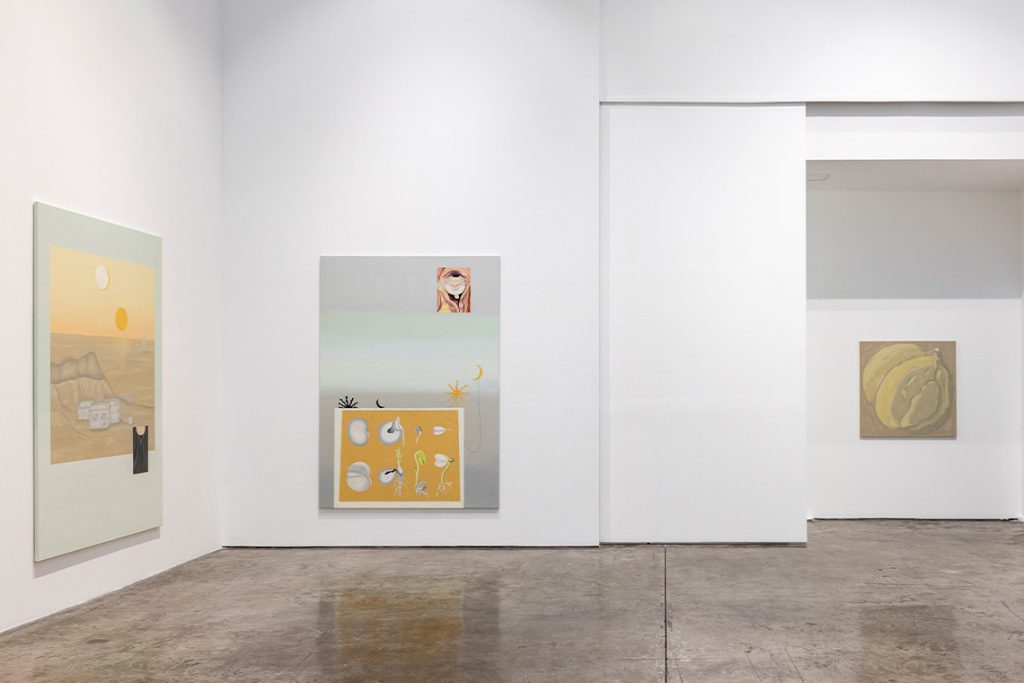
Installed across the first gallery, the works move between figuration and abstraction, refusing to stabilise into a singular reading. Images, ranging from botanical forms and grains to fragments of skin and symbolic markers, appear suspended within fields of colour that echo the ambient neutrality of digital screens. There is a distinct sense of assembly at play. Elements seem to have been placed through association, as though ‘dragged and dropped’ into position. This compositional strategy reflects a broader condition of meaning-making today, where understanding is increasingly constructed through accumulation, juxtaposition and fragmented encounters rather than linear coherence.
Central to the works is an exploration of boundaries not as fixed lines, but as porous and shifting conditions. Naim draws on references as varied as quantum mechanics and biological processes to destabilise the notion of the contained object. Skin, recurring throughout the series, becomes a particularly charged site. It operates simultaneously as surface and subject, as something that holds identity while remaining in constant exchange with its surroundings. In this sense, the canvas mirrors the body. Layered, permeable and resistant to closure.
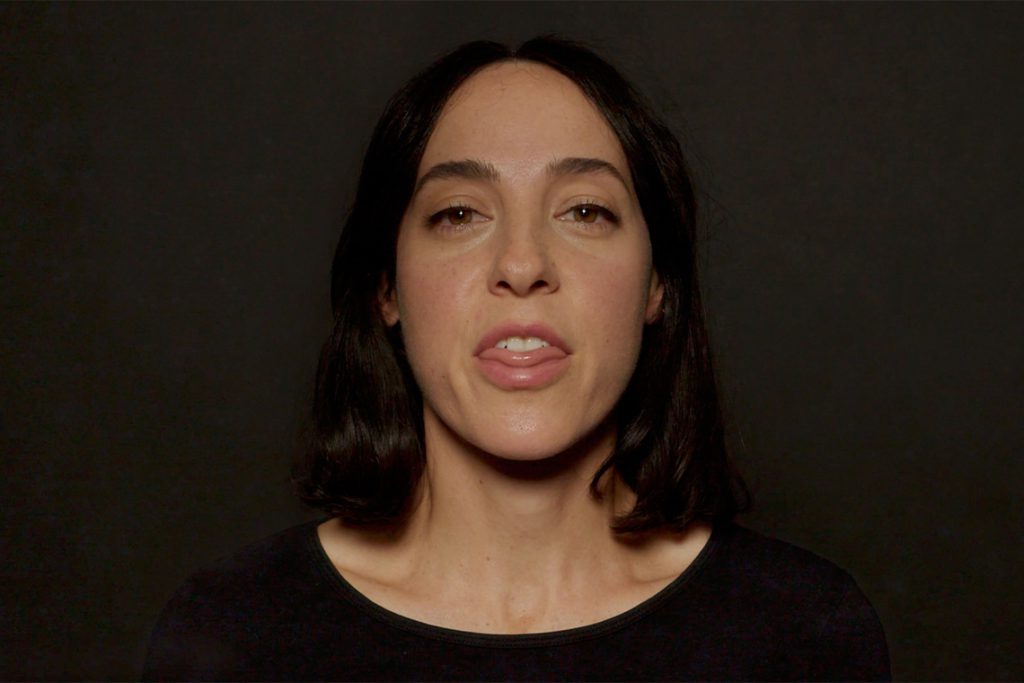
Interspersed within these fundamental references are symbols that point more directly to systems of control, religious iconography, markers of territorial authority, even the presence of a patrol dog. These elements introduce a quieter but insistent consideration of how power operates through visual and symbolic languages. Here, boundaries are constructed, enforced and maintained through systems that determine inclusion and exclusion. By placing these alongside forms that inherently resist containment, such as pollinating plants, shedding skin, Naim draws attention to the friction between imposed order and fluidity.The exhibition extends into a video work, Mother Practices Her Tongue (2026), which shifts the focus from image to speech. Framed in a manner that recalls a photographic portrait, Naim addresses the camera directly, attempting to form Arabic letters and sounds with her mouth. The sequence is not fluid; letters are repeated, isolated and rearranged until they dissolve into guttural, abstract utterances. What begins as language gradually loses its linguistic clarity, with just retention, and not an effective charge.
In this breakdown, language is revealed not as an inherent system of meaning but as a constructed one, dependent on order, repetition and shared understanding. The disruption of this order gestures toward the ways in which language functions within broader structures of power, exposing the fragility of communication. A tool that can be both articulate and constrain, include and exclude. In a contemporary context shaped by algorithmic filtering, political rhetoric and contested narratives, this destabilisation feels particularly evocative.
Yet, the exhibition does not position itself as a critique in overt terms. It instead operates through a series of subtle displacements of medium, of meaning, of expectation. The absence of a fixed interpretative framework allows the works to invite the viewer into an active process of thinking and constructing, and to remain open. In Naim’s work, this openness and the encounter between the works and the observer is never fully contained but is continuously practiced.
The spatial dialogue within the gallery reinforces this condition. If the paintings propose a visual field where images circulate and accumulate, the video introduces a temporal dimension in which language unravels in real time. Together, they form an expanded system, one that moves between surface and body, seeing and speaking, structure and intuition.
Navigating these shifts, From the Perspective of Language resists resolution. Its strength lies not in offering clarity but in sustaining ambiguity, reflecting a broader contemporary condition, one in which systems of knowledge and representation are increasingly unstable, and where meaning is as much felt as it is understood.
From the Perspective of Language runs until 31 May
