

The collective’s appetite for telling the world’s untold stories and non-written tales shows no sign of slowing down.
A purple-faced mulberry confidently declares no fruit “gives” as much as him, with punchy beats booming to his self-involved lyrics. A sharp-witted apricot immediately snaps back in dismissal: “Lonely kings eat you, as do the poor”. He instead takes pride in being the choice of both the “noble and common”. Apple, however, claims the stage with a biblical homage: “I am the comeliest in the garden”. This relentlessly bitter fruitarian battle, titled The Contest of the Fruits (2021), is the only video work so far by Slavs and Tatars, embodying the collective’s satirical sprit with a biting humour and immediately arresting aesthetic command. The glorious clash of the fruits is an adaption of a piece by a nineteenth-century Uyghur poet, rapped by the Uyghur-American singer Nash Tarr to beats by the Polish musician Lubomir Grzelak (aka Lutto Lento). Manchester’s East and Southeast Asian art-focused non-profit centre esea contemporary will present the nearly eight-minute film’s UK debut as part of the Berlin-based collective’s first institutional outing in Britain, which opens on 14 June.
Cartoonish and uncanny, each brightly hued rapper holds facial characteristics formed by Arabic calligraphy. Think a peach whose lush eyebrows elegantly curve and a pomegranate with eyes glaring in exquisite penmanship. Each visage is in fact the spelling of the fruit’s name in Uyghur, written in Arabic script. The gesture alludes to Hurufism, the fourteenth-century Sufi belief that sought connections between Arabic letters and the human face, especially through the configuration of its hairy parts, such as the brows, the moustache and eyelashes. “I find it a bit lazy to tell stories through people because I am not just interested in biographies,” says Payam Sharifi. The Slavs and Tatars co-founder prefers to utilise typography to illustrate overly animated and culturally ambiguous faces, a sign of the collective’s fascination with history’s nooks and crannies. He believes in the abundance of the “overlooked in our world” and, as a narrator of speculative histories and hard fact myths, he invests in the dark horse. “We should be telling stories through the plants, the rocks and the fruits, which requires some mental gymnastics,” he admits.
Eurasian folklore, Sufic principles, battle rap and vitamin-induced geopolitical jabs – which the collective alchemised together during a residency in 2021 in Haverford’s Hurford Center for the Arts and Humanities – embody brilliantly their foundational multicultural principals. With an uncompromising loyalty to remaining disloyal to any geopolitical presumption, Slavs and Tatars formulates arrestingly alternative portraits of a land bookended by the “east of the former Berlin Wall and the west of the Great Wall of China”. They excavate histories while eschewing the brick-heavy history books for the sake of lore, dialects, cuisines, songs and myths. Never shying away from making a pact with the underdogs and the eccentrics, they roam the minefields of semantic beefs and ethnological bickering. No matter how bold the flight is, they always land in a territory of slippery grounds drawn by the mercurial borders of the real, the fictional and the unexpected.
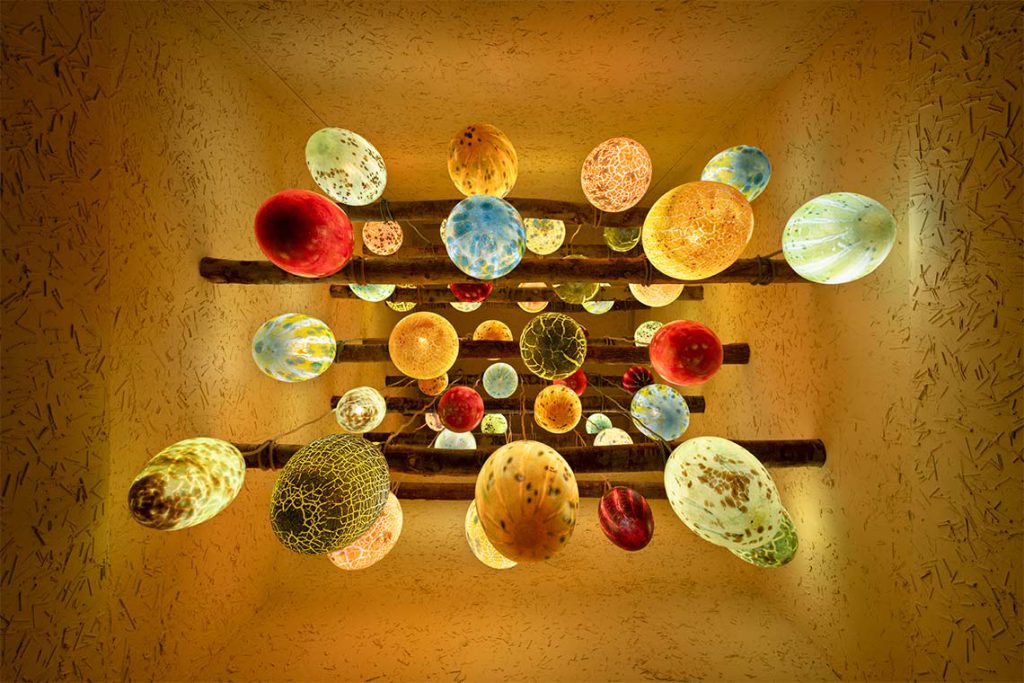
Melon Mahallah (2025), their installation in the current Islamic Arts Biennale in Jeddah, features around 60 hand-blown glass melon lamps, suspended in a wind tower in the show’s Al Midhallah section. The collective chose the sweet gourds for their mythical influence on a vast geography, including China, where melons were valued as war loot during the Qing dynasty, and the Islamic nations through the belief that Mohammed consumed them. For the ancient Uzbeks, melons were God’s effort to communicate with mortals through the unique cracks on the melon skins, rendered in the installation through a transparent luminosity in variant shades. “We are interested in the peripheries,” says Sharifi.
The Texan-born Persian-American artist started the collective in 2006 with the Polish artist Kasia Korczak, initially as a bookclub. Their interest in printed matter today extends to their commitment to publish titles and host readings and discussions in their multipurpose space Pickle Bar in Berlin’s Moabit district. Decentralising the approach to understanding multitudes and kinship is still an essential. “The centre is always rotten,” adds Sharifi, who omits the forefront for the far back. “We are interested in what bleeds from the centre towards the edges.”
Pickle has, therefore, been a relentless source of fascination. From larger-than-life mirror sculptures to posters in which a gherkin appears in bodily suggestions, the fermented cucumber stands in both for the over-marination and unripeness of the knowledge. “Pickle is one of the things I would call a stupid medium,” Sharifi quips about the simplicity of its ingredients, as well as a lack of nutrient and flavour. “Bacteria is such a fascinating and polarising subject matter, especially after the pandemic.”
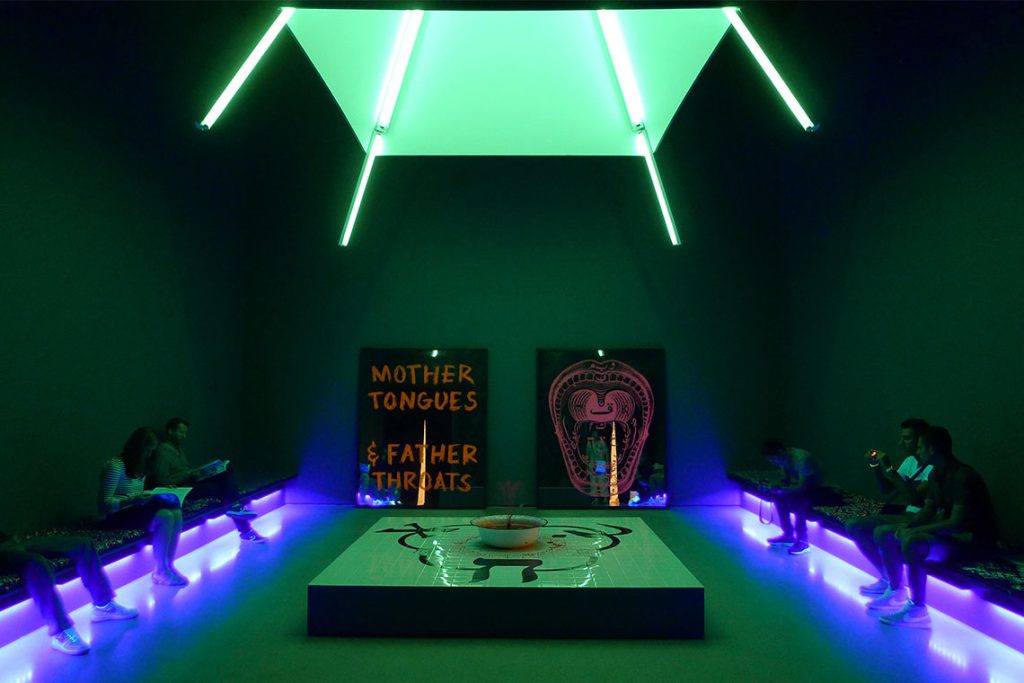
Sharifi finds a correlation between our pandemic-fuelled escape from bacteria, which also exists heavily in our systems as around 39 trillion microbial cells, and the culture’s dabbling with the unknown and the uninvited foreigner which has recently escalated through anti-immigrant politics. Pickle Bar allows the collective to use their platform for a larger discourse with multidisciplinary Eurasia-based residents who are invited to present work in a fluid area of performance, poetry, music and literature. Through pop-ups, mentorship programmes and fermented delicacies, the space reflects the collective’s effort to leave a humorously sour flavour in the tastebuds of their audience. “We are just the MCs who set up the scenography and let others perform,” says Sharifi. He finds power in relinquishing some of the visibility and “witnessing others investigate ideas that are not contingent upon our authorship”.
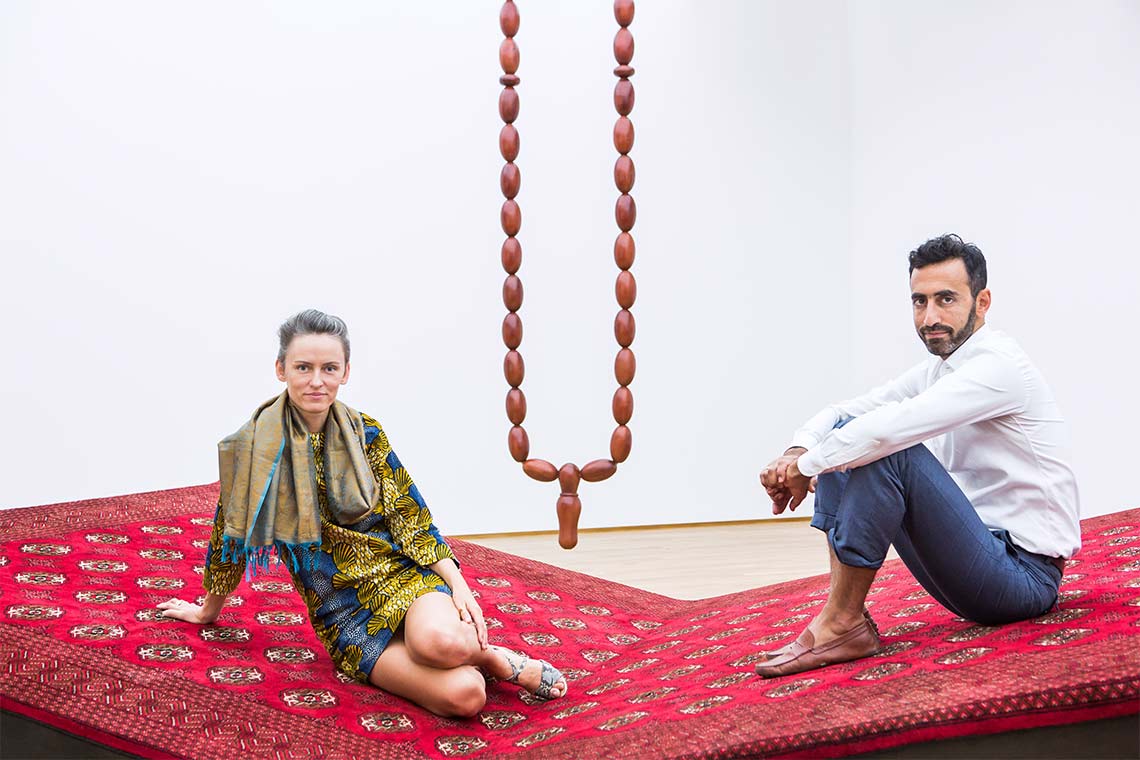
As the collective nears the end of its second decade, its members have maintained their position as one of the millennium’s most prolific and consistent artistic collaborations. Whether marrying alternative publishing with commercial exhibition formats or blurring the roles between curation and art production, they have remained in the service of punchy humour and twisted graphics. The collective has translated their intellectual and idiosyncratic curiosities into shows across the globe, including MoMA, the Venice Biennale and SALT Galata. From a massive wooden prayer bead which moonlights as an adult swing to flashy tongue-twister texts in vacuum-formed plastic prints, they have requested participation that is bodily and mental, or even gastronomical.
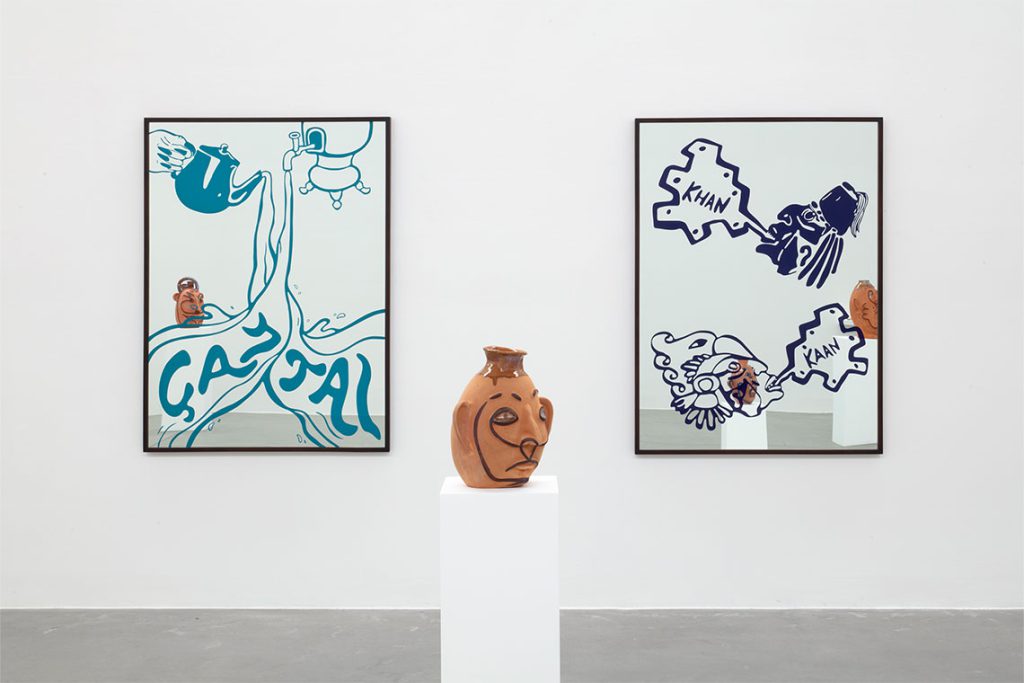
MAYATEPEK, the first exhibition by Slavs and Tatars in Mexico and which opened on 8 May at Galerie Nordenhake, is a tongue-in-cheek look at a historical oddity about Hasan Tahsin Mayatepek, who served as Türkiye’s ambassador in Mexico City during the 1930s. An amateur anthropologist, he believed that Turkish was the precedent of many Mayan and Aztec languages. “He made an incredibly detailed taxonomy on many Central American dialects and found uncanny resemblances between some of the words,” explains Sharifi. A series of ceramic face jugs humorously pair Mayan and Turkish words with similar intonation.
While the collective’s most recognisable trait is perhaps still infusing a contemporary jab into the inconspicuous, an adventurous soul for new materials always leads them to new discoveries. Charm – whether through materials, puns or colours – remains an entry point, regardless of how remote a subject matter seems for the viewer. In the end, the interest of Slavs and Tatars is barely on the countries themselves. “We have to train a certain muscle to talk about the transnational, like different language groups and the rituals,” Sharifi affirms. The uncompromisable for the collective is still the power of satire – both in civilisations long ago and today – as a survival tool and the key that opens the mind’s heavily locked doors.
