

The exhibition Tétanos at 32Bis in Tunis sees Aïcha Snoussi use tetanus as a metaphor for contamination, prompting viewers to question the forces that infect objects and memory.
Now a glittering creative space, 32Bis once sat at the heart of a very different world. Built in 1953, the building was originally a Philips factory, a key landmark in the local manufacturing industry. A range of garages and other factories surrounded the property, the sound of clanging and banging once reverberating relentlessly. Although much has changed today, traces still linger; visitors will find shops specialised in tools and mechanical parts around 32Bis, alongside abandoned warehouse spaces and discarded scrap piles.
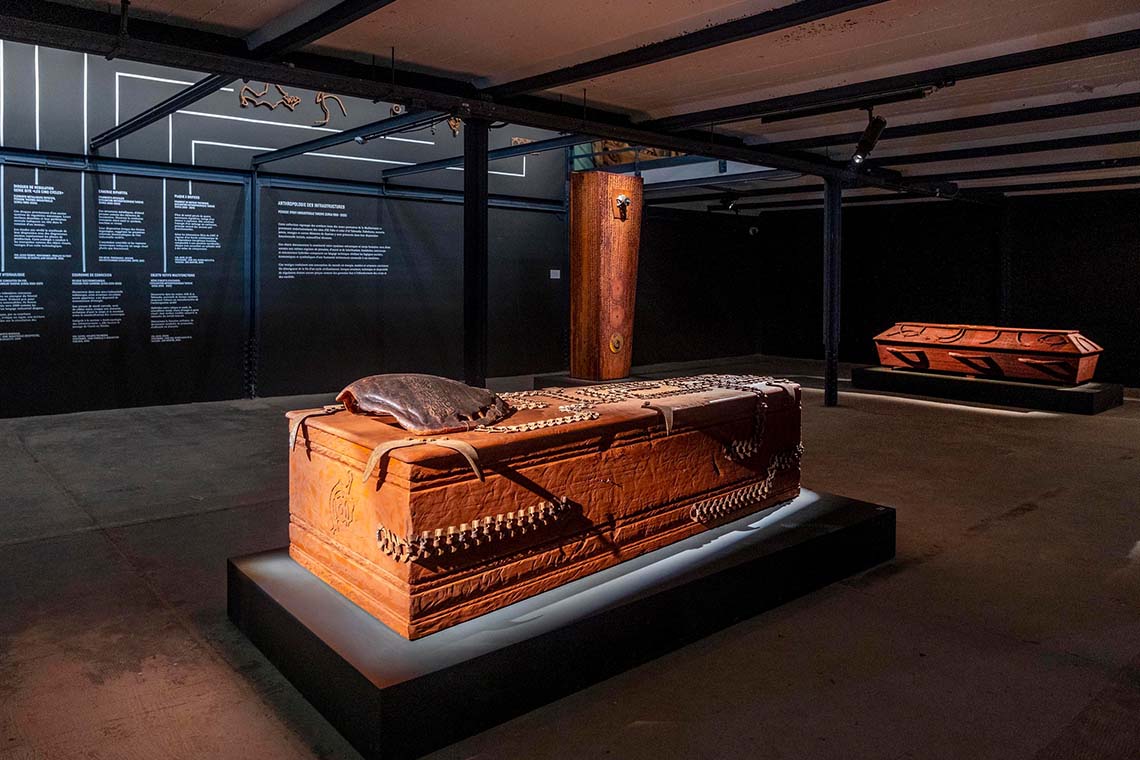
Curated by Hela Djobbi, Aïcha Snoussi’s exhibition, Tétanos, cleverly draws the industrial past of the neighbourhood back into the space. Visitors are first welcomed into a Museum area, where Snoussi presents us with a series of wooden coffins engulfed in metal parts and chains. These additions serve to anchor down the coffins, drawing on the sense of absoluteness that such objects inherently evoke. Through this installation, entitled Mechanical Transit Box N402 to N405 (2025), Snoussi has created a work that is at once tied to the past while also being tethered to the future of those still present. Its layered nature introduces the core questions proposed throughout Tétanos. How do objects change with time? What is their value to different people? And how do we determine it?
Along the back wall of the museum space hang three embroidered pieces: Apotropaic Veils 402, 403, and 405 (2025). Made of authentic green silk velvet, the cloth resembles a pall used to cover coffins. Once again, the themes of death and destruction hint at a lack of permanence that seems at odds with the premise of a museum – a place traditionally employed to preserve pieces for posterity, or at least the foreseeable future. The gold-embroidered lettering on the cloth also consists of only harakat, symbols that are used to vocalise Arabic script and have the power to change the entire meaning of words. Through the embroidery, Snoussi adeptly outlines another key theme: the ability for both the meaning and use of objects to change with time.
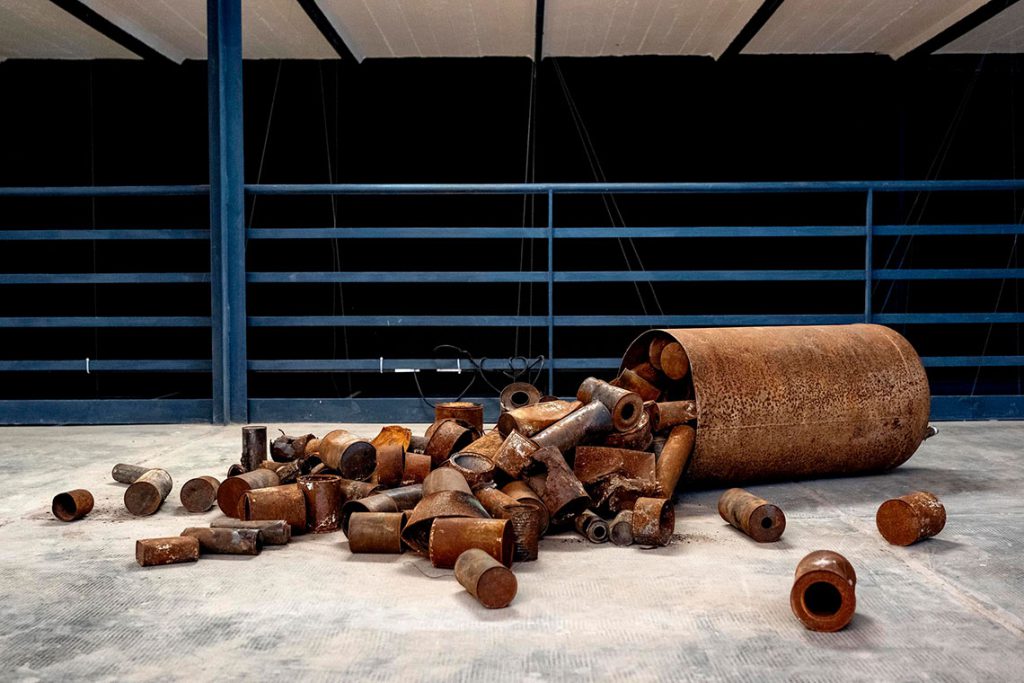
This sense of temporality and change is further highlighted by Lost Items Inventory (2025), which consists of discarded metal parts. Oxidised and corroded, the pieces nod to the title of the exhibition, Tétanos. Referring to the ways in which the bacterial infection can be transmitted through rusted metal, the name explores the contaminating forces that often eat away at objects, in turn distorting our very perceptions and memories of the pieces.
As visitors move to the second level of 32Bis, they enter the Archaeological Site. Compared to the static nature of the Museum – where traditional objects dominate and visitors are guided in their interpretations through written texts – this area focuses on archival materials. Installations are far more scattered; Rust Room 1 (2025) consists of scrap metals placed on the floor, with corroded parts of cars propped up against the walls. Elsewhere, in Kitab al-Āla wal-Ghayb (2025), we see Snoussi’s drawings and notes pinned on the walls and strewn across the floor. Rust Room 2 (2025) portrays scrap metal parts flowing from overturned barrels and spilling out of rusting bathtubs as though caught in movement. These pieces – disorganised and active – are in the process of being catalogued. Visitors are thus confronted with the question of what should be treasured or discarded, once again finding themselves asking: How do we determine the value of an object?
The third and final floor of the exhibition, the Living Space, brings all of these questions into sharper focus. Here, the sound of moving parts and machinery rings throughout the exhibition in sound bites made in collaboration with Oussema Menchaoui. Semi-functioning machinery reinforces the sense of being in a factory space. Transfluid Chamber (2025) consists of softly lit PVC pipes overflowing from a sterilisation vat and connecting into the nearby wall. In another corner, Die Machine Kafka 6-12 (2025) actively shudders, long pen-like mechanical parts moving swiftly and scribbling on a sheet below. Suddenly, we transgress the boundaries of simply being spectators contemplating the history of the objects and instead witness the factory functioning before us. The pieces, no longer designed to be observed or valued based on their history, are now subject to our interaction with them – both passive and active, all at once. Visitors become all too aware of the potential impact they have on these objects.
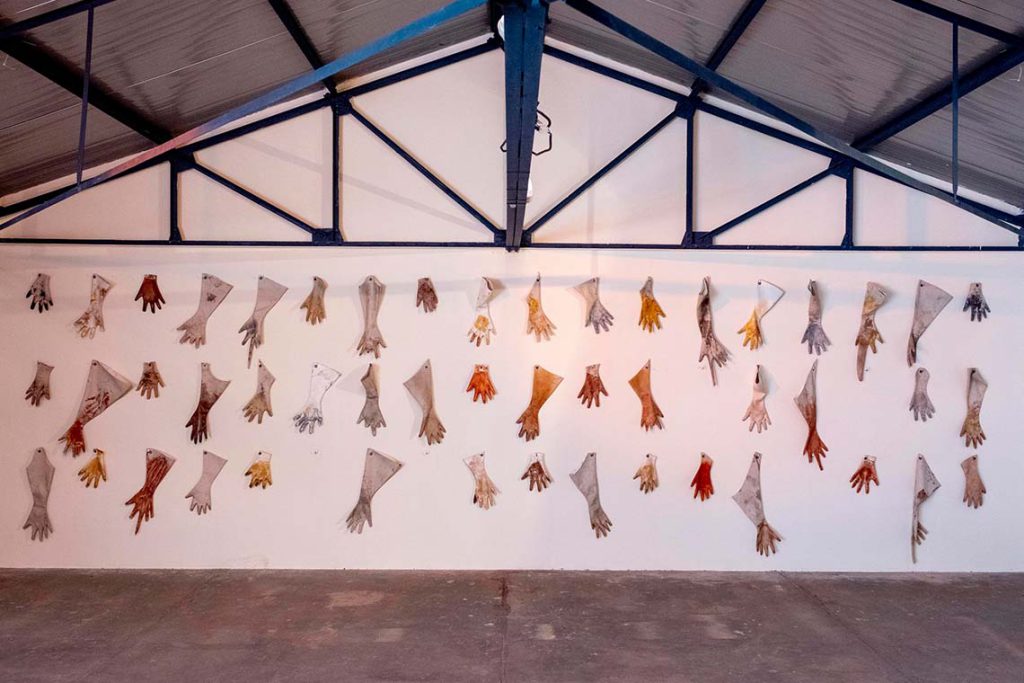
A final installation, Hide_32 (2025), solidifies the role of human interactions in our value system. Here, leather and canvas suits are hung by chains from metal pipes. The figures, resembling factory workers, appear to be bound – a nod perhaps to the constrictions of capitalism and consumerism. Although evoking a living entity, each uniform appears rather lifeless, as though suspended in time. This eerie sense of soullessness is drawn out further by an installation of gloves – these are stretched out and pinned to the wall, each piece dipped in a varying shade of ochre, orange and red. The red is perhaps the most captivating of all, evoking an image of bloodied hands. We are forced to confront the deep connection between humans and the industrial sector, and I find myself questioning both the sacrifices at play in this relationship and the value system that drives it. Through this human-focused final installation at Tétanos, Snoussi leaves no doubt over from whose hands the contamination of objects and memories ultimately flows.
Tétanos runs until 13 February 2026
