


Following the artist’s recent institutional solo shows in Mexico and Spain, and his residency at the Louvre in Paris, his current outing in New York explores breakage and reformation.
Dried winter leaves had blown into Kader Attia’s exhibition, Shattering and Gathering our Traces, during a recent visit to Lehmann Maupin gallery. The notoriously brutal Hudson River gust had patiently shoved the crusty autumn leftovers into the Chelsea gallery with each arriving and departing visitor. Remains – and our struggles to make something from their ghostliness – are an important part of Attia’s practice. Trauma and insufficiently recorded or biased histories are the particular remnants he generally focuses on, and mending is often his work’s suggestion. Sewn or glued, the artist’s sculptures and mixed-media collages alchemise a surgical care with an archivist’s curiosity. Far from hiding their flaws, they underline the tear, putting value in the healing process for each unique trauma.
Attia conducts his practice in exploration of the violence embedded in the colonialist agenda and the possibilities to exhume erased narratives. The French-Algerian artist’s new show – his first in New York in six years – explores the intertwined natures of cause and effect, adopting the aesthetic and poetic rhythms of breakage and reformation. Shattered and even lost, stories and objects return to the present in defiance of any sign of wear. A trio of bulging circular mirrors invites attention with their impeccable shininess. The viewer’s reflection of their likeness, however, is interrupted by intense tears that reveal dark innards. Cast in the firm physicality of glass, these wounds seem eternal, far from the slow healing that any cut eventually leads to.
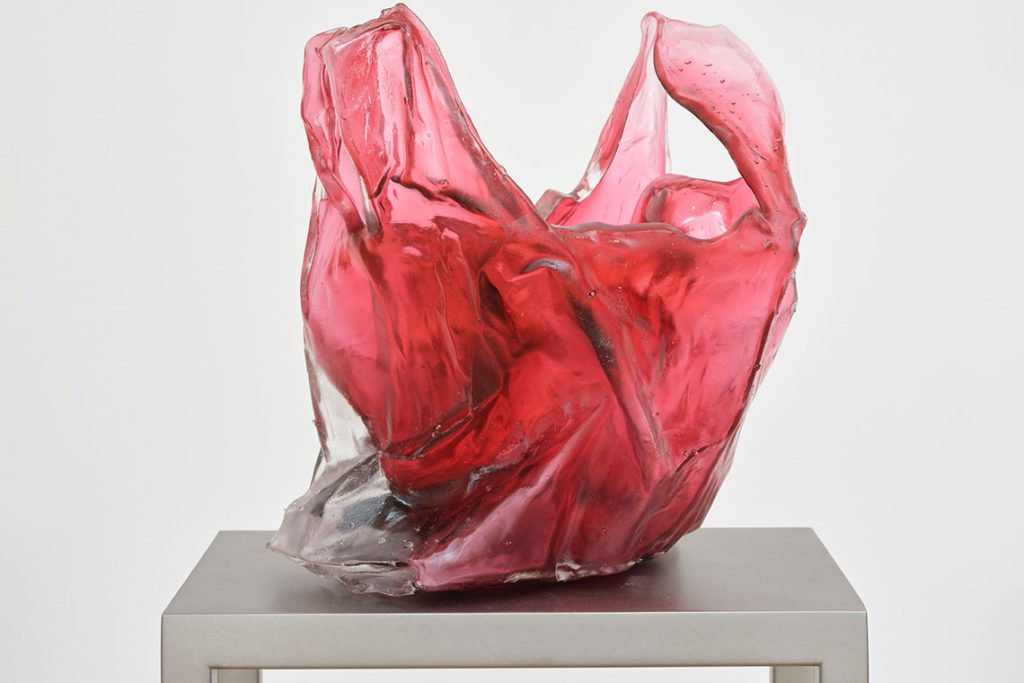
Image courtesy of the artist and Lehmann Maupin, New York, Seoul, and London
Glass also appears as shards filling a group of suitcases placed on the gallery’s main and basement floors. The spectral weight of an unattended luggage radiates through the sharp piles, with the blinding lights that rise from each suitcase suggesting emotional gruesomeness. The red or green linings of the cases determine the hue in which the shattered light beams across the wall. Attia exhibited another edition of this work in the recently concluded 36th São Paulo Biennial, Not All Travellers Walk Roads – Of Humanity as Practice. Here, the single-channel film La Valise oubliée (The Forgotten Suitcase) (2024), which was also on view in Brazil, sits in the dark basement, where the sole witnesses of its rotating run is a duo of suitcases. The bits of broken glass inside them bear kaleidoscopic rays of light inside the dim space, while the film shows a conversation between Attia and his mother about his father’s suitcase during his travels between France and Algeria.
Importance and trivia are always in combat in Attia’s practice, which commits to excavating what is deemed inconsequential and then healing its trauma of erasure. Such is the case in a trio of glass sculptures in red, green and blue – each Untitled (2025) – which beam their colours in daringly poppy tones. Each freezes a moment in a plastic bag’s aimless blow into the air, with heft occupying otherwise nearly weightless disposable objects. The artist’s urge to revive what history has concealed takes an introspective turn in these glass works which build on a series of plastic bag sculptures Attia had attempted to create over fifteen years ago.
© Kader Attia. Image courtesy of the artist and Lehmann Maupin, New York, Seoul, and London
From his own personal history, Attia then hands the agency to the audience, offering every visitor a role in the show’s monumental installation, Resonance (2025). More than 20 bird cages are suspended by thick ropes, grounding the room and its high ceilings with a sense of transcendence. In lieu of joyful sparrows or canaries, each cage hosts various types of bells, which await to be chimed by shaking the ropes. Visitors find themselves between the silent and the sonic, not only through their active participation in playing the bells but also in the face of the missing chirps of the absent birds. Attia often faces his audience with a devastating encounter with the bygone, reminding us of the precarious nature of having – whether this means limbs, in his suspended installation of prosthetic legs and arms in On Silence (2021), or legacy in Untitled (Ghardaïa) (2009), the small-scale couscous replica of the namesake Algerian town that heavily influenced Le Corbusier.
Each cage of Resonance carries particular visual and material qualities, variously of wood, plastic and rusty metal. The allegory of a caged bird in illustration of freedom and autonomy is evident at first sight as much as the oppressor’s decision-making power in returning the independence to the oppressed. The gathering of cages in all forms and colours, however, also echoes with the particularity of freedoms, reminding us of the beauty in heterogeneous ways of owning a body and of the thought within collectively owned liberties.
