

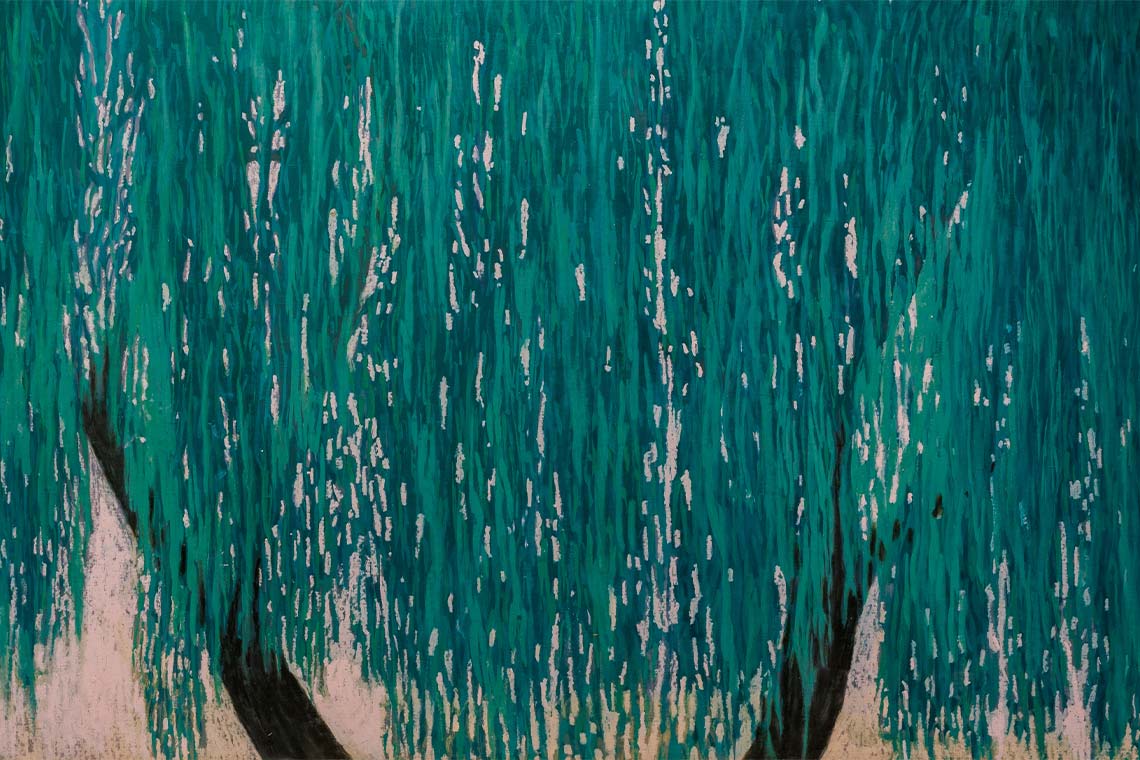
In Plain Sight marks Emirati artist Alia Zaal’s first solo exhibition at Gallery Isabelle following her participation in the group show I Wish to Be Happy, I Want to Be Yellow in 2024. Based between Abu Dhabi and Dubai, Zaal has developed a practice rooted in close observation of her everyday surroundings. Rather than depicting these environments as recognisable panoramas, she lingers on fleeting encounters with nature, where leaves, branches and light become intimate reflections on seeing and remembering.
Moving through the exhibition, it becomes apparent that no single medium dominates Zaal’s practice. Paintings on canvas sit alongside works on paper, fabric and painted ceramic tiles. Rather than treating materials as separate bodies of work, the artist allows them to speak to one another. Across the works, she repeatedly draws the viewer into intimate, closely observed moments. This approach is evident in Sunday Afternoon (2026), where the skeletal veins of fronds spread across the canvas. Rendered against a soft blush-pink background, the dark fronds create a delicate tension between presence and observance. Rather than presenting a recognisable emblem of the Gulf, Zaal draws attention to the underlying structure, encouraging viewers to take a close look into the geometry of a familiar tree.
On the same wall, a series of seven framed ceramic works, entitled Beyond Time (2023), introduces a subtle shift in material and colour. Their intimate scale and grid-like arrangement, composed of 15 x 15 cm ceramic tiles, reveal what can be seen as fragmented, almost translucent landscapes. Having established a language of close attention, Zaal gradually begins to undermine the certainty of vision. In Biarritz Evening and Biarritz by Night (both 2026), blurred foliage appears almost submerged beneath the painted surface, as though drifting underwater. The softened edges of the greenery deny a fixed focal point, creating the sensation that the leaves are suspended between appearing and disappearing.
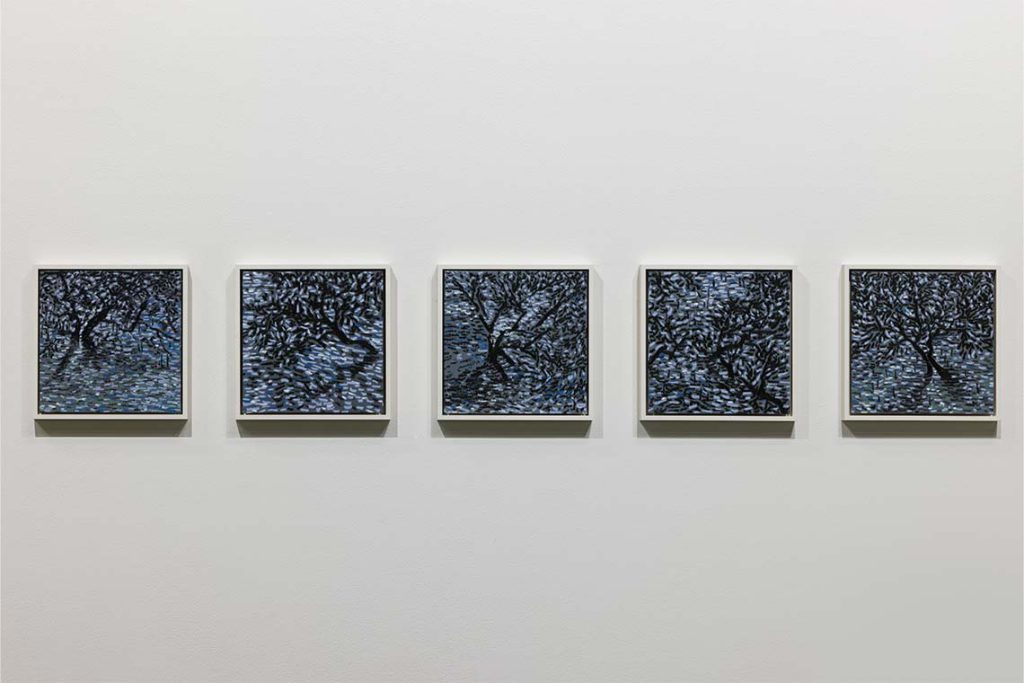
Across five oil paintings on canvas, the series Through his Eyes (2026) presents landscapes constructed via a dense accumulation of brush strokes, translating her father’s perception of landscapes, which are shaped by his limited ability of differentiate between colours. Emerging through layers of blues, greens, purples and black tones, the landscapes appear and dissolve. Through this palette, Zaal extends her gaze into the emotional and perceptual qualities of the landscape and how different ways of seeing can alter how landscapes are experienced.
Zaal also demonstrates a command of scale without abandoning the intimate focus that defines the exhibition. Ghaf Memory in Biarritz (2026) measures around one by two metres and is among the largest works on view. Yet the expanded canvas does not open into a seeping landscape. Instead, Zaal continues to direct her attention towards the delicate leaves of a ghaf, the UAE’s national tree. Cropped tightly, its fine leaves almost look like woven threads, creating a dense network of intersecting lines.
The recurring presence of the ghaf finds another expression in Mushrif Mist (2026). Presented as an illuminated lightbox, the painting possesses the quiet luminosity of moonlight. Its title immediately situates the viewer within the Mushrif Parks found in both Abu Dhabi and Dubai, places that hold cherished memories of many who have grown up in the UAE. Here, the trees reflect the emotional resonance, creating a dreamlike atmosphere in which memory is rendered as something fluid and unstable, informed by perception and time.
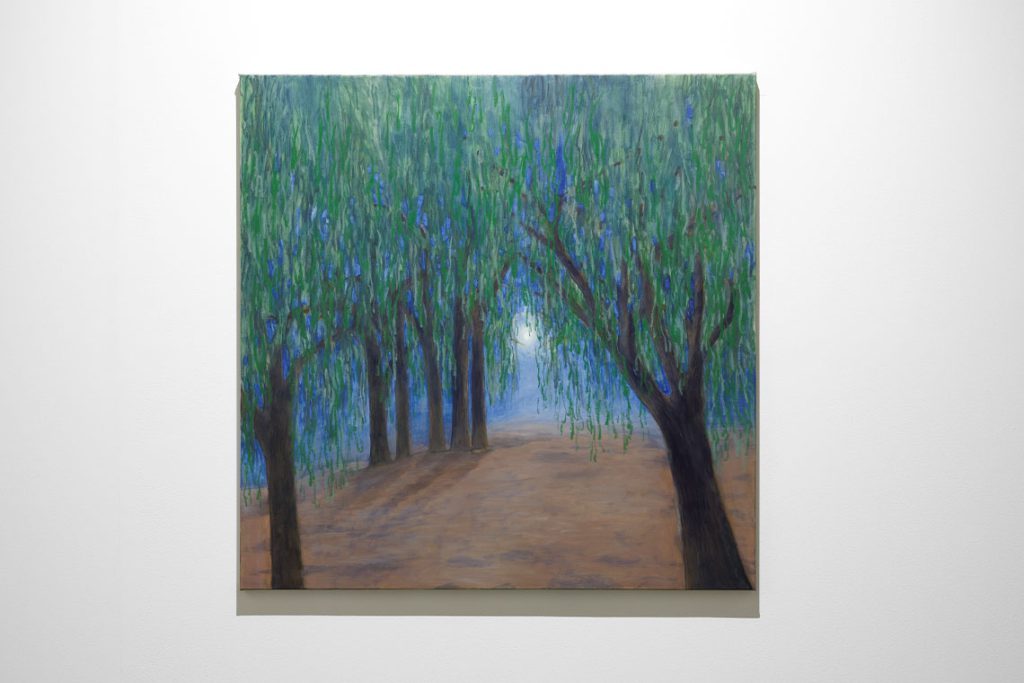
In Afternoon in Al Jubail and Sunset in Al Jubail (both 2026), Zaal returns her gaze towards the landscape of Abu Dhabi’s Jubail Island, known for its expansive mangrove forests, tidal channels and waterfront ecosystems. These works translate scenes through the softness of the fabric, allowing the landscape to appear almost absorbed into the materials itself. There is a sense of fragility and movement, echoing the changing conditions of the coastal environment and the fleeting nature of memory.
In dialogue with Ibn al-Haytham’s eleventh century Kitab al-Manazir (The Book of Optics), a seven-volume study of light, vision and perception, Zaal engages with the understanding of sight as an active interaction with the external world and the inner mind through the process of interpretation. Using modern-day technology, such as smartphones, the artist captures images and creates a digital reference that becomes the foundation of the works she creates.
What becomes clear throughout In Plain Sight is Zaal’s meditative mode of seeing. The artist takes time to examine the smallest details within each environment, carefully processing the visual fragments that shape her understanding of the landscapes around her. Through this slow engagement with form, light and material, she reveals that ‘looking into’ is not a passive act but a process of preservation, capturing not only the appearance of a landscape but also the feelings, memories and associations that are attached to it.
In Plain Sight runs until 15 September
