

Afra Al Dhaheri transforms repetition into meditation on memory and time, exploring how images linger, fade and return within both material and perception.
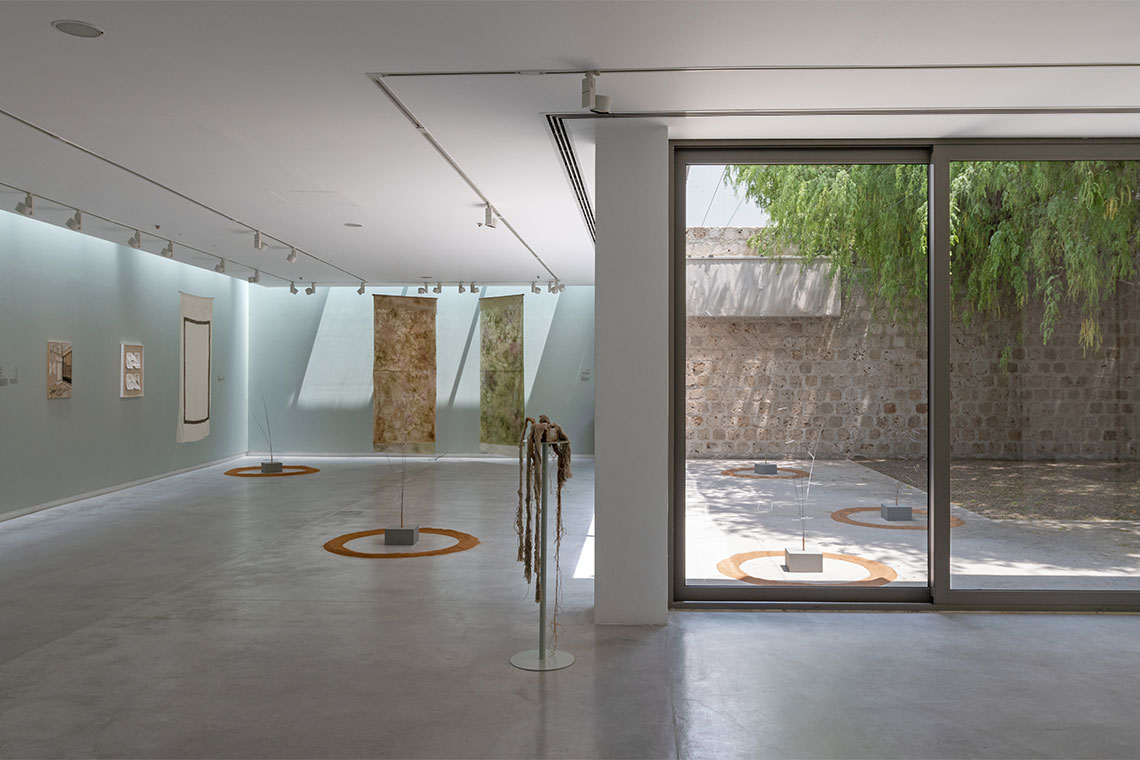
The chirping of birds accompanied my arrival at Sharjah Art Foundation, their sound mingling with the quiet hum of the afternoon. At the entrance, three ginger cats brushed gently against my feet, a tender welcome before I stepped into gallery 6. Curated by May Alqaydi, Afra al Dhaheri’s Restless Circle reveals itself gently – measured, patient and deeply contemplative.
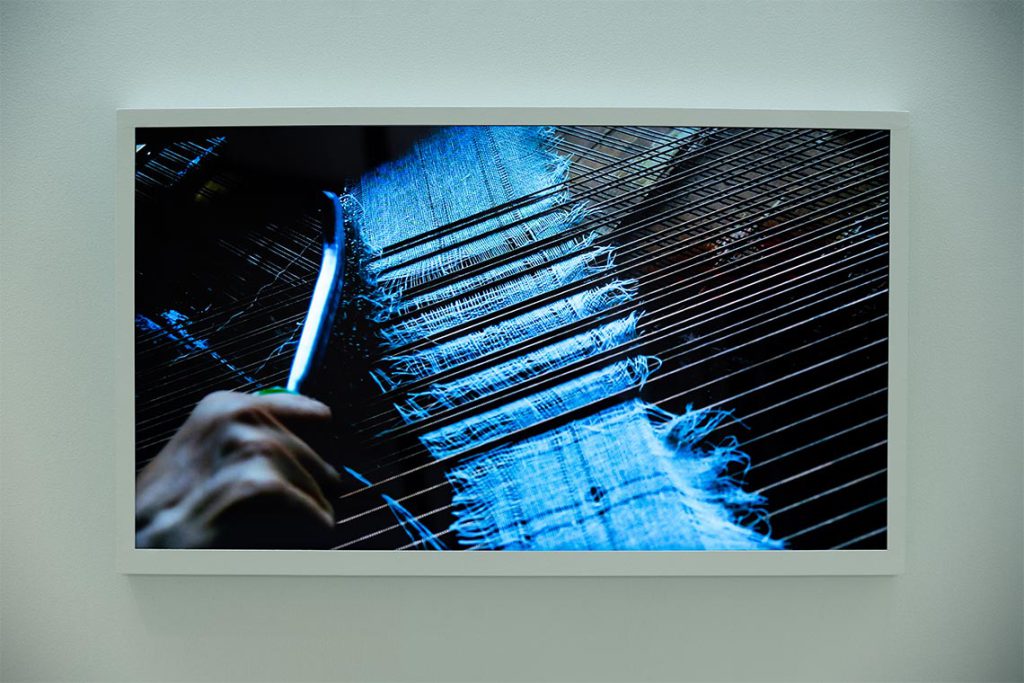
Pale green walls embrace the space. The L-shaped gallery opens onto a glass façade overlooking a solitary ghaf tree, grounding the works in the enduring presence of the desert. The only sounds are mechanical whispers, the hum of the air conditioning and the scraping sound from Conditioning the Knot (2022), a film where repetition becomes a ritual. A hand moves slowly across taut strings, unravelling fragile strips of fabric woven tightly between them. The act of unmaking is repeated, over and over – until the act itself becomes a rhythm. The sound of screeching fabric, although subtle, might unsettle those sensitive to sound, a raw edge of tension caught in the air.
From this point, the exhibition begins to reveal its logic. Restless Circle, spanning nearly ten years of Al Dhaheri’s practice, establishes a space where time loosens and familiar structures fall out of order. Curator May Alqaydi describes this condition as a way of working with time rather than against it, allowing its disruptions, hesitations and returns to shape the work’s form and presence. “Time bears witness both to what fades and to what insists on remaining,” she explains. “The experience of time is never static. It can seem to rush forward or fold back on itself, but it always remains in motion. Movement continues even in moments of disruption, as if nothing has changed, as if the world is still holding steady even when everything is quietly shifting.”
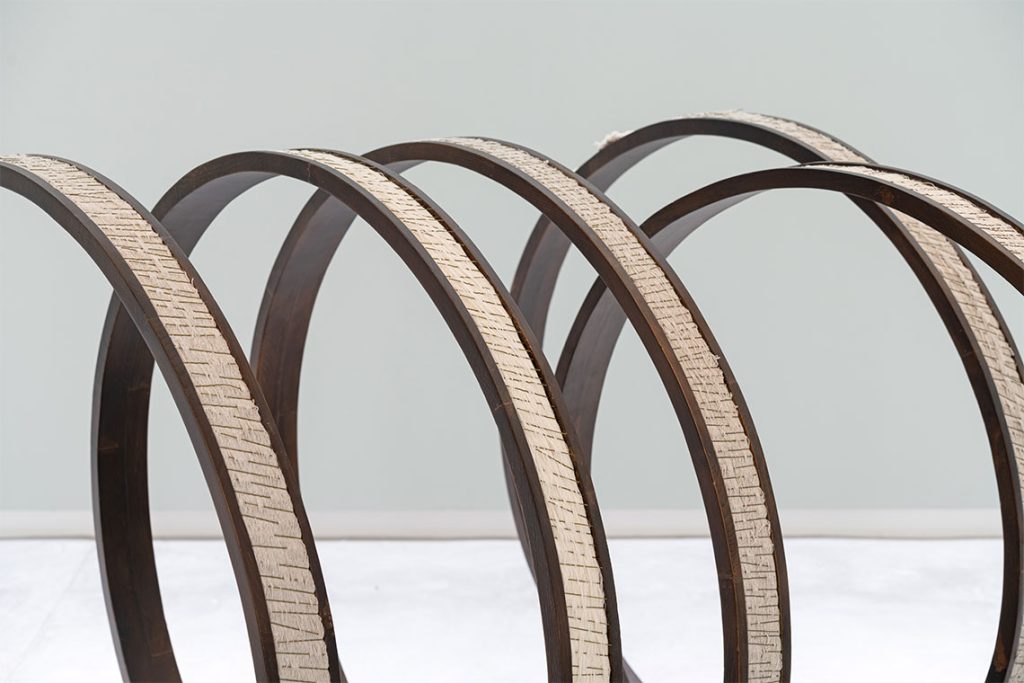
Close by, a series of five circular wooden rings entitled Round and Round We Go (2023) appear as if they are floating. As the light shifts across their surfaces, small pin-like forms reveal themselves, evoking the look of hair pins – yet they hold the threads, not strands of hair. These small fastenings become reminders of the practical, often intimate gestures that keep a structure together.
Encountering the commissioned installation Restless Circle (2025), I was immediately struck by its quiet insistence – a kind of exhaustion made visible, etched into the arcs and curves of its form. Inspired by the tall bushman grass, which sways and carves fleeting patterns across the desert sands, the work seems to move in rhythms that are familiar yet unpredictable, as if waiting for a mechanical hiccup, a pause, or for the pattern itself to falter under its own weight. Time here is neither linear nor resolute, it drifts, folds back and spirals, echoing the emotional fatigue that accumulates in human effort.
A similar sense of lingering weight forms straining under the pressure of their own repetition, runs through the artist’s earlier exploration of memory and materials. In absence we forget (2015), she presses a cement rectangle multiple times into the fabric, leaving stains that feel like the residue of something already adapting and taking shape. Al Dhaheri later transforms an installation view of that piece into To Revisit (2016), a slow unmaking in print form, where the image lightens and thins with every repetition, as though memory itself were fraying at the edges. The dwindling trace becomes the seed for To Preserve (no.2) (2017), where the fabric hangs steadily, its edges subtly shifting and overlapping, never quite fixed.
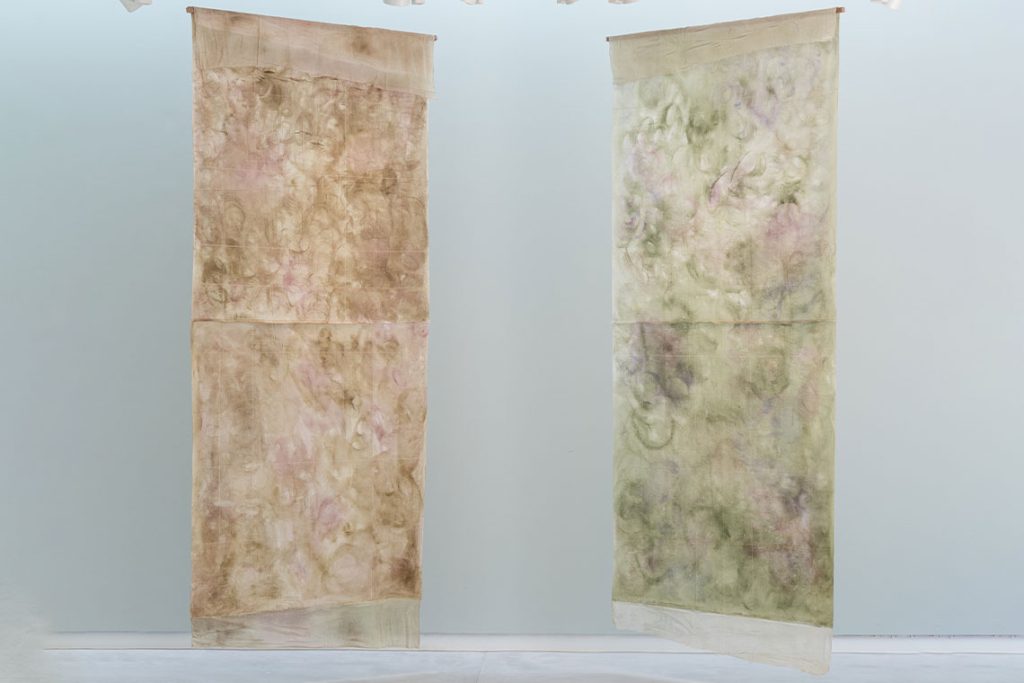
On a single wall, two suspended works float lightly in space, their presence delicate and commanding. Positioned close to the window façade, the pieces drink in the shifting light of the day, with sunlight drifting and glancing across their surfaces. In I carved a garden, it emerged in the folds (2025), Al Dhaheri traces the memory of each crease with acrylic paint, letting the gestures accumulate like whispers of time.
Stepping outside, the calm environment of the courtyard is punctuated by three installations of Restless Circle (2025), sheltered by the ghaf tree. At the centre of each circle, a small grey block of concrete anchors slender, arching wires that rise and bend, brushing against the edges of the sand as if rehearsing invisible movements. Each circle seems both solitary and in conversation with the others, a choreography suspended between gravity and subtle wind.
Restless Circle carries a kind of stillness that leaves no place to withdraw to. A circle gives no shelter, no angled edge to disappear into. Instead, it draws you into its orbit, asking you to stay with the slow retuning of each gesture. In this roundness, memory feels less like something to grasp and more like something that moves through oneself. For a moment, I carry the stillness within, a small pause held against the world’s relentless motion.
