

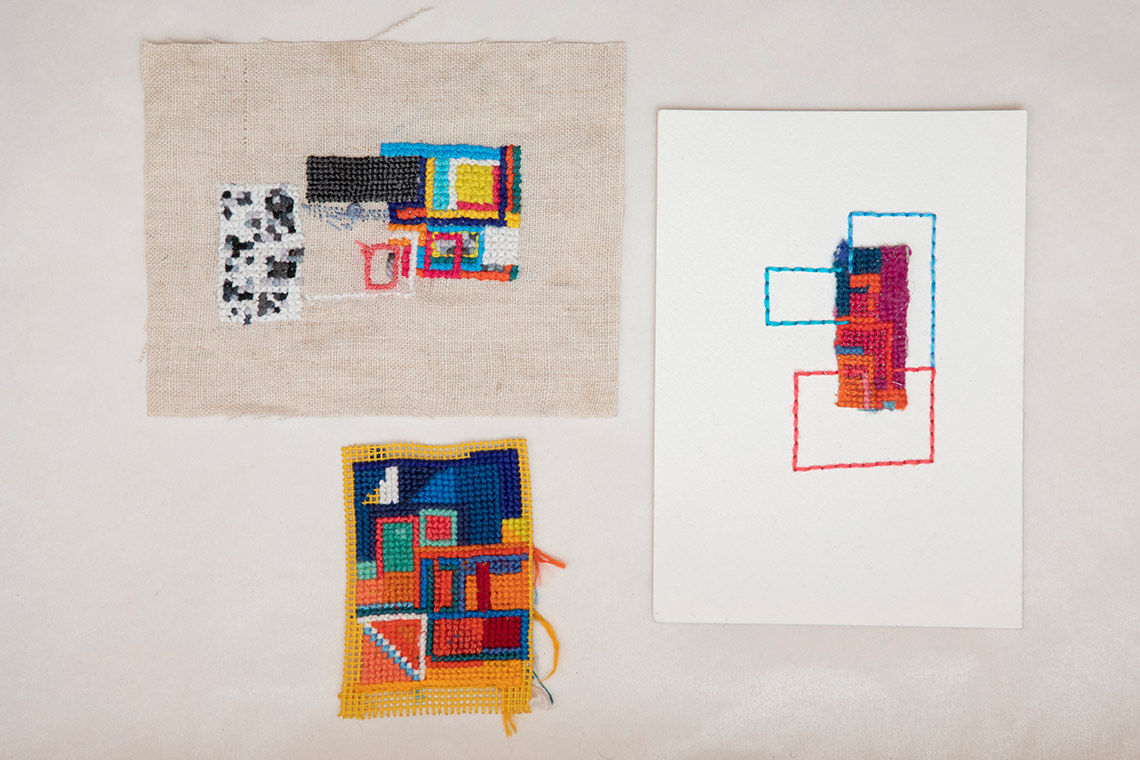
In a former wool mill in rural Scotland, Majd Abdel Hamid‘s works reward patient, deliberate looking – hidden in drawers, near-invisible in white thread, low to the ground.
Cample Line is not a place you’re likely to stumble upon. A converted mill in a corner of rural Scotland where sheep or cattle seem more plausible footfall than roving art lovers, it feels an unexpected staging post for a Palestinian artist based between Beirut and Paris. Yet it chimes: Majd Abdel Hamid’s Murmuration is a small show – a single room, with some works barely larger than a hand’s span – and the mill’s own history of thread and cloth (it once processed wool for blankets) feels apt before you’ve even seen a single piece.
As he put it in a recent conversation at the gallery with writer and curator Francis McKee, who wrote the exhibition’s accompanying essay, Abdel Hamid studied contemporary art and spent years “constantly freaking out” about never committing to one form – until embroidery offered him something else entirely: a language that “anyone can read”, he says, “a bit like music”. That universality, and the fact that embroidery is traditionally unsigned women’s labour rather than an authored gesture, is central to how he wants the work understood: not as monument, but as something closer to daily necessity. “They need to make the embroidery rather than to make a statement. It’s just how you respond to the environment, it’s how you respond to life,” he explains.
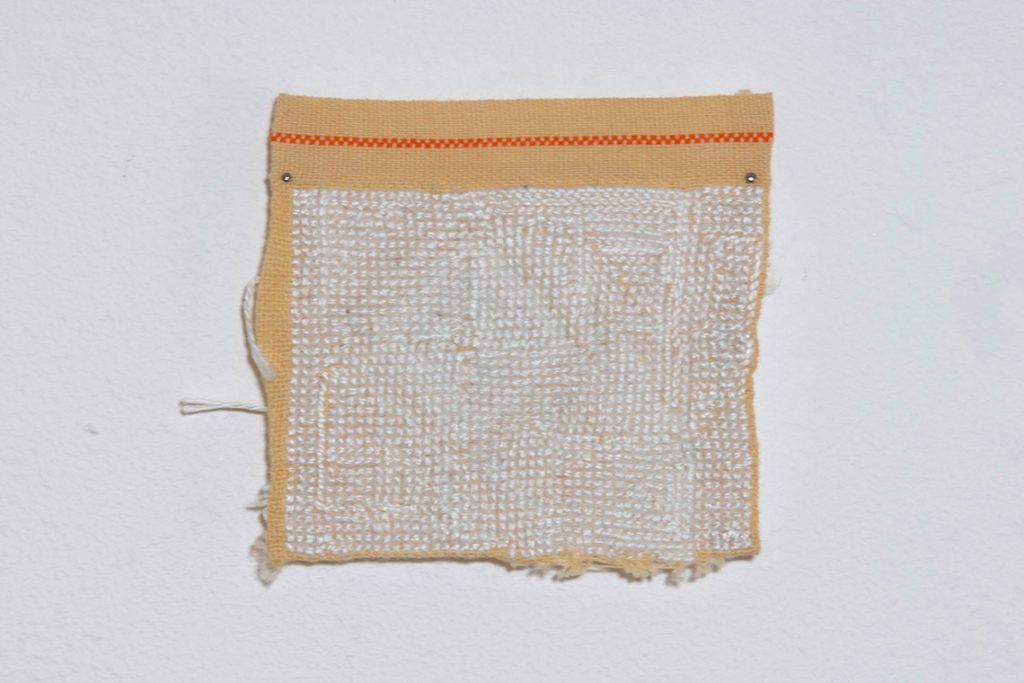
Most of the room, though, belongs to the ongoing series Son this is a waste of time, begun in 2015 and still in progress. These are partly white-thread-on-white-fabric embroideries – on cotton, linen, etamine, with some on metal mesh – and so pale that the cross-stitched motifs all but disappear until light catches them at an angle. Up close, the metal-ground pieces resemble frost or lichen colonising a surface rather than thread sitting on it. The title comes from an exchange with a seamstress in Ramallah, who refused Abdel Hamid’s commission for a plain white piece: “Son, this is a waste of time,” she told him – so he began stitching them himself. He’s kept the phrase as a kind of running argument with her ever since, 11 years on.
The largest single gesture in the show is also the most generous. Along one wall, on the floor, runs a line of hundreds of fortune tellers – those folded, four-pocketed origami toys familiar from childhood playgrounds, usually accompanied by a chant – made from Abdel Hamid’s own collected fabric offcuts. Visitors are invited to take a couple. I spent longer than I’d like to admit choosing mine, eventually settling on a deep pink piece patterned with flowers. The gesture nods openly to Félix González-Torres’s candy spills, and Abdel Hamid is candid about the impulse behind it. Rather than start a “nostalgic practice” trying to recreate Beirut in Paris, he decided to give the fabric away as a “game”, adding, simply, “I like fun in art.”
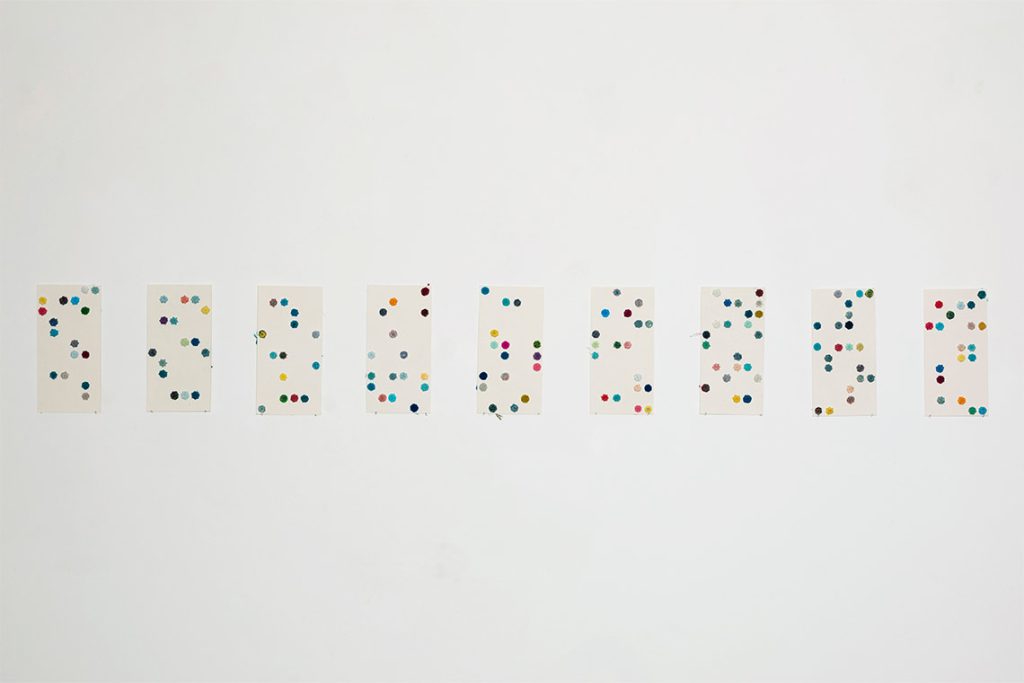
On a nearby wall, Code (2024) reads from a distance like a row of dominoes, or – to my eye – something like American ballot papers, circles filled in black beside the chosen candidate. Closer still, each round form turns out to be a small button of assorted coloured thread, imperfect, more like a Tudor rose than a geometric circle, with frayed thread coming out slightly from behind the paper at one edge. Abdel Hamid has spoken about wanting to gesture towards the Jacquard loom’s punch-card system, the ancestor of modern computing, without actually reproducing binary code – he calls it “a dysfunctional binary code”, something deliberately unreadable by a machine. That refusal carries through to Music Box (2024), where the same dot-pattern is translated instead into sound via an antique music box tucked into a chest of drawers – not a system that reads him back, but one he can simply listen to.
The drawers themselves are worth dwelling on. A good portion of the exhibition is contained within an old chest, in a corner, so that looking at the work becomes an act of discovery rather than display – you open a drawer, find a fragment, close it again. In that sense the chest is a bit like Cample Line itself: nothing here is going to present itself to you unbidden. You have to be intentional and go looking. Tucked within them is an iPad looping a four-minute, silent video. Someone, presumably the artist, is picking apart a woven piece of fabric by hand, flecks of thread and cloth drifting off it like snow, slow and as repetitive as the embroidery itself. Abdel Hamid has explained at length why the drawer, rather than the wall, is where he wants this kind of work to live. Hanging a video in a gallery, he’s said, creates a subtle pressure to sit through it regardless of whether it’s holding your attention – “you kind of have to finish it… even if it’s not really working for you.”
A drawer removes that obligation entirely. “You can just simply close it and move on.” But the format isn’t only a way of lowering the stakes – Abdel Hamid is drawn to the “magical” familiarity of the gesture itself, the shared memory everyone has of rifling through an old drawer at home. “I like the joy of discovery,” he admits, “you open [the drawer] and say ‘Ha!’.” It’s a small mechanism, but it reframes the whole show as something closer to rummaging than viewing. In the bottom drawer, a small cluster of 2025–26 Compositions breaks from the white-on-white restraint into sudden, saturated colour – blocky, angular fields that recall both Tetris and the shaded maps used to illustrate election results, block by block.
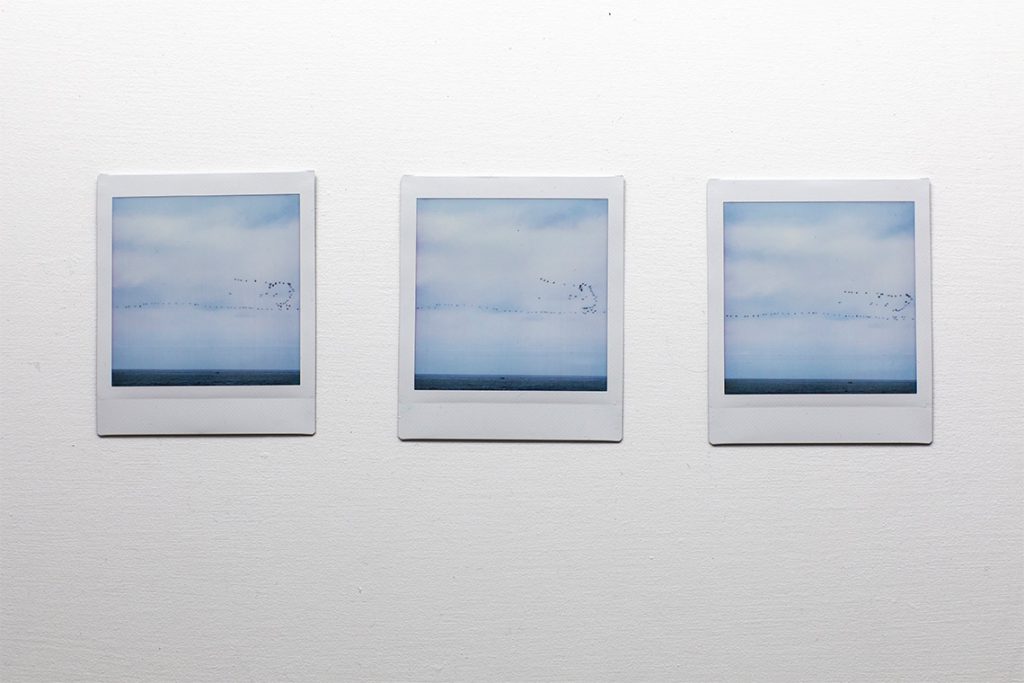
McKee, in his own essay for the exhibition, notes that there is “quite a lot of other media lurking” here beyond thread and cloth. The clearest proof of that sits unassumingly on a windowsill: three small Polaroids, titled Ode to Sea (murmuration) (2026), showing the phenomenon that gives the show its name. They’re easy to miss – I also hadn’t known what a murmuration was before walking in – but they do useful work, tying the exhibition’s central metaphor back to something you can actually see, namely a black, shifting cloud of birds, caught in miniature on a strip of instant film.
The most affecting piece, perhaps, is Muscle Memory (2026), a small indigo-dyed fabric work that, from a distance, reads almost like a photographic negative. It draws on a Palestinian mourning custom in which a dress belonging to a bereaved woman would be dipped in indigo, fading gradually with each wash until the original colour returned, though never quite completely. Abdel Hamid developed the piece after the 2020 Beirut port explosion, having concluded that grief does not move through tidy linear stages – anger, then acceptance – as convention suggests. He scrubbed the dyed cloths himself, by hand, for some ten hours.
McKee’s own essay reaches for the language of physics and flocking behaviour to describe what holds this fragmented body of work together, and it is a fair extension of what Abdel Hamid says about his own methods – nothing here resolves into a single, static image. Pieces are recomposed between showings, with nothing travelling the same way twice. It would be easy for a show this modest in scale, tucked into one room of a former mill, to feel slight, but it doesn’t. The demand it makes is simply that you get close – to the thread, to the floor, to the half-visible pattern – and stay there a while.
Murmuration runs until 6 September
